The Asset Outperformer Engine answers the refresh question in one line of its FAQ: it runs a full scan every six hours, and each scan processes over three thousand assets across every supported type. Four scans a day. The hero line at the top of the same page says the board is ranked daily, and the paragraph underneath it says the engine ranks assets every morning. Those statements are not in conflict, but the space between them is where your entry timing actually lives, and almost nobody works it out before they click.
Four scans a day against a page that says daily
The useful way to think about the ordering is that it is a stepped object. It does not drift. It sits perfectly still for hours and then jumps at a scan boundary. The prices in the same table do the opposite: they move continuously, all day, in whichever market the asset trades. So every decision you make on that board combines a score of some unknown age with a price of zero age, and the two are not describing the same moment.
Six hours is a long time in the assets that dominate the top of this board. On the capture I am working from, the highest scored name, Columbus Acquisition Corp at a score of 93, showed a 1D move of +10.27 percent. The second, AVAX One Technology at 89, showed +14.95 percent on the day. The Glimpse Group at 77 showed +15.05 percent. Three of the top names each moved more in a single session than most portfolios move in a quarter. A rank built at 6am and read at noon has watched a chunk of that move happen without updating.
The scan age the board does not show you
Here is the part I have to be straight about. In the view I am working from there is no last-scan timestamp anywhere on the board. There is no countdown, no "updated 47 minutes ago" line next to the table. So you cannot read the age of the ranking off the screen, which means the decision about how old your data is has been handed back to you.
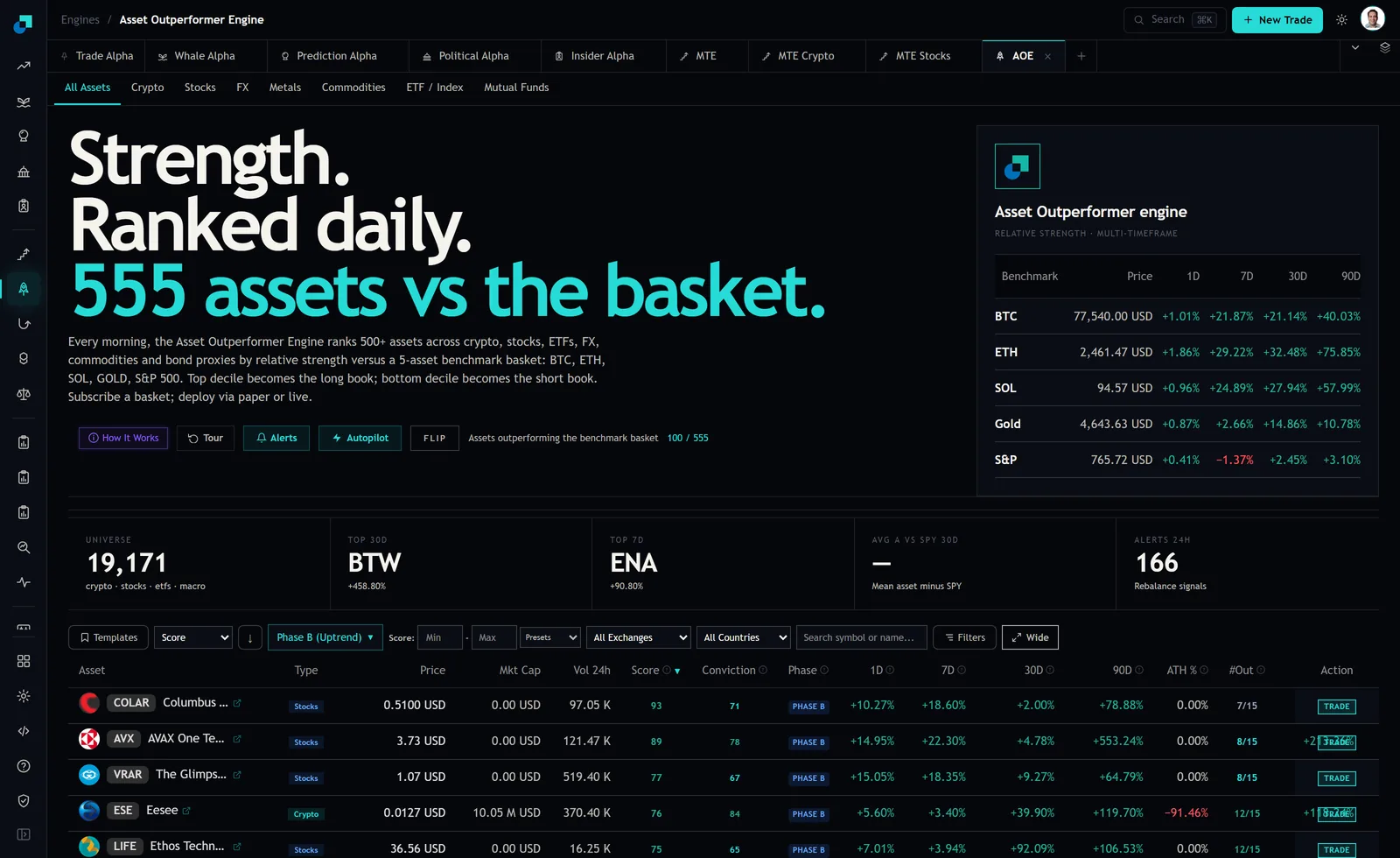
What I do instead is cheap. The first time in a day that I open the board, I write down the time and the top five symbols in that order. Next time I open it, if the order is identical, nothing has rescanned since my note and my working assumption is that the data is at least as old as my note. If the order has changed, a scan has landed somewhere between the two readings and I know the ranking is fresher than my last check. Two lines in a notebook gets you most of what a timestamp would have given you, and it costs about ten seconds a day.
Do not try to infer the schedule from the alerts figure. The board's 24-hour alert tile read 166 rebalance signals on this capture. Spread across four scans that is roughly forty signals a scan, which tells you about how noisy the board is at the margin, not when it ran.
What a rank costs in the hour it prints
Chasing a rank the hour it appears is the most expensive way to use this engine, and the reason is visible in the table itself rather than in any theory about momentum. Look again at Columbus Acquisition: score 93, 1D +10.27 percent, 30D +2.00 percent. Over thirty days that name has gone essentially nowhere. Its position at the top of the board is being carried by a very recent burst. If you buy it in the hours after that scan lands, you are paying a price that already contains the entire reason it ranks.
Put a number on that. Say you allocate 800 dollars. Buying after a 10 percent single-day move means your cost basis is roughly 10 percent above where the move started, so a full round trip back to the pre-move price is 80 dollars of loss before spread and commission. On a thinly traded name the spread alone can be another 1 to 2 percent of your order. The engine did not promise you the move; it reported one that already happened.
The names where a fresh print is worth less are exactly the ones with a big 1D and a small 30D. The names where it may still be worth something are the ones where the recent session is a continuation of a longer run: AVAX One showed +14.95 percent on the day but also +22.30 percent over seven days and +553.24 percent over ninety. That is a different animal from a one-session pop, though it comes with its own problem, which is that you are very late to a move of that size.
Hour five, when the ordering is stale and the price is not
The other end of the cycle is more interesting and gets discussed less. At hour five, the ordering you see was computed against prices that are five hours old, while the price column beside it is current. A name that has fallen 6 percent since the scan still carries the score the scan gave it. The board has not caught up, and it will not until the next run.
That gap cuts both ways and you should be honest with yourself about which side you are on. If the drop is the start of the rank breaking down, you are buying a score that is about to be revised away, and the next scan will simply drop the name. If the drop is noise inside an intact trend, you are getting the same rank at a better price than anyone who acted at hour zero. Nothing on the board distinguishes those two cases for you. The 1D, 7D, 30D and 90D cells give you the shape of what has happened, and the judgement is yours.
The practical rule I use: a stale rank plus a lower price is worth a look, a stale rank plus a higher price is not. If a name has run further since the scan, I have all the disadvantages of being late with none of the compensation, and I would rather wait for the next scan to tell me whether the score survived the move.
The cadence that fits around a job
Four scans a day does not mean you need to check four times a day. It means the fastest the board can change is four times, so checking more often than that is guaranteed waste. Checking less often than once a day means you will regularly look at ranks that are three or four scans old, which is fine for research and poor for entry.
What has worked for me is one fixed check a day at a time I can actually keep, with the notebook line described above, and a rule that I do not place a market order in the same session I first see a name. If a name is genuinely ranked, it will still be there tomorrow, and if it is not there tomorrow then the six hours I waited saved me the entire position. When I do want a name, I put a limit order somewhere below the current print rather than crossing the spread, and I let the next scan tell me whether the rank held while my order sat there unfilled.
That last part is the trade-off worth stating plainly: you will miss fills. Some of the names you skip will keep running without you, and you will see them at the top of the board again a week later with another 40 percent on them. That is the cost of not paying for a move you did not participate in, and on a five thousand dollar account, where a single bad entry is a meaningful share of the year, it is a cost I would take every time.