A chief financial officer buying a meaningful block of their own heavily shorted company is one of the more interesting things a filing can tell you. It is also the setup where standard retail position sizing produces the largest errors, because every common sizing rule depends on an assumption that does not hold in these names: that you can get out at roughly the price where you decided to get out.
Why a flat percentage of the account is the wrong rule here
The usual advice is to risk one or two percent of the account per idea and to derive the position size from the distance to your stop. Risk five hundred dollars, place the stop ten percent below entry, so the position is five thousand dollars. That arithmetic is clean and it is correct in a liquid stock during normal hours.
In a name with twenty percent of its float sold short and a few hundred thousand dollars of daily volume, the assumption underneath it fails in both directions. Bad news arrives outside market hours, the stock opens forty percent lower, and your ten percent stop becomes a market order into the first available bid. You did not risk five hundred dollars. You risked whatever the opening print decided, and you had no input into it.
The same structure is what makes the setup attractive on the upside. Shorts covering into a thin float can move a price a long way in a session, which is exactly why people want these positions. You cannot have the asymmetry without the gap. So the sizing rule has to be built around the gap rather than around a stop that will not be honoured.
What the screen gives you toward the gap estimate
Two columns on the Squeeze view speak to how violently a name can move, and they are not the ones people quote in the group chat. At capture the table header carried Ticker, Company, Insider, Filed, Trade value, SI percent of float sorted descending, DTC and Signal.
SI percent of float is the crowding measure. DTC is days to cover, which is shares short divided by average daily volume, and it is the better of the two for this purpose because it combines the size of the short base with how thinly the stock trades. A high days to cover is a direct statement that a lot of shares need to change hands in a market that does not naturally accommodate them, and that is the definition of gap risk in both directions.
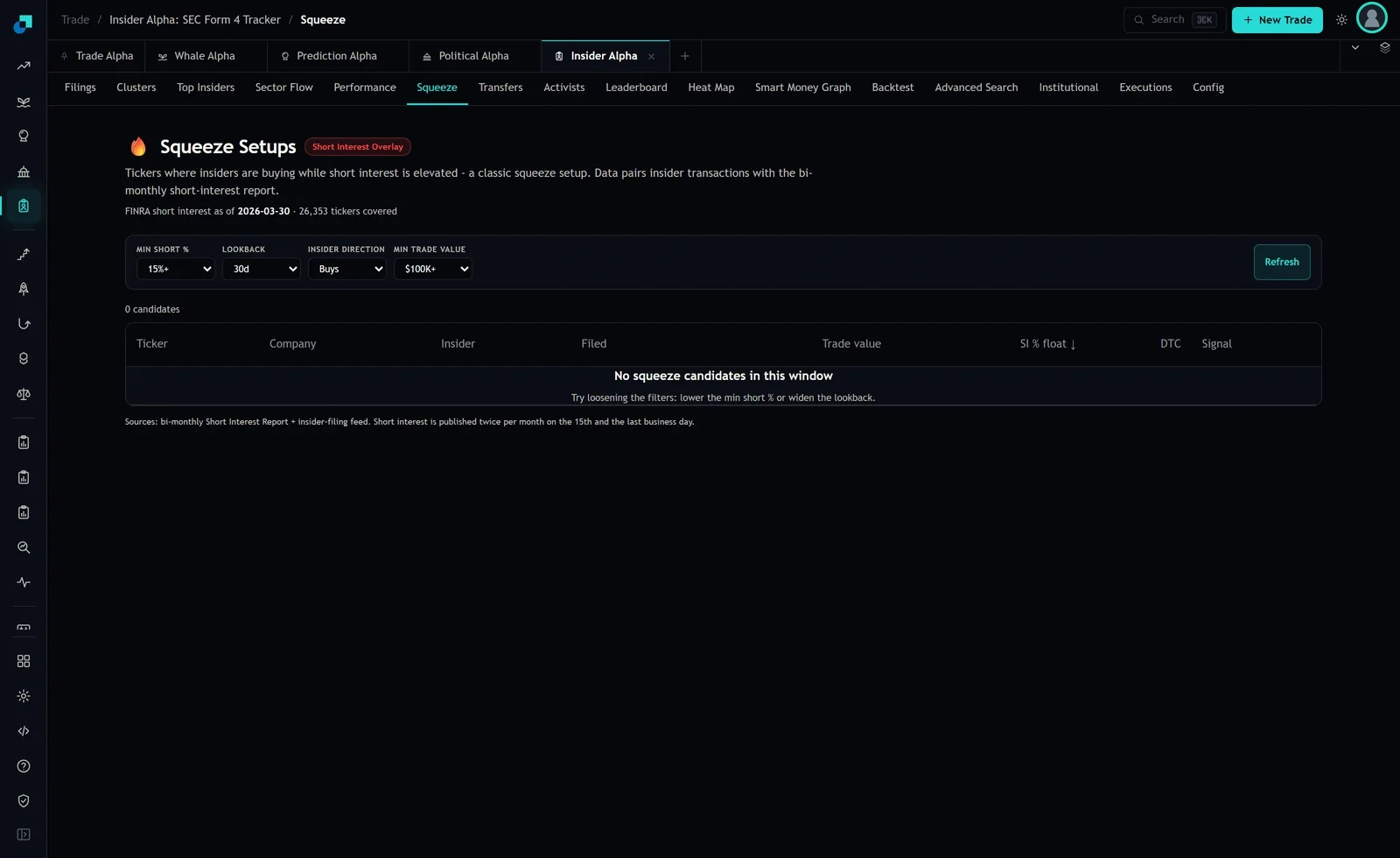
What the screen does not give you is a volatility figure, an average daily volume column or a borrow rate, so the gap estimate is a judgment you make with the price history in front of you. Look at the last two years of the name's own history and find the worst single day it has had. Not the average day. The worst one. That is your starting assumption for the adverse gap, and if the name has never had a bad day, use forty percent, because a stock that is twenty percent short has one available to it.
The arithmetic on a fifty thousand dollar account
The rule is one line. Position size equals your risk budget for the idea divided by the adverse gap you are assuming. Not divided by the stop distance. Divided by the gap.
| Account | Risk budget at 1 percent | Assumed adverse gap | Position size | Position as percent of account |
|---|---|---|---|---|
| 50,000 USD | 500 USD | 30 percent | 1,667 USD | 3.3 |
| 50,000 USD | 500 USD | 50 percent | 1,000 USD | 2.0 |
| 50,000 USD | 500 USD | 70 percent | 714 USD | 1.4 |
| 50,000 USD | 1,000 USD | 50 percent | 2,000 USD | 4.0 |
Compare that with what the conventional rule would have produced. A five hundred dollar risk budget with a ten percent stop gives a five thousand dollar position, three to seven times larger than the numbers above. If the gap arrives, that position loses two and a half thousand dollars on a fifty percent move, which is five percent of the account on a single idea you told yourself was a one percent risk. The gap based number loses five hundred dollars, which is what you actually budgeted.
The uncomfortable implication is that honest sizing in these names produces positions that feel too small to be worth the effort. That feeling is correct and it is the price of admission. If a one to four percent position is not worth your time, the answer is not to size up, it is that this strategy is not for you, and that is a legitimate conclusion to reach before rather than after.
Stops here are a device for realising the gap at the worst price
Once the position is sized off gap risk, the stop stops being a risk control and becomes a discretionary exit. That changes how you should use it.
A stop loss order in a thin, heavily shorted name has three failure modes worth knowing. It does not protect against overnight moves, because it can only execute when the market is open. It fills at whatever the book offers, which in a gap is far below your trigger. And it is vulnerable to ordinary intraday noise, because these stocks routinely move ten or fifteen percent on nothing at all, which means a stop tight enough to matter will be hit by volatility that has no information in it.
So do not place one for protection. Your protection is the size, which you already set so that a total loss is survivable. If you want a discretionary exit rule, make it a closing price rule you check in the evening rather than an intraday trigger, and write it down before entry so it is a rule rather than a reaction.
Defined risk alternatives, and what they actually cost
Buying a call instead of the stock caps your loss at the premium, which solves the gap problem by construction and is a genuinely reasonable structure for an asymmetric setup. It is not free and the costs are specific.
Option spreads in small heavily shorted names are wide, sometimes several percent of the premium on each side, because the person quoting them has to hedge in the same illiquid stock you are trying to avoid. Implied volatility in these names is already elevated precisely because everyone knows the gap risk exists, so you are paying for the asymmetry rather than getting it cheaply. And an option expires, which converts your thesis into a bet on timing when the original insight had no timing in it at all. A chief financial officer buying stock tells you nothing about the next six weeks.
The version that makes sense is a long dated call with enough time that the thesis can be wrong for a quarter, sized so the entire premium is inside the same risk budget you would have used for the stock. If that premium is more than your risk budget allows, you have learned that the market is charging more for this asymmetry than you are willing to pay, which is a useful thing to learn before entering.
The limit that matters more than any single position
The last rule is the one people skip. Set a cap on total exposure to this entire category, not just per name.
Squeeze positions correlate with each other far more than their tickers suggest, because they respond to the same things: a change in risk appetite, a shift in borrow availability across the market, a broad move in small caps. Three separate names each sized at two percent are not three independent two percent bets, they are closer to one five percent bet that happens to have three names in it. Cap the category at five percent of the account and count every open position against it, so the fourth idea has to displace one of the first three rather than adding to them.
Then hold the line on the entry standard, because sizing discipline collapses when candidate quality does. The minimum trade value control on the screen offered buckets at 25 thousand, 100 thousand, 500 thousand and one million dollars, and a purchase at the low end is not the setup this article is about. A chief financial officer committing a serious amount of their own money is rare. Size it properly and wait for the next one.