Every whale feed asks you the same question within about a minute of opening it: how big does a trade have to be before you want to hear about it. Most people answer it by picking whichever number sounds impressive, which is usually a million dollars, and then wonder six weeks later why the feed is so quiet. The right way to answer it is to work backwards from how many minutes a day you will genuinely spend reading the thing, and there is enough on the screen to do that arithmetic properly.
The number that sets everything else
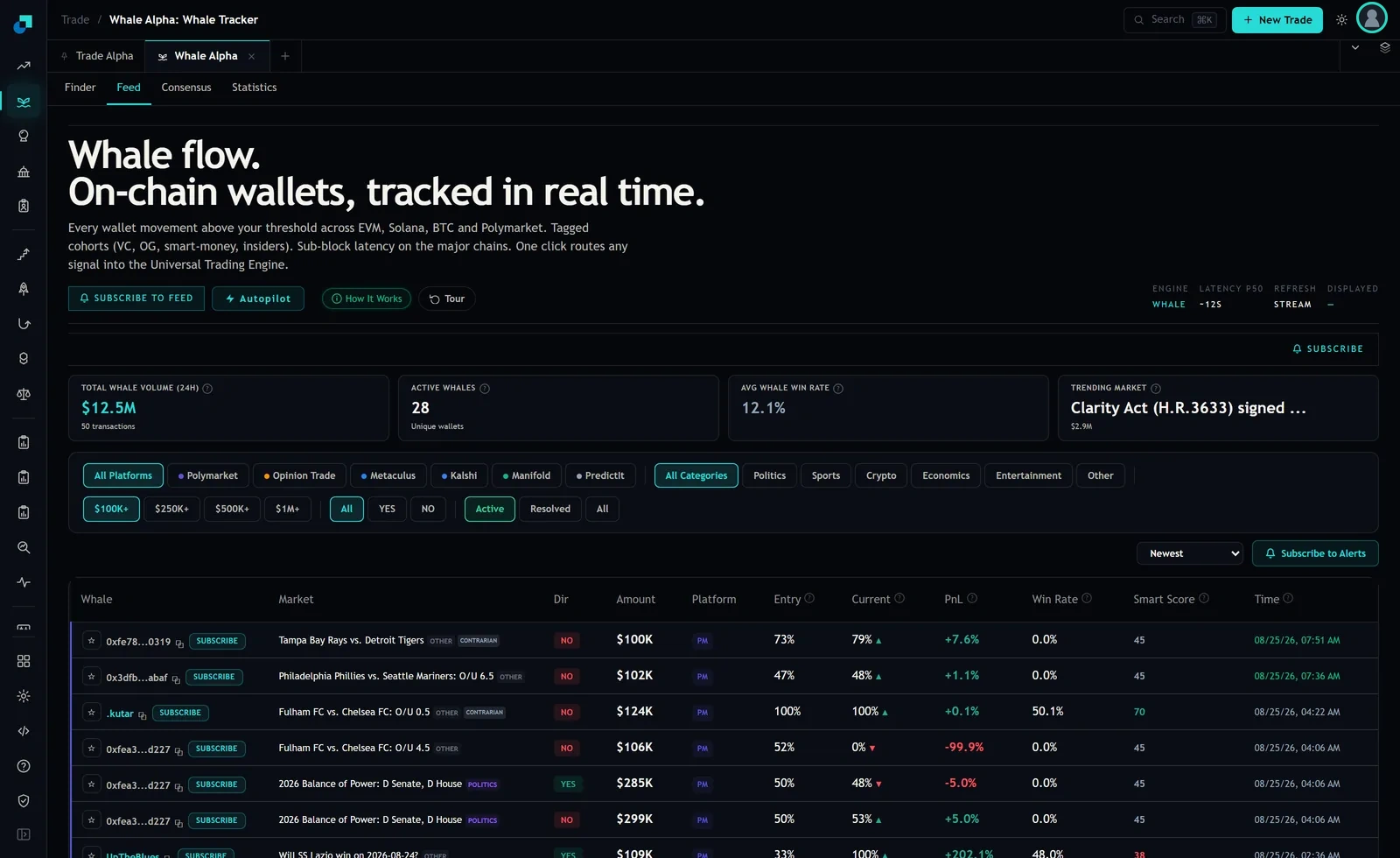
At capture, the Whale Alpha Feed reported 12.5 million dollars of total whale volume over twenty four hours, spread across 50 transactions from 28 active wallets. Those three figures together are the entire basis for a sensible threshold choice, and they take ten seconds to read.
Fifty prints in a day is roughly two an hour, which is a volume of information a person can actually consume. Twelve and a half million dollars divided across those fifty prints puts the average at about 250,000 dollars. And 28 unique wallets producing 50 prints means fewer than two actions per wallet, so the feed is not one hyperactive address filling your screen. It is a broad, thin stream.
Hold that 250,000 dollar average print in your head, because it is the reference point against which every threshold you might pick gets judged. A floor is not high or low in the abstract. It is high or low relative to the typical size of the thing you are filtering.
What a million dollar floor does to a 250,000 dollar stream
A million dollar minimum is four times the average print. Trade sizes are right skewed, which means most of the mass sits below the average and a long thin tail sits above it. Setting the floor at four times the mean does not halve your feed. It leaves you with the tail, and the tail on a fifty print day is a handful of events, possibly none at all.
That may be exactly what you want. If you check the feed once in the evening and only care about events large enough to move a market you already hold, a floor that leaves you three items a day is a well designed filter, not a broken one. Quiet is a feature when your alternative is not reading it at all.
It is the wrong choice if you are trying to build a picture of what the cohort is doing, because you will be inferring the behaviour of 28 wallets from the three loudest things they did. That is a biased sample in a specific direction: it selects for conviction and for wallets with large books, and it systematically hides the smaller, more frequent positioning that often tells you more about what a wallet actually thinks.
What a hundred thousand dollar floor costs you
Drop to a hundred thousand and you are below the average print, so you keep most of the distribution. On a day like the one captured, that is something close to the full fifty events. Fifty items is a real reading commitment. At twenty seconds each, honestly assessed, that is over fifteen minutes a day, every day, and the failure mode is not that it takes too long. It is that after nine days you stop reading it carefully, and an unread feed is worse than no feed because it produces the feeling of being informed without the substance.
There is a second cost that people underrate. A low floor pulls in more wallets, and more wallets means a higher proportion of the flow comes from addresses you have never evaluated. A print of a hundred and twenty thousand dollars from a wallet you know nothing about is not a signal. It is a research task disguised as one, and if you act on it directly you have skipped the entire wallet quality question that whale following depends on.
The dimension that cuts harder than dollars
Before you spend much energy on the size floor, look at the platform selector. The feed at capture separated all platforms from Polymarket, Opinion Trade and Metaculus, and choosing one of those cuts your volume far more decisively than any dollar threshold will, and it cuts it in a way that is actually meaningful to you.
If you do not trade prediction markets, filtering to a venue you never touch turns the feed silent and you have learned nothing. If you do trade them, filtering to the one venue where you have an account converts a general purpose stream into something where every item is potentially actionable. That is a better filter than size, because it selects on relevance rather than on volume, and relevance is what you are actually short of.
The trending market tile makes the same point from the other side. At capture it showed a single market, the Clarity Act question, carrying 2.9 million dollars of the day's flow. One question absorbing that fraction of 12.5 million dollars is a concentration fact, and no size threshold would have surfaced it as clearly as the tile did.
How I would set it on a small account
Start with the time budget. Decide honestly how many minutes a day you will read this, then divide by twenty seconds per item to get your event budget. Ten minutes is thirty items. Three minutes is nine.
Then set the floor to land near that count, using the average print as your anchor. Below the average gets you most of the stream. Around two to three times the average gets you a modest subset. Four times and up gets you the tail. Adjust after a week against what actually arrived rather than against what you assumed would.
One thing not to do, whatever you choose: do not treat the feed as something to react to inside the minute. The engine header reports a median latency of around twelve seconds, which is fast for a data product and slow relative to anybody trading against the same flow programmatically. You are not going to win a race that starts twelve seconds after the gun. What the feed gives a retail account is context accumulated over days, which wallets are building where, which venues are absorbing flow, whether the cohort is entering or unwinding. Set the threshold that lets you actually read it, and read it as a diary rather than an alarm.