The word delisting arrives in a headline and everybody reads it as an obituary for the token. Frequently it is nothing of the sort. It is a venue closing one book, in one quote asset, and the token carries on trading in the room next door.
The distinction is worth about the difference between a considered exit and a panic sell into a thin book at four in the morning, which on a small position is most of the position. It takes five minutes to establish which case you are looking at, and almost nobody spends them.
The row is keyed on a pair
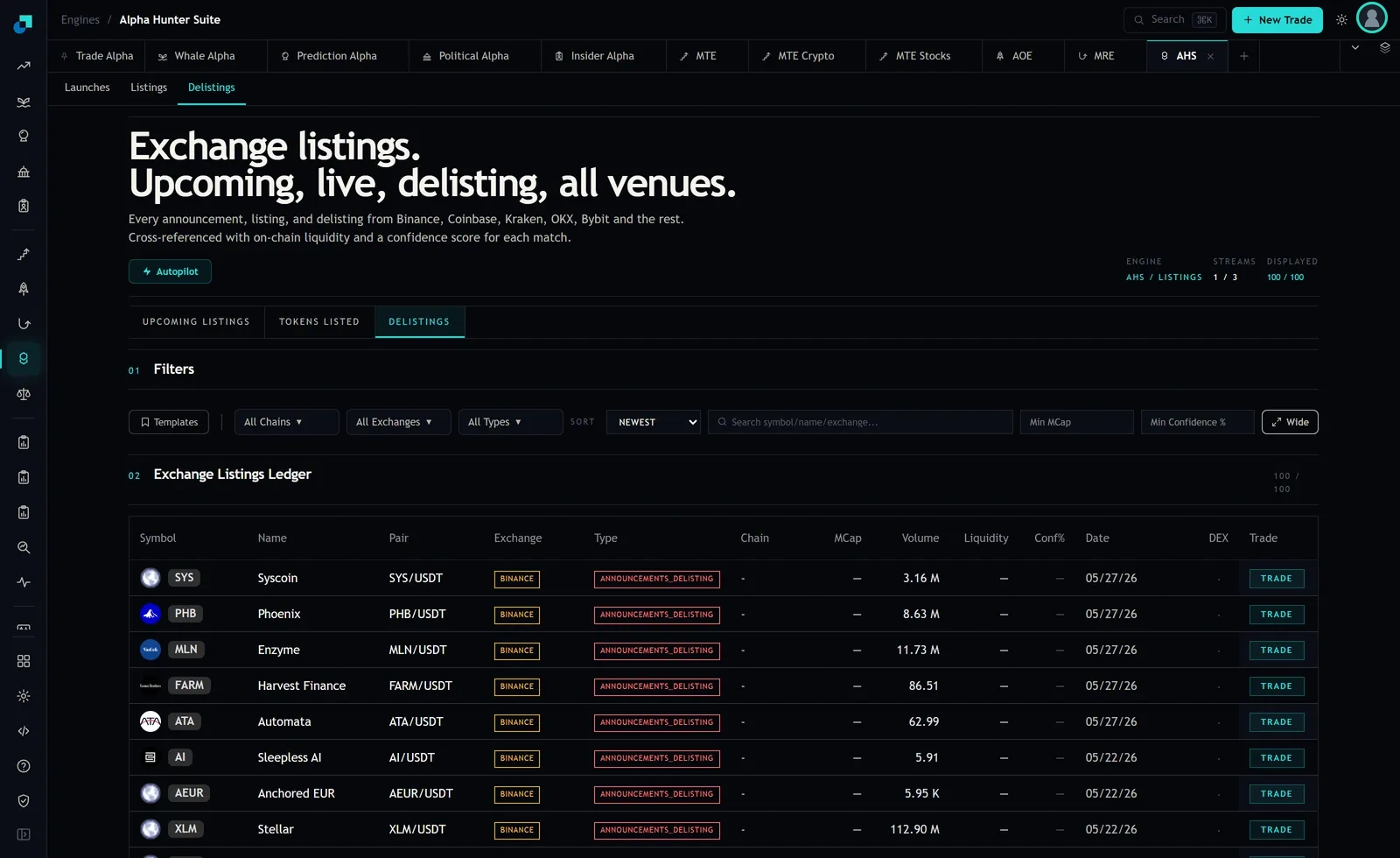
Look at what the delistings stream is actually listing. On my capture, the Pair column read SYS/USDT, PHB/USDT, MLN/USDT, FARM/USDT, ATA/USDT, AI/USDT, AEUR/USDT and XLM/USDT, with a Binance chip on every row and a type of ANNOUNCEMENTS_DELISTING.
Every one of those entries names two assets. The token, and the thing it is quoted against. That is not a formatting detail, it is the unit of the announcement. A venue does not usually delete a token from its systems, it stops running a particular order book, and an order book is a pair.
Which means the row answers a narrower question than the word suggests. It tells you that this pair is going away at this venue on this date. It does not tell you whether the same token still has another book at the same venue, whether it trades at other venues, or whether your balance is affected beyond needing to route a sale differently.
Be straight about the limits of what the panel can settle here. The ledger shows you the pair being retired. It does not show you the token's other pairs at that venue, and there is no column that says whether this is a partial pruning or a full removal. That answer lives in the venue's own announcement, and the row's job is to send you to it quickly rather than to replace it.
The three cases hiding behind one row
Every delisting row you will ever read resolves into one of three situations, and they have different consequences.
The first is a pair retirement. The venue closes the book in one quote asset, usually because it is not getting used, and the token continues trading against a different quote on the same venue. Your balance is untouched. Your route changes. If you were trading the retired pair, you now trade a different one, and the practical effect is a different spread and possibly an extra conversion step.
The second is a full token delisting at that venue. Every book for that token closes and the venue sets a timetable for trading to stop and for withdrawals to close. Your balance is very much affected and there is a clock on it. This is the case people picture when they read the word, and it is the one that justifies urgency.
The third is a venue-level exit, where the venue is leaving a market or a jurisdiction and the token is incidental. This looks like case two on your screen but the fix is different, because the token is fine and the relationship with the venue is not.
The five-minute check that separates them
Run these in order and stop as soon as you have the answer.
- Open the venue's own announcement, not a screenshot of it. The ledger row gives you the symbol, the pair and the date, which is enough to find the notice. The notice is the only authoritative statement of what is being removed and when.
- Search the venue for the token's other pairs. If the token still lists against another quote asset on that venue, you are in case one and the urgency drops immediately.
- Check whether deposits and withdrawals for that token are still open at the venue. In a full delisting these get suspended on their own schedule, usually after trading stops, and the gap between the two dates is your window to move the asset rather than sell it.
- Check whether the token trades anywhere else you can actually reach with your account. Not whether it trades somewhere in the world. Whether you can get to that venue and out again.
- Look at the on-chain route. If the token has a functioning pool and you can hold it in a wallet, the venue's decision is an inconvenience rather than a terminal event.
Only after those five do you have any business deciding what to do, because the first four determine which decision you are even making.
What changes about your exit in each case
In case one, almost nothing changes and the correct response is usually to do nothing quickly. You will trade the surviving pair instead. The cost is the difference in spread between the old book and the new one, plus a conversion if the new quote asset is not what you want to hold. That is a real cost and it is small, and it does not justify dumping a position into a book that other people are dumping into for the same bad reason.
In case two you have a genuine deadline and two routes. Sell on the venue before trading stops, or withdraw the token and deal with it elsewhere. The comparison is arithmetic. On the sell side, spread plus fee plus whatever impact your size causes in a book that is thinning as the halt approaches. On the withdrawal side, the withdrawal fee, the network cost, the deposit and any listing constraints at the destination, and the spread wherever you eventually trade. Neither is automatically better and the balance shifts with your size and the token's liquidity elsewhere.
In case three, withdrawal is usually the answer if it is available to you, because the problem is the venue and not the asset. The thing to check first is whether the venue's exit also restricts withdrawals for your region, since that turns a straightforward move into a much narrower window.
Why the reflexive sell is usually the expensive branch
The mechanics of a delisting announcement create a predictable crowd. A notice lands, it gets read as an obituary, and a group of holders who did not check which case they were in all send market orders into the same book at the same time. Meanwhile the market makers who were quoting that book have every reason to widen or step away, since they are being asked to warehouse an asset whose venue is about to disappear.
So the worst liquidity of the whole episode frequently sits in the hours right after the announcement, which is exactly when the uninformed selling arrives. That is not a prediction about where the price goes. It is a statement about what the book looks like, and it means the cost of acting instantly is systematically higher than the cost of acting an hour later with the notice actually read.
There is a real exception. If the token has no other venue you can reach, no functioning on-chain route, and withdrawals are already restricted, then the closing book is your only exit and delay makes it worse rather than better. That situation exists and it is the one case where speed genuinely wins. The point of the five-minute check is that you will know which one you are in, instead of guessing under time pressure with a headline as your only input.