The first DCF I built spent about six hours on the forecast and thirty seconds on the last line. Six hours modelling revenue growth quarter by quarter, working out how gross margin drifts as the product mix changes, arguing with myself about capex. Then a terminal growth rate typed in from habit, and a fair value. It took me embarrassingly long to work out that the thirty second number was driving roughly three quarters of the answer and the six hour part was decoration.
This is not a flaw in my model. It is what a DCF is. If you are going to use one, the honest version of the work is to spend your time where the value actually sits, and then to bound it deliberately, because terminal value is the input with the least evidence behind it and the most leverage over the output.
The share of value that sits past your forecast
Take a company throwing off 100 dollars of free cash flow, growing at 6 percent through the explicit forecast, discounted at 9 percent, with terminal growth of 2.5 percent. Run the same assumptions over three different forecast horizons and look at what changes.
| Forecast horizon | PV of forecast years | PV of terminal value | Terminal share |
|---|---|---|---|
| 5 years | 460 | 1,372 | 74.9% |
| 10 years | 861 | 1,193 | 58.1% |
| 15 years | 1,209 | 1,038 | 46.2% |
On a five year model, three quarters of your fair value comes from a single line computed with one growth assumption. Extending to fifteen years pulls it under half, but notice what that actually did. It did not reduce the uncertainty. It moved the uncertainty into years eleven through fifteen of a forecast, which is a place where you have no more real information than you did in the terminal line. You have replaced one guess you can see with five guesses you can pretend are analysis.
That is the first thing worth knowing. Lengthening the forecast makes the terminal share look better without making the valuation better. I now use ten years for most things and treat the shrinking terminal share as cosmetic.
How small a change moves the whole answer
Hold the ten year model fixed and move only the terminal growth rate. Nothing else changes, not one line of the forecast you spent the afternoon on.
| Terminal growth | Total present value | Terminal share |
|---|---|---|
| 1.0% | 1,816 | 52.6% |
| 2.0% | 1,963 | 56.2% |
| 2.5% | 2,053 | 58.1% |
| 3.0% | 2,159 | 60.1% |
| 4.0% | 2,434 | 64.6% |
Moving terminal growth from 2 percent to 4 percent, a change most people would make without pausing, lifts fair value by about 24 percent. If the stock was 20 percent overvalued on your model, it is now cheap. Nothing about the business changed. You changed a rate you cannot observe and will never be able to check.
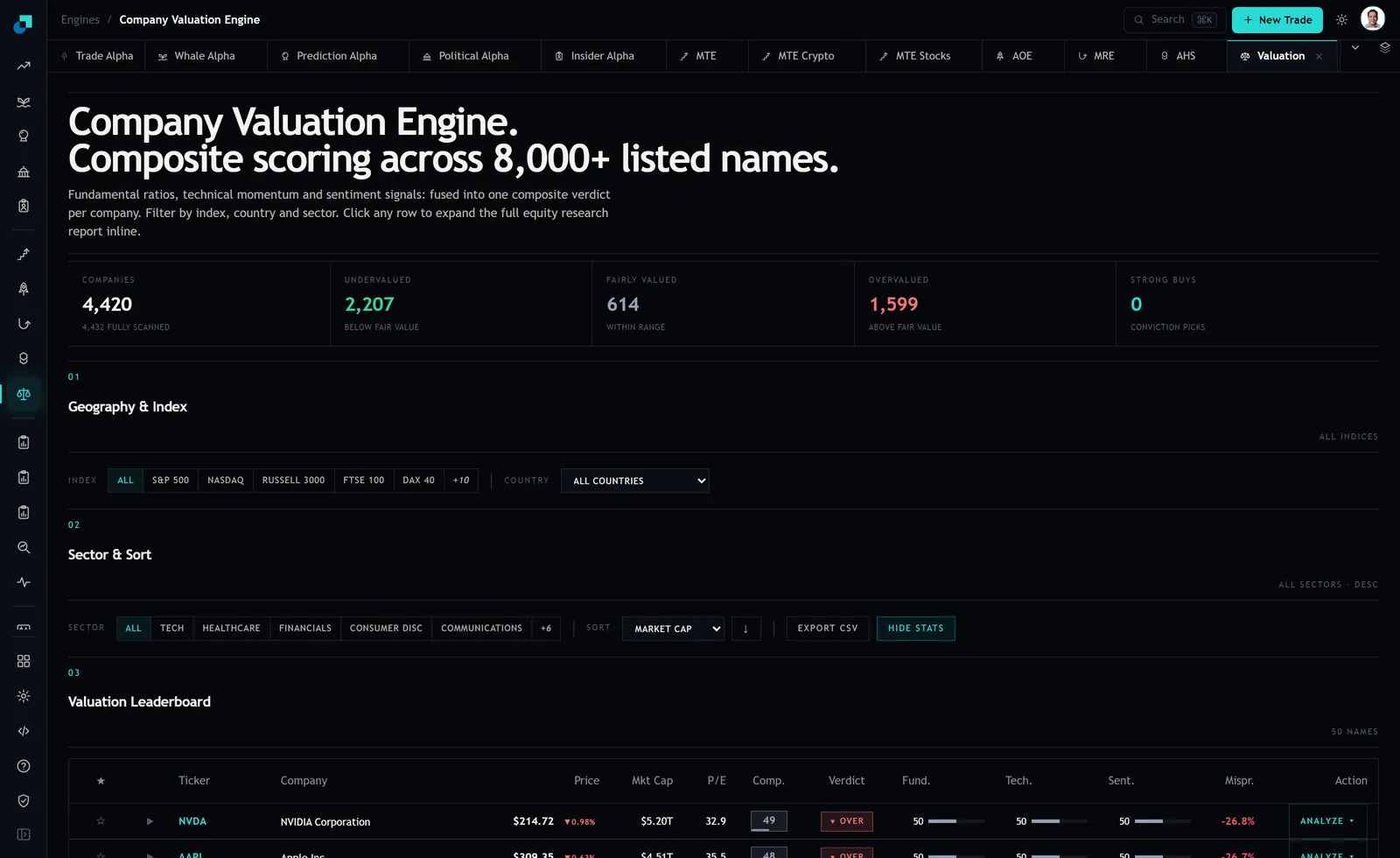
That caret is why I mention anchoring at all. The Company Valuation Engine screen above lists names with a composite score and a verdict, and expanding a row opens the full research report for that company. It is genuinely useful, and it is also the fastest way to talk yourself into a terminal growth rate that happens to close the gap to somebody else's number. Write yours down before you open the row. If you then change it, log why, in one sentence, so you can tell later whether you were persuaded or just anchored.
Three caps worth applying before you look at anyone else's number
Caps are not precision. They are guardrails that stop the least defensible input from doing the most damage. These three take about ten minutes together.
Cap one: terminal growth cannot exceed long run nominal growth of the economy the company sells into. A business growing forever at 5 percent in a 4 percent nominal economy eventually becomes the economy. That is not a rhetorical point, it is arithmetic, and it is the standard objection to any high terminal growth number. For most developed market businesses this puts the ceiling somewhere around long run inflation plus modest real growth. I use 2.5 percent as my default and treat anything above 3 percent as needing a written reason.
Cap two: sanity check the implied exit multiple. A perpetuity is a multiple whether you call it one or not. Terminal value divided by terminal year cash flow gives you the multiple you are implicitly paying, and the number can be startling.
| Terminal growth | At 8% discount | At 9% discount | At 10% discount |
|---|---|---|---|
| 2.0% | 17.0x | 14.6x | 12.8x |
| 2.5% | 18.6x | 15.8x | 13.7x |
| 3.0% | 20.6x | 17.2x | 14.7x |
If your perpetuity implies you are selling the business in year ten at 20 times cash flow, ask yourself whether mature businesses in that industry trade there. Sometimes the answer is yes and the assumption survives. Often the answer makes you lower the growth rate or raise the discount rate, and either is better than shipping a number you could not have defended.
Cap three: fade the growth into the terminal rate rather than stepping down to it. The typical amateur model runs 12 percent growth for ten years then drops to 2.5 percent in year eleven. Nothing in the world works that way. Taper the growth rate down over the back half of the forecast so the terminal year is already a mature year. This usually cuts fair value, which is the point. It removes the free option you were giving yourself by keeping the good years right up against the perpetuity.
What to actually do with this on a Sunday afternoon
If you have a model open, the highest value thing you can do this week is not to refine the forecast. It is to run three versions of the terminal line and see whether your investment case survives all three.
Version one is your base assumption. Version two caps terminal growth at long run nominal growth and fades into it. Version three abandons the perpetuity entirely and applies a conservative exit multiple drawn from what mature businesses in the sector trade at today. If the stock looks like a buy in all three, you have something. If it only works in version one, you do not own a valuation, you own an assumption about a decade you cannot see, and the position size should reflect that.
The version three exercise has a second benefit. It usually reveals that your discount rate and your terminal growth rate were doing the same job. A 12 percent discount rate with 4 percent terminal growth and a 9 percent rate with 2 percent growth land in similar places, and if you have been tuning both, you have effectively been dialling in an answer through two knobs at once. Pick one to be your policy number and leave it alone across every model you build. Mine is the discount rate. Yours can be the growth rate. What does not work is treating both as free.
There is a version of this article that ends by telling you terminal value is dangerous and you should be careful. That is not useful. The useful statement is narrower: on a five year DCF, roughly three quarters of what you are calling analysis is one number, so cap it before you look at anyone else's fair value, and size the position against the version of the model you like least.