The expensive version of this mistake is not buying a bad story. It is buying a good story at the wrong size, at the point where the story is loudest and the price has already moved. The narrative was correct. The entry was late and the position was full.
What has kept me out of most of those is a rule with two gates, run in order, before any size goes on. Gate one: the claim has to exist somewhere I can point at, stated as a metric with a state, not as a feeling I absorbed from a timeline. Gate two: price has to already be paying for it. Both gates, or the position is a fraction of what I planned.
Gate one: find the claim, not the vibe
A narrative you cannot write down in one line with a subject and a state is not a narrative you can trade. "Alt season is starting" fails. "Ether is outperforming bitcoin and bitcoin dominance is falling" passes, because both halves name a thing that can be measured and can be wrong.
This is the whole reason a scorecard beats a timeline as a starting point. A scorecard is a list of claims someone had to commit to in advance, each with a name and a current state. You are not asking it what to think. You are using it to convert whatever you already believe into a form that can be checked.
The practical test is falsifiability, and you apply it to yourself. Before you look at the current state, write down which reading would make you drop the idea. If no reading would, you do not have a thesis, you have an attachment, and the rest of this procedure cannot help you.
Gate two: the price has to already be paying
Gate two is the one people skip, because it feels backwards. If price has already moved, have you not missed it? No. You have replaced a forecast with an observation, and observations are cheaper to be wrong about.
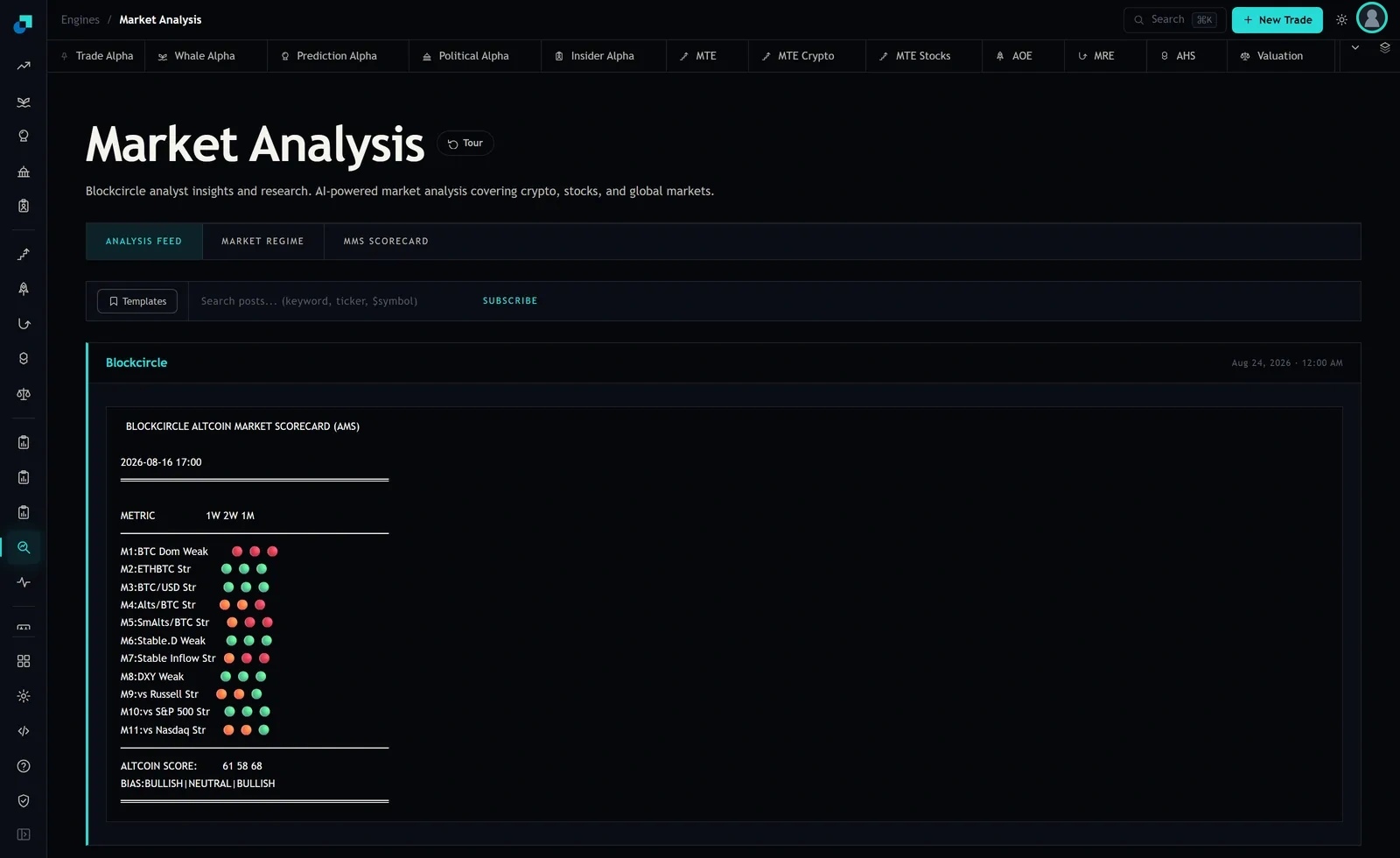
Look at the capture above. The composite reads bullish on the one week and one month horizons and neutral on the two week, at 61, 58 and 68. If your story is "alts are rotating," the metric that carries that claim is M4, alts against bitcoin, and it reads amber on 1W, amber on 2W and red on 1M. The small alt line, M5, is worse: amber, red, red. Meanwhile the ether leg, M2, is green across all three, and the bitcoin dominance line, M1, is red across all three.
Read as a whole, that is not a broad altcoin rotation. It is a bitcoin and ether market with a weak dominance reading, and the majors are doing the work. A trader who heard "alt season" and sized into small caps would have been trading a narrative that the alt-versus-bitcoin rows were actively contradicting at the moment of the capture. The story was in the feed. The price was not paying for that version of it.
This is what gate two protects against, and it is the more common failure by a wide margin. The narrative is usually roughly right. It is the specific expression that is wrong, and the specific expression is where your money goes.
Sizing off the count of agreeing horizons
Once both gates are live, sizing becomes arithmetic rather than conviction, which is the point.
The scorecard gives three horizons per metric. I use the count of horizons agreeing with my thesis as a direct size multiplier, decided before I look.
- Three of three agreeing: full planned size.
- Two of three: half.
- One of three: a quarter, and only if the disagreeing horizon is the longest one.
- Zero: no position, and go and find out why you believed it.
On a $4,000 planned position, that is $4,000, $2,000, $1,000 or nothing. The rule matters most in the case where it hurts. Take the ether leg from the capture: green on all three, so full size. Take the small alt leg: amber, red, red, so nothing, no matter how good the writeup that brought you there was.
The reason to fix these fractions in advance is that in the moment you will find a reason why this particular one deserves an exception. Everybody does. Writing the ladder down converts a judgement call made under excitement into a lookup.
The stale-data trap in both gates
Both gates depend on the reading being current, and this is where an analysis feed can quietly betray you.
Look at the timestamps on that card. The post is stamped Aug 24, 2026 at 12:00 AM in the feed header, and the scorecard printed inside it carries its own stamp of 2026-08-16 17:00. Those are eight days apart. Whichever one is the moment the metrics were computed, the other one is not, and if you read the header date as the data date you are treating a week-old reading as this morning's.
Eight days is long enough for several of those colours to flip. Further down the same feed there are user posts from Aug 20 discussing the scorecard flipping back to bullish on the one week, described at the time as barely so. A metric that is barely on one side of a line is exactly the metric that will not still be there a week later.
So the check is: find the data stamp, not the post stamp, and if the gap is longer than the shortest horizon you are trading, the reading is a starting point for your own look rather than a confirmation of anything. This costs ten seconds and it is the difference between confirmation and decoration.
When both gates pass and the trade still fails
The rule is not a filter for winners, and pretending otherwise is how people stop following it after two bad outcomes.
The main way it fails honestly is lateness. A composite built on one week, two week and one month lookbacks is by construction a description of what has already happened. When all three horizons agree, you are at the point of maximum agreement, which is often also the point of maximum crowding. You will get stopped out of correctly identified trends near their end, and there is no version of a backward-looking confirmation rule that avoids this.
The second way is composition. A single number built from eleven inputs can sit still while its parts churn underneath. Two metrics improving and two deteriorating can leave a score of 61 unchanged and your position facing a different market. This is why gate two is applied to the specific rows carrying your thesis and not to the headline score, and it is why the bias line is the last thing I look at rather than the first.
The third is that neither gate says anything about your entry price. The gates govern whether a position goes on and how large. Where your stop sits, and whether the level that invalidates you is close enough to make the size affordable, is a separate question and it does not get answered by a scorecard.