Every regime model I have reviewed has been presented as if its history were a fact. The label series arrives in a research note looking like a calendar, one row per week, each week carrying a name. It is not a calendar. It is a set of estimates, each one conditional on the data available at the moment the classifier last ran, and some of those estimates change when the classifier runs again.
The question that decides whether the series is usable in research is not how accurate the labels are. It is how much of the series moves when new data lands, and how far back the movement reaches.
Two different diseases produce the same symptom
When a label at time t is different in this week's vintage from what it was in last week's vintage, one of two things has happened, and they carry completely different consequences.
The first is edge instability. The most recent few periods sit near a classification boundary, and the arrival of one more observation tips them across. This is expected, it is what any real-time classifier does, and it is not disqualifying. It is the cost of getting a label at all before the period is comfortably in the past.
The second is deep-history rewriting. A label six months or two years back changes because the model re-fits on the full sample, or because a smoothing step uses observations from both sides of t, or because an underlying input series was revised. This one is fatal for research use, and it is fatal in a specific way that survives every sanity check people usually run. A label at t that depends on data from after t encodes the future. Any strategy conditioned on that label inherits foresight it will not have live, and the backtest will look good for exactly that reason.
The Market Regime Detector fuses three scorecards, the Altcoin Market Scorecard, the Macroeconomic Risk Scorecard, and the Global Liquidity Scorecard. That construction matters here because macro inputs are the classic source of the second disease. Macroeconomic series are revised as a matter of routine, so a macro-conditioned label computed on today's data for a week last spring is not the label anyone could have computed that spring, even if the model itself never re-fits.
A churn metric two analysts will compute the same way
Fix a history window of T periods ending at the vintage date. For vintage v the model gives you labels L(v, t) for t in that window. Compare consecutive vintages on the overlapping periods only, excluding the newly added period, since that one has no prior value to disagree with.
Total churn is the fraction of overlapping t where L(v, t) differs from L(v minus 1, t). Report it as a rate per vintage, and report the vintage cadence alongside it, because a two percent churn rate on daily vintages is a different animal from two percent on monthly ones.
Then split it, because the aggregate hides the distinction that matters. Bucket each revision by its lag, meaning the distance from the revised period t back from the vintage date. Three buckets are enough in practice. Near edge, within the last four periods. Middle, from five periods back to roughly a year. Deep, beyond a year. Publish three numbers, never one.
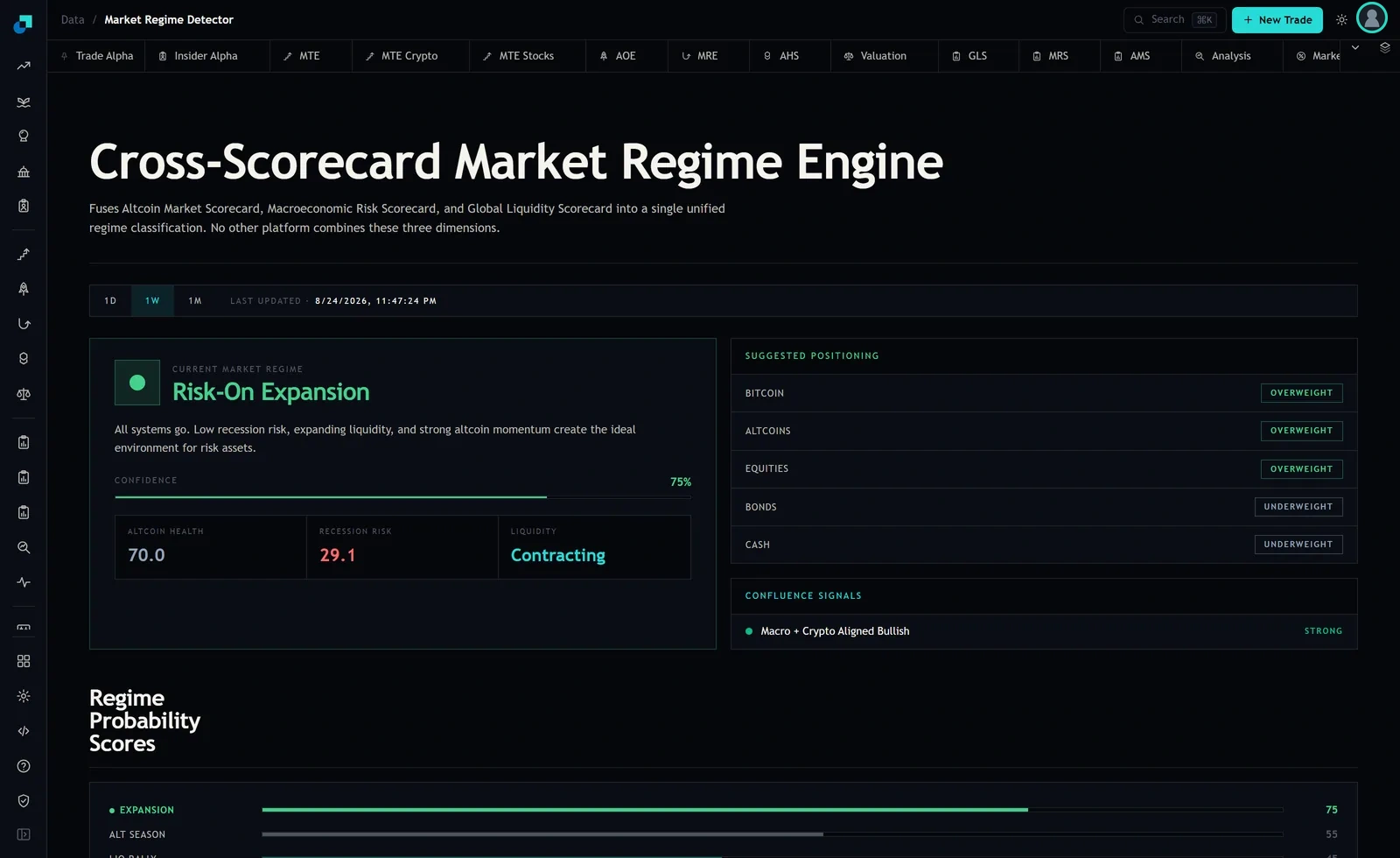
Two refinements are worth the extra code. First, weight revisions by whether they cross a positioning boundary rather than counting all name changes equally, since a switch between two labels that both imply overweight risk assets costs you nothing in implementation. Second, track confidence churn as well as label churn. The captured card shows a confidence figure of 75 percent under the Risk-On Expansion label, and confidence moving several points at a fixed label is the early warning that the label itself is about to move.
Where the number stops being tolerable
Deep churn has a threshold of zero. Not a low number, zero. If any label more than a year old changes between vintages, the series is not a function of information available at t, and it cannot be used to condition a backtest without a full point-in-time reconstruction. This is a binary test and it is the first one to run, because a failure here makes the rest of the analysis pointless.
Middle churn is where judgement lives. My working line is that if more than about one period in twenty in the five-periods-to-one-year band moves in a typical vintage, the label series is too soft to attribute performance to. You can still trade the current reading. You cannot write a memo saying the strategy earned its return in the Expansion regime, because the set of weeks called Expansion will be a different set by the next review.
Near-edge churn should be high, and a suspiciously low figure there is its own warning. A classifier whose most recent labels never move is either enormously confident or is not really updating at the edge, and the second is more common. The useful diagnostic is not the churn rate itself but the delay to settlement, which is how many vintages a period takes before its label stops changing. Compute the median. That number is the true publication lag of the regime series, and it is almost always longer than the update timestamp implies.
Building the vintage archive the screen does not keep
None of this is available from the module as captured. What the screen gives you is the current classification, a set of component readings, and a last-updated stamp with second resolution. There is no history table in the capture, so the archive is yours to build, and building it costs almost nothing if you start now and everything if you start later.
Snapshot on a fixed schedule and store the full row rather than the label alone. At minimum, the as-of timestamp, which of the 1D, 1W and 1M timeframes you read, the regime name, the confidence figure, the component readings, and each probability score. The capture shows Expansion at 75, Alt Season at 55 and Liq Rally at 45, and storing those raw scores rather than the winning name is what lets you separate a genuine regime change from a hairline crossing between two scores that were always close.
One practical note from the capture. The narrative sentence attached to the regime described expanding liquidity while the liquidity tile in the same card read Contracting. That tells you the prose is bound to the label rather than recomputed from the components, so diff the label, the numeric tiles and the scores, and ignore the description text entirely in any automated comparison. Prose that never changes will make a churn measurement look artificially clean.
Repairing research you have already published
If you have a regime-conditioned study built on a single downloaded vintage, you do not need to throw it out, but you do need to bound the damage before it goes in front of anyone.
The cheap version is a stability shim. Re-run the study on a shifted label series, where each label is lagged by the median settlement delay you measured. If the conclusion survives, the study was not living on revision. If it evaporates, you have learned that the result was an artifact of labels that were not knowable at the time, which is worth more than the original finding was.
The thorough version is a proper point-in-time panel, one row per period per vintage, from which you read the label as of the decision date rather than as of today. It is more work than anyone budgets for, and it is the only version that lets you claim the regime conditioning was real. Until that panel exists, the honest sentence for the memo is that the regime attribution is computed on final-vintage labels and has not been reconstructed point-in-time, which tells a reader exactly how much weight to put on it.