A profile following a daily timeframe signal makes at most one decision a day and may go a week without making any. Watching it in real time would be a waste of a person. That is the point of running it, and it is also the reason supervision of automated strategies tends to quietly become nobody's job: there is no moment in the day when the strategy demands attention, so no moment gets allocated to it.
The obligation does not attach to the schedule. Whatever regime you operate under, the common requirement is that a named person is responsible for the conduct of the activity, is capable of exercising that responsibility, and can evidence having done so. None of that is satisfied by the strategy being quiet. It is satisfied by a roster.
What the supervisor is actually answering
Supervision goes wrong when it is defined as watching. Watching an unattended strategy produces boredom and then inattention. Define it instead as periodically answering four questions, each of which has an artefact behind it.
Is it doing what it was approved to do? This is a comparison between the running configuration and the approved specification, and it is the question that most often turns up something, because configurations drift by small increments that nobody registers as changes.
Is it inside its limits? Exposure, concurrency, instrument universe, venue. Not whether the limits are set, whether they are being respected, which is a different observation requiring different evidence.
Is the data underneath it sound? A strategy acting on a stale or wrong input will look completely healthy from the outside, because it is executing correctly on bad information. Nothing about the order flow will tell you.
Is it still worth running? Performance against expectation, slippage against assumption, capacity against the size you now run. This one is quarterly, not daily, and it is the question that gets deferred indefinitely because there is never a day when it is urgent.
The roster, with the artefact named
A cadence without a named output is a diary entry. What makes this hold up in a review is that each row produces something signed and dated, including on the days when the answer was that nothing happened.
| Cadence | What is checked | Where it is read | What is signed |
|---|---|---|---|
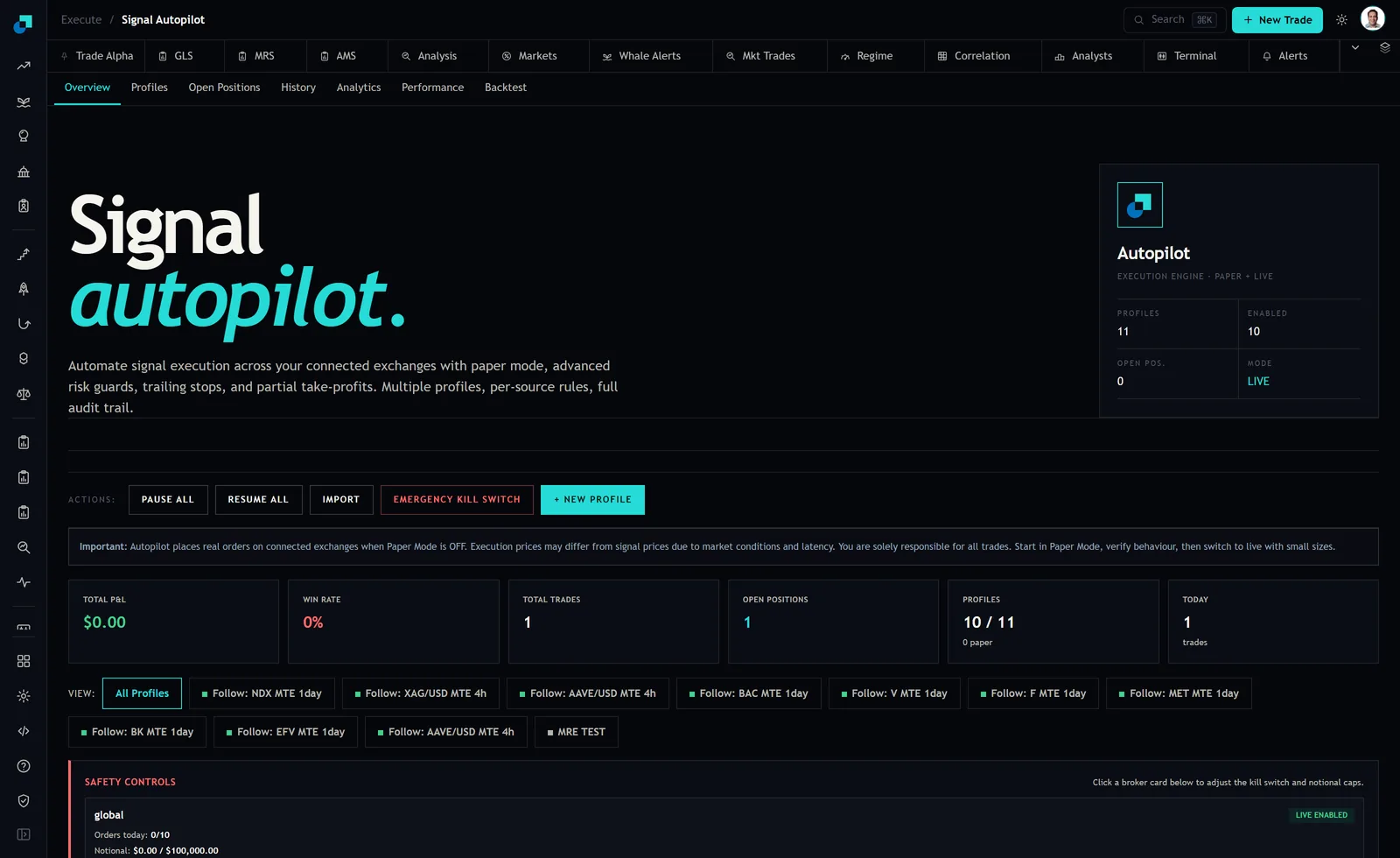
| Daily, by mid morning | Enabled profile count and names against the approval register. Mode flag live or paper. Open positions against limits. Prior session fills and any guardrail declines. | Overview strip, Open Positions tab, History tab | A five line daily check with the counts written out, signed even when clean |
| Weekly | Realised results against expectation, slippage against assumption, any configuration change made during the week and who made it | Analytics tab, change record | A short written note, exceptions explained rather than listed |
| Monthly | Full parameter diff against the last approved version. Aged reconciliation items. Concentration across profiles that individually pass | Profile configuration, break register | Diff attached to the file, signed by the supervisor and the profile owner |
| Quarterly | Continuation decision. Backtest refreshed against live behaviour, capacity and crowding, whether the original rationale still holds | Backtest tab, performance record | A continue, resize or retire decision with reasons |
The daily row is the one that carries the weight, and it is deliberately mechanical. Counting enabled profiles and comparing names to a list requires no strategy expertise at all, which means it can be delegated, verified, and performed by a deputy when the usual person is away. Sophisticated supervisory checks that only one person can perform are not controls, they are dependencies.
Signing on the days nothing happened
The instinct is to record exceptions only, on the reasonable ground that a clean day generates no information. Resist it, because a control that produces no artefact on quiet days is indistinguishable, months later, from a control nobody performed.
This becomes concrete quickly. My own overview at the time of writing read TOTAL TRADES 1 and TODAY 1, which is close to a standing still engine. A supervisor could go a fortnight without seeing anything worth escalating. If the only records in that fortnight are silence, then when something does go wrong the file shows two weeks of nothing followed by an incident, and there is no way to demonstrate that the checks happened at all. Five lines a day, with the actual numbers written down rather than a tick, costs a couple of minutes and converts silence into evidence.
It also has a practical benefit that has nothing to do with compliance. Writing the numbers down daily is how you notice slow drift. A count that moves from ten to eleven to twelve over six weeks is invisible if you only look when something breaks.
What the supervisor may switch off without asking
Authority is where these arrangements usually turn out to be decorative, and the test is simple: can the supervisor stop the strategy right now, alone, without needing to reach anybody? If the answer requires a phone call, you have an observer rather than a supervisor.
Grant stopping powers broadly and starting powers narrowly. The asymmetry is the whole design. A supervisor should be able to disable an individual profile, and to use the book wide PAUSE ALL or EMERGENCY KILL SWITCH controls on the overview, unilaterally and without justification in advance. They should not be able to enable a profile, raise a limit, or alter a parameter, because those are activation decisions and belong to the approval path with its own author and approver.
Two conditions come with that. First, prefer the granular stop. Disabling the one profile that is misbehaving is proportionate, and reaching for a book wide halt switches off every well behaved strategy alongside it, which is a decision you will be asked to defend. The supervisor should have practised the per profile disable, not just read about it.
Second, every stop is recorded with a reason at the time, and this matters more than it looks because RESUME ALL sits directly beside PAUSE ALL in the same action row. A bulk resume will happily restore something that was paused for cause, reversing a risk decision without anyone deciding to reverse it. The rule that prevents this is short: anything paused for cause is flagged as such and may only be resumed individually, by the person who owns it, with the reason for resumption written next to the reason for the pause.
When the supervisor is also the person who built it
At a small firm the person who designed the strategy, configured the profile and understands the data is also the only person qualified to supervise it. Pretending otherwise by putting a name on a form that belongs to someone who cannot read the Analytics tab is worse than admitting the constraint, because it produces a control that looks satisfied and is not.
Admit it in writing and build compensating controls around it. Split the daily check so that the mechanical half, comparing the enabled count and names against the approval register and confirming the mode flag, is performed by someone outside the desk. That half needs no expertise and it catches the failures that self review will never catch, since the reason self review fails is not incompetence, it is that people do not notice their own changes.
Route the artefacts to a third party on a fixed schedule, so that the daily notes go somewhere rather than into a personal folder. Set the quarterly continuation decision as a discussion with at least one person who has no stake in the strategy continuing. And write down explicitly, in the same document, that the supervisor and the author are the same person and that these are the compensating measures. A documented weakness with mitigations is a position you can defend. An undocumented one is the finding.