The sector heatmap prints one headline number per bucket. Meme Coins +40.7 percent over seven days, Layer 2 +37.2 percent, DEX Tokens +34.0 percent. Nothing on the card says how that number was weighted, and there is no weighting control on the panel that I can point to. That is the entire problem, and it is not specific to this vendor. Almost no sector display anywhere tells you which of the two possible numbers you are looking at.
It matters because the two answers are not close. Below I recompute the same three buckets from the constituents the card itself lists, equally weighted, and the leaderboard inverts. The bucket that leads on the headline finishes last, and the bucket that finishes last on the headline leads.
What the card states, and what it leaves unstated
Take an inventory before doing any arithmetic. Each card states a sector name, a headline return for the selected window, three windows underneath at 24h, 7d and 30d, a combined market capitalisation, and a row of constituent chips with each token's return. The toggle at the top right of the heatmap was on 7d at capture.
What is not stated on the card: the weighting scheme, the full constituent count, whether the chips shown are the complete membership or a display subset, the rebalance convention, the treatment of tokens that belong to more than one bucket, and an as-of timestamp. PUMP appears in both the Meme Coins card and the DEX Tokens card, so multi-bucket membership is not hypothetical here, it is on the screen.
Every one of those unstated items changes the number. None of them is recoverable from the display. If this reading is going into a client deck, that gap is yours to close, and the way you close it is by recomputing from constituents you control and disclosing which number you used.
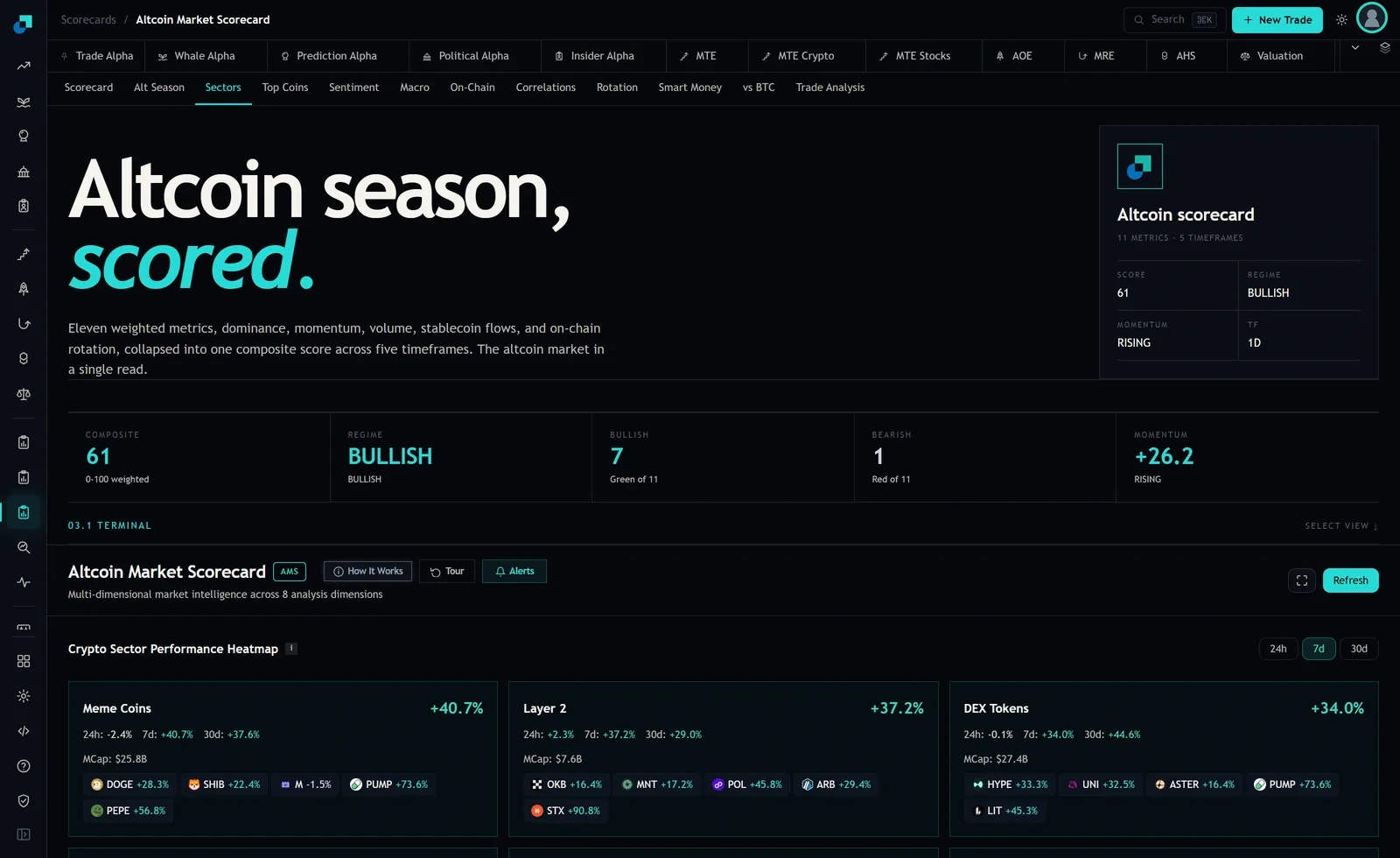
The reorder, computed off the chips on the card
Equal-weighting the constituents each card displays gives Meme Coins +35.9 percent against a +40.7 percent headline, Layer 2 +39.9 percent against +37.2 percent, and DEX Tokens +40.2 percent against +34.0 percent. In headline order the ranking is Meme Coins, Layer 2, DEX Tokens. In equal-weight order it is DEX Tokens, Layer 2, Meme Coins. First and last swap places, and the spread between best and worst compresses from 6.7 points to 4.3 points.
One caveat that has to travel with those numbers. The card may be showing a subset of members rather than the full bucket, so treat this as a demonstration of the size of the effect rather than as a published equal-weight series. That caveat is itself the finding: you cannot verify a weighting effect from a display that does not disclose its membership, which is why the recomputation belongs in your own stack against a constituent list you maintain.
The mechanism behind the inversion is unremarkable and completely general. Cap weighting concentrates the reading in the largest members. Equal weighting concentrates it in the count. When a bucket's strongest performers are small, equal weight looks better; when the strength is in the largest names, cap weight looks better. That is why the ordering can invert without a single price being wrong.
Which read belongs in a benchmark and which belongs in a signal
These are different jobs and the choice is not a matter of taste.
A benchmark has to be investable at your size. Cap weighting is the only scheme that is naturally capacity-consistent, because the weights are proportional to what exists, so a larger allocation does not push you further into names that cannot absorb it. It also drifts with the market and therefore does not demand turnover to stay aligned. If a number is going to be used to judge a manager or to size a sleeve, it should be cap weighted, and preferably capped, because an uncapped crypto sector index is frequently a single-name position wearing a sector's name.
A signal about breadth has to be democratic. Equal weight answers a different question: how is the typical member of this bucket doing. That is the correct input for a participation or breadth read, for deciding whether a sector move is broad enough to be worth expressing at all, and for anything where you are trying to detect rotation rather than measure it. Its costs are real and structural. Equal weight carries a mechanical rebalance requirement, it tilts small by construction, and its implementation shortfall in crypto smalls is materially worse in basis points than the tracking numbers suggest, because the names it overweights are the ones with the thinnest books.
The error to avoid is using one for the other. A breadth signal quoted as sector performance overstates what a portfolio could have earned. A cap-weighted benchmark used as a breadth read tells you a large token had a good week and nothing about participation. Both errors have the same fix, which is stating the scheme every time the number appears.
The disclosure a client deck needs
When a sector number goes on a page, this is what belongs next to it, in a footnote if not in the label itself.
- The weighting scheme, named. Cap weighted, capped cap weighted with the cap level, or equal weighted, with the rebalance frequency for the last two.
- The constituent universe and the count as of the reporting date, plus the eligibility rule that produced it.
- The as-of timestamp and the window, including whether the window is calendar or trailing.
- The treatment of multi-bucket members, since a token counted in two sectors is double counted in any aggregate you build across sectors.
- Whether the series is point-in-time or has been restated under the current taxonomy, which is the single most common reason a sector return in a deck cannot be reproduced six months later.
- The source, and whether the figure was recomputed by you or quoted from a display.
That last line is worth being strict about. A number you quoted from a screen and a number you computed from constituents you hold are different objects with different liabilities, and the distinction should survive into the deck.
Three questions before the number leaves the desk
Ask the provider, or ask your own data team if the series is internal.
First, is the headline weighted by market capitalisation, and if so is it free float adjusted. Crypto float adjustment is not standard, and unlocked supply versus circulating supply can move a bucket weight materially.
Second, what is the membership rule and when does it get applied. A bucket that gains a member after that member has already run has a return series that no investor could have held, and the difference between that and a point-in-time series is the whole of the credibility question.
Third, what happens on a reclassification. If a token moves from one bucket to another, does the history move with it. If it does, every sector return you have ever quoted is subject to revision, and your attribution will change with no trade behind it. That is a documentation problem you want to discover before a client does, not during the review where the sector call is being examined.