The Consensus tab on Whale Alpha has three buttons above the list. Total Volume, Whale Count, Conviction. They look like a preference, the way a sort dropdown on a shopping site is a preference. They are not. Each one answers a genuinely different question, and if you read the top of the board without knowing which question you asked, you will act on the wrong row roughly a third of the time.
The board defaults to Total Volume. That means the list you see when you land on the tab is answering the question where is the most whale money parked, which is a fine question and almost certainly not the one you had in mind.
Three buttons, three different questions
Total Volume ranks by dollars. It tells you where the size is. Whale Count ranks by how many distinct tracked wallets are in the market. It tells you how many independent opinions exist. Conviction ranks by how lopsided the money is between the two sides. It tells you how one-sided the money that is there happens to be.
Those three properties come apart constantly, because one large wallet produces high volume with a whale count of one, and five medium wallets produce a lower volume with a count of five. Whichever button is lit decides which of those two rows you see first.
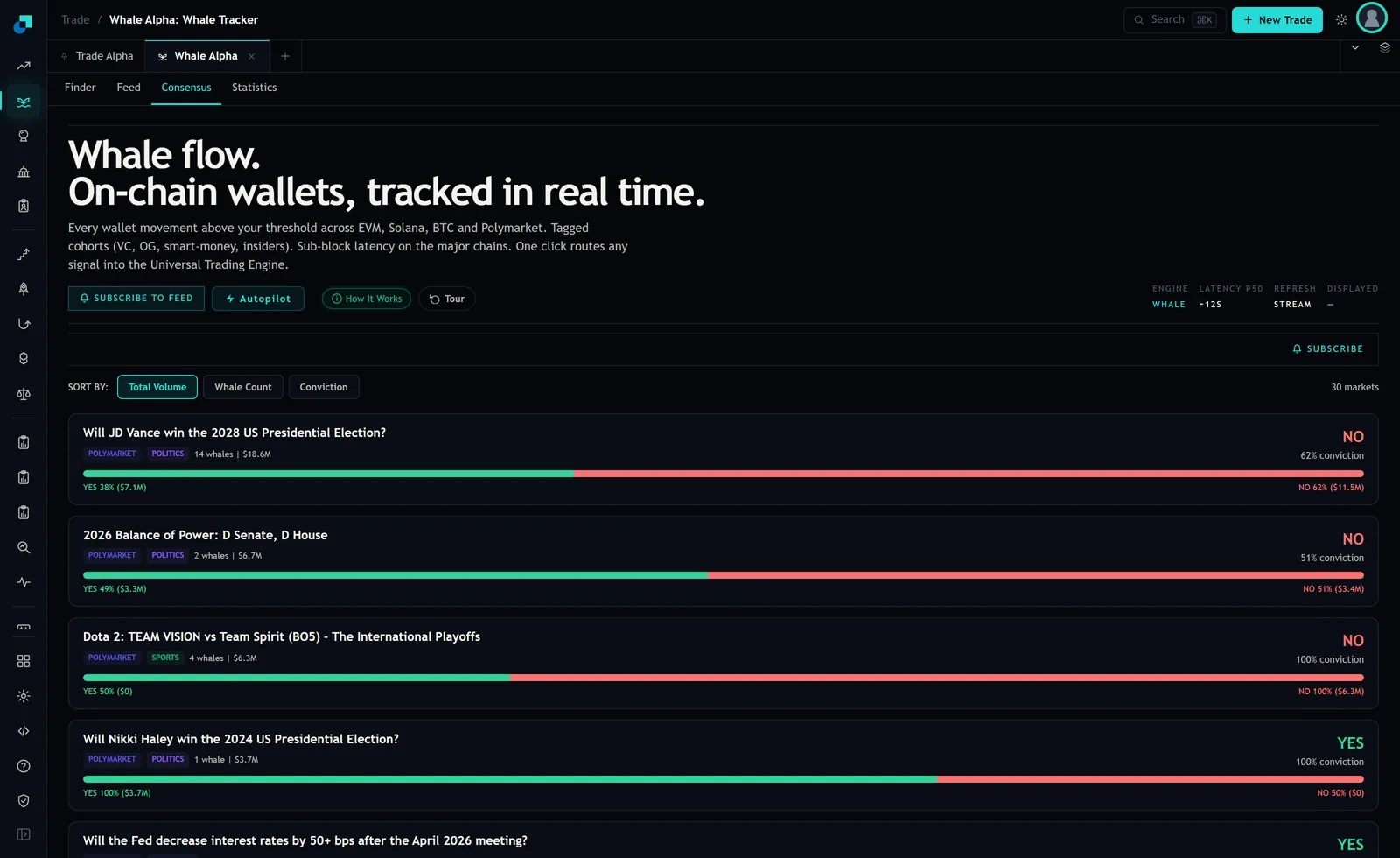
The same five rows, three different orders
Here is the top of the board as captured, under the default Total Volume sort, with the dollars per whale worked out because that column is the one that shows you what is about to happen.
| Market | Whales | Volume | Per whale | Conviction |
|---|---|---|---|---|
| JD Vance 2028 presidency | 14 | $18.6M | $1.33M | NO 62% |
| 2026 Balance of Power, D Senate D House | 2 | $6.7M | $3.35M | NO 51% |
| Dota 2 playoff match | 4 | $6.3M | $1.58M | NO 100% |
| Nikki Haley 2024 presidency | 1 | $3.7M | $3.70M | YES 100% |
Now press Whale Count. Rows two and three swap, because four whales beat two whales even though $6.3M is less than $6.7M. That is a real inversion sitting inside the visible part of the board, and it matters, because a market with four independent wallets on the same side is a different object from a market with two, no matter what the dollar totals say.
Now press Conviction. The top of the list changes completely. The two 100% rows go to the front and the $18.6M market with 62% conviction drops behind both of them. You have gone from a list headed by the largest, most contested political market on the board to a list headed by an esports match and a presidential race that finished two years ago.
Why 100 percent conviction usually means one wallet
Look at the Nikki Haley row. One whale, $3.7M, 100% conviction. That is not consensus. That is a single wallet, and the conviction figure is doing nothing except reporting that this one wallet did not hedge itself.
Conviction is a ratio of dollars between two sides. Ratios are unstable when the denominator is small, and a whale count of one is the smallest denominator there is. The Dota row has the same problem in milder form, four whales all on NO for $6.3M, which reads as unanimity and could equally be one view copied three times, or four wallets that are not as independent as four separate rows imply.
So the rule I use is blunt. Conviction is never a ranking column. It is a filter you apply after you have already decided a market is worth looking at, and you apply it alongside the whale count on the same row, never instead of it. A 62% conviction across 14 wallets is a stronger statement than a 100% conviction across one, and the Conviction sort will rank them in exactly the wrong order.
The empty side still prints 50 percent
The two 100% rows both carry a strange looking split underneath the bar. The Dota row shows YES 50% at $0 against NO 100% at $6.3M. The Haley row shows YES 100% at $3.7M against NO 50% at $0.
Read the dollar figure, not the percentage. Both of those 50% labels sit next to $0, which means there is nothing on that side at all. The 50% is what the display prints when a side is empty, not a measurement of a balanced market. If you scan the board quickly and take the percentages at face value, you will see markets that look evenly split and are in fact completely one sided, or the reverse.
This is the single most common way to misread this board, and the fix takes no time at all. Every row shows both the percentage and the dollar amount for each side. Always read the dollars.
Check whether the market is a market
The Haley row is worth one more paragraph, because it is a useful reminder about every whale board rather than a complaint about this one. It refers to the 2024 presidential election. The board was captured in August 2026. Whatever that $3.7M represents, it is not a position anybody is taking a view on this week.
Stale, resolved and near-dead markets survive on ranked boards because the ranking columns are dollar and count aggregates that do not care whether the underlying event is still open. Before you act on any row, click through and check three things: that the event is still ahead of you, that the current price is not already at 1 or 99 cents, and that there is enough resting size to get you in and out at something near the quoted price. That check costs thirty seconds and it kills more rows than the sort buttons ever will.
Which sort belongs to which decision
Assign them, and then stop pressing buttons at random.
- Use Total Volume when the question is where is the risk. This is the sort for understanding what tracked whales are actually exposed to, and for capacity, since a market with $18.6M of whale money in it can absorb your ticket and a market with $200K cannot.
- Use Whale Count when the question is how many people think this. This is the sort for finding breadth and for avoiding the trap of copying a single wallet while believing you have found a crowd. It is the sort I open first.
- Use Conviction only after you have a shortlist, and only while looking at the whale count and the dollar split on the same row. It answers how lopsided, and lopsided is only interesting once you know the sample is bigger than one.
The concrete thing to do this week, if you use this board at all, is to stop landing on it and reading the top row. Press Whale Count, take everything with three or more whales, then read the dollar splits on those rows only, then click through to check the markets are still live. Four steps, about two minutes, and it removes the two failure modes that actually lose money here, which are following one wallet you mistook for a consensus and buying into an event that has already happened.
One caveat worth holding on to. Every number on this board is a description of wallets somebody has chosen to track, not a census of the market. A market showing two whales has two tracked whales in it, which is not the same as two large participants existing. That gap is invisible on the board and it is why the count is a floor rather than a measurement, in every case, under every sort.