A signal arrives. An offshore master and an onshore vehicle both want it. What looks like one decision is now two orders that will differ in venue, in instrument, in margin treatment, in settlement and in what gets reported afterwards, and the only thing they will genuinely share is the moment the idea was formed.
Most firms handle this by convention, which works until the conventions live in one person's head and that person is on holiday. The divergences are predictable enough to be written down, and one of them is dangerous enough that it should be handled by structure rather than by care.
One signal is not one order
The feed is deliberately singular. Trade Alpha describes itself as an aggregated queue where every engine's output lands in one place, deduplicated across sources on a ninety second window. That is the right design for a research signal and it is exactly the wrong shape for an execution instruction, because a signal row has no entity on it and cannot have one.
Which means the translation from row to orders is a step you own, and it should be an explicit step with a written rule rather than an inference made by whoever is at the desk. The rule takes one row and produces, for each entity that is eligible, an instrument, a venue, a size and a sequence position. If any of those four cannot be determined for an entity, that entity does not trade the row, and the reason is recorded.
Eligibility is decided before venue selection, and the region row is only a filter
The Brokers catalog is a good place to see the shape of the problem, provided you are clear about what its controls do.
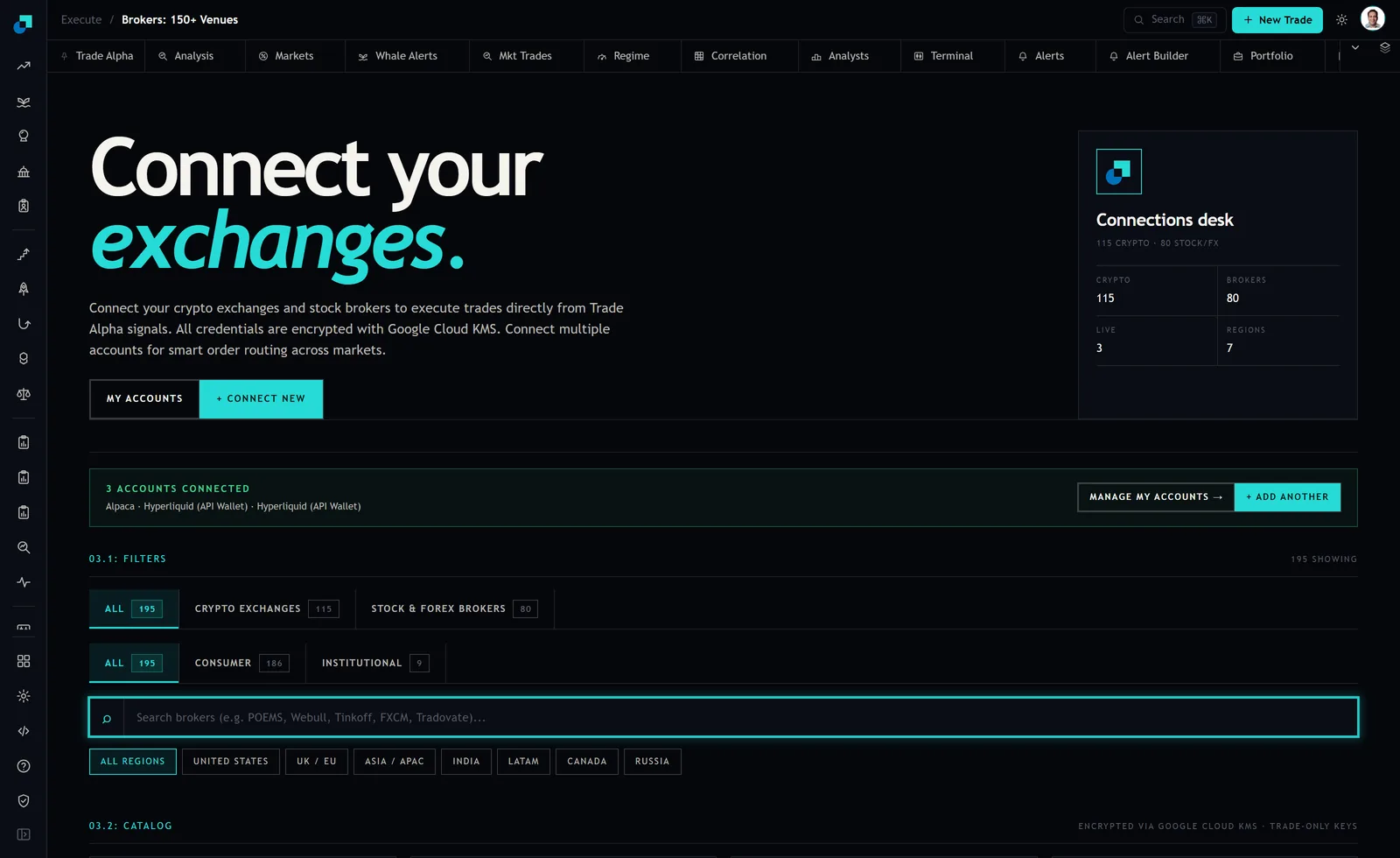
At capture the catalog showed 195 venues, 115 crypto exchanges and 80 stock and forex brokers, filterable across all regions, United States, UK and EU, Asia and APAC, India, LATAM, Canada and Russia, with a second row splitting 186 consumer against 9 institutional.
Use those filters as a shortlisting aid and nothing more. The region row tells you where a venue is oriented. It does not encode whether your Cayman master may face it, whether your onshore vehicle's mandate permits it, whether the venue will onboard a corporate entity from your jurisdiction at all, or what your counsel has said about any of it. Eligibility is a determination you make per entity, per venue, in advance, and then record as a schedule.
The consumer and institutional split is the more useful of the two for this purpose. A regulated onshore vehicle frequently cannot face a venue built for individual customers, for reasons that have nothing to do with the venue's quality: the account terms, the segregation arrangements, the reporting outputs and the onboarding path are all built for a different counterparty. That does not make the 186 unusable across the board, but it does mean the eligibility answer will often differ between your two entities for the same venue, and that asymmetry is the thing your schedule exists to record.
The same idea in two wrappers is two instruments
A feed row carries an asset and a type. In the capture I am working from the visible rows read STOCKS and METALS, with entries such as a metals row at 64.71 USD and equity rows in the teens and the hundreds. What the row does not carry, because it cannot, is the wrapper.
A metals exposure can be expressed as spot, as a listed future, as a perpetual contract on a crypto venue, or as a tokenised claim. An equity exposure can be the security itself or a synthetic. If your offshore vehicle takes the perpetual and your onshore vehicle takes the listed instrument, both have implemented the same idea and they now hold two different instruments with different margin mechanics, different financing, different settlement, different tax characterisation and different reporting obligations.
Three consequences follow and all three should be pre-agreed rather than discovered.
- The positions will not net across the group in any system that keys on the underlying, so group risk aggregation has to key on an instrument master that distinguishes wrapper, or it will quietly misstate the exposure in both directions.
- The two entities will not have the same profit and loss from the same idea, and the gap is a financing and basis effect rather than an execution failure. Say so in advance, in writing, so that the first quarter it happens is not the quarter someone asks whether one entity is being favoured.
- Performance attribution has to separate the signal contribution from the wrapper contribution, or the wrapper decision will be silently credited or blamed on the signal.
The crossing risk, and the partition that removes it
This is the one to solve structurally, because it is the one where good intentions fail.
If both entities act on the same row at the same moment in opposite directions, or if one is entering while the other is exiting, and both are at the same venue, you can end up as both sides of a trade between your own vehicles. Depending on where you sit that is anything from an awkward conversation to a regulatory problem, and the fact that it was unintentional is not much of a defence when the pattern repeats.
Care does not fix this. Partition does. Three mechanisms, in order of strength.
The strongest is a venue partition, where each entity's schedule is constructed so that the two do not share a venue for the same instrument. That removes the possibility rather than managing it, and where your eligibility answers already differ, you may find the partition is most of the way there for free.
Where sharing a venue is unavoidable, use a sequencing rule with a stated separation, so that the two entities' orders in the same instrument on the same day are never live simultaneously, and record the sequence. Combine it with a pre-send check that reads the other entity's open orders in that instrument, and make the check a hard gate rather than a reminder.
The weakest and most common approach is to rely on a trader noticing. Write down that this is what you are relying on if it is, because at least then it is a documented residual risk rather than an assumption.
Attribution when the anchor is shared and the fills are not
There is one genuine benefit to the two entities working off the same row, and it is worth harvesting.
Because both orders trace to a single feed row with a single timestamp and a single entry price, you have a common arrival anchor for both. That makes cross-entity execution comparison meaningful in a way it usually is not: the same idea, the same moment, two implementations, and any difference in outcome is implementation rather than selection. That is a rare and genuinely informative comparison, and it is the fastest way to find out that one of your two setups is systematically worse.
Report it per entity, never blended. The platform side will not do the entity mapping for you: the performance view groups by account, showing groupings such as a named broker account and a secondary account with trade counts against each, over windows from one day to a year. Accounts are not entities. The mapping from account to legal vehicle is a document you maintain, it needs an owner, and it needs to be reconciled against the connections list rather than assumed.
The connection layer, one entity at a time
Finally, the operational rule that keeps all of the above from collapsing.
Each entity gets its own venue accounts and its own credentials. Never share a key between two entities, and never route one entity's flow through an account that belongs to the other, whatever the settlement intention afterwards. A shared credential destroys the audit trail that every control above depends on, and it converts a clean structural separation into a bookkeeping exercise performed after the fact.
Keep the key scoping discipline intact while you are at it. The Brokers page states that credentials are encrypted with Google Cloud KMS and describes the keys as trade-only, and trade-only is the right scope for every connection regardless of which entity it serves. A credential that can move funds across a structure like this is not just an operational risk, it is an inter-entity transfer path that nobody approved, and it will be discovered by the wrong person at the wrong time.