COMPLETE SETUP & CONFIGURATION MANUAL
PREREQUISITES & INITIAL SETUP
Before beginning, ensure you have:
- A TradingView account (minimum Essential, preferably Plus+)
- Active Blockcircle subscription
Account Integration Process
- TradingView Account Creation -> Navigate to TradingView.com and create your account. Choose a username carefully, as this will be permanent and case-sensitive. Write down your exact username, including any numbers, underscores, or capital letters. For example, if you register as “Blockcircle_Trader1234”, this exact format must be used everywhere.
- Blockcircle Integration Visit blockcircle.com/account and enter your TradingView username exactly as registered. The system performs case-sensitive matching – “Blockcircle_Trader1234” will not match “blockcircle_trader1234”. After entering your username, you’ll receive access to the Blockcircle AMS – Altcoin Market Scorecard.
- Accessing Your Trading Chart -> Once logged into TradingView, click “Chart” in the top navigation menu. You’ll see a default chart appear. To change the trading pair, click the symbol in the top-left corner (usually showing “AAPL” or another default). Type your desired pair, such as “BTCUSDT,” and select the appropriate exchange (BINANCE, COINBASE, KRAKEN, etc.).
- Timeframe Selection Above the chart, you’ll see timeframe options (1m, 5m, 15m, 1h, 4h, D, W, M).
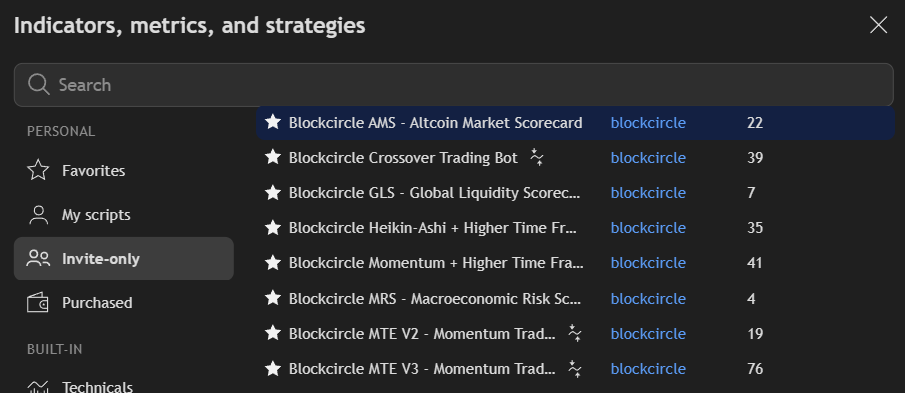
- Adding Blockcircle AMS – Altcoin Market Scorecard to Your Chart -> Click the “Indicators” button (looks like ƒx) at the top of your chart. In the search window that appears, navigate to the “Invite-Only” tab. You should see “Blockcircle AMS – Altcoin Market Scorecard” if your account has been granted access. Click on it once to add it to your chart.
Overview
The Blockcircle AMS is a comprehensive multi-timeframe analysis tool that provides real-time market sentiment for altcoins by analyzing 11 critical market relationships across multiple timeframes simultaneously.
Section-by-Section Guide
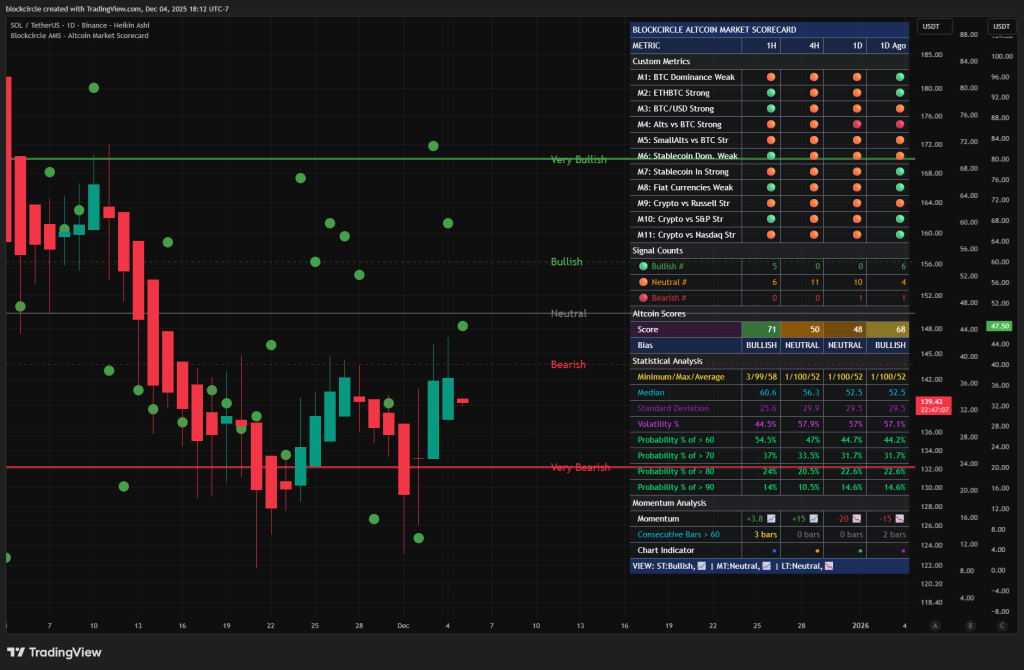
Header Section
- Timeframe Labels: Shows active timeframes (e.g., 1H, 1D, 1W)
- Chart: Uses current chart timeframe
- Ago: Indicates prior period comparison (useful for momentum analysis)
Input Tab Section
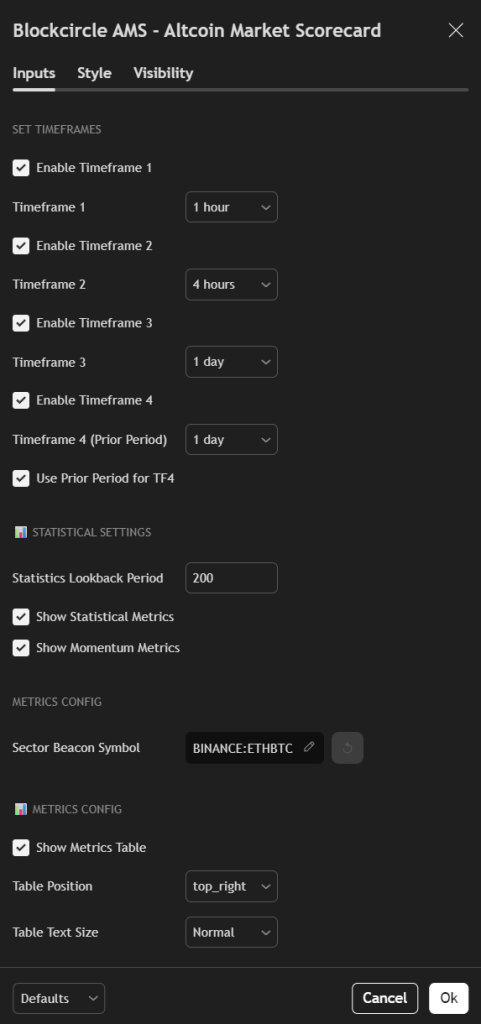
You can adjust the timeframes to 1-hour / 1-day / 1-week / 1-week ago as well, OR if you want a longer term view, you can set it to 1-day / 1-week / 1-month / 1-month ago, that would give you the full picture from multiple angles.
Market Metrics Section
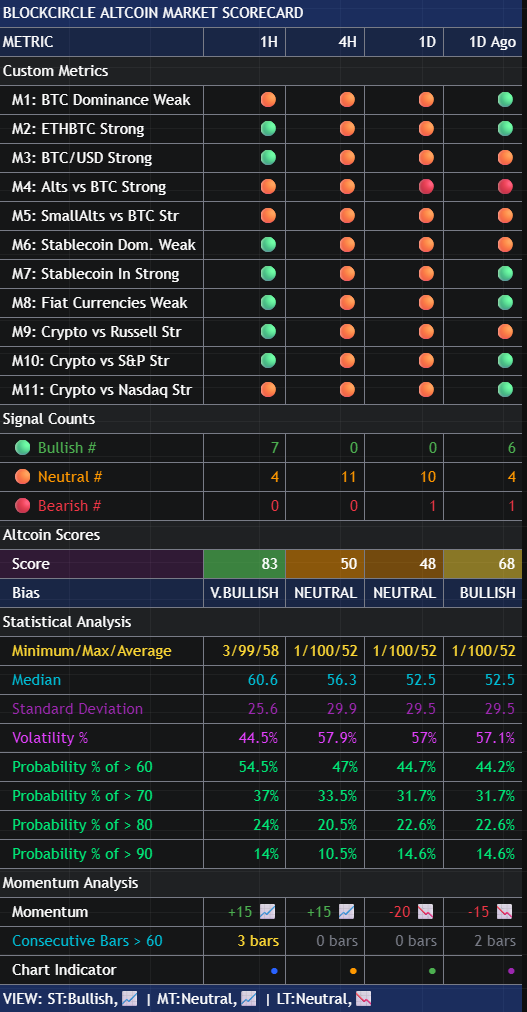
This section displays 11 proprietary indicators using a traffic light system:
- 🟢 Green: Favorable for altcoins
- 🟠 Orange: Mixed/Neutral signal
- 🔴 Red: Unfavorable for altcoins
Key Metrics to Watch:
- M1 (BTC.D): Bitcoin dominance – When red, altcoins typically underperform
- M3 (BTC/USD): Bitcoin strength – Green helps mini altcoin seasons
- M6 (Stable.D): Stablecoin dominance – Green indicates money flowing into risk assets
- M9 (vs Russell): Crypto vs small-cap stocks – Green shows crypto outperformance
Signal Counts Section
Provides a quick visual summary of market conditions:
- Bullish Count >7: Strong altcoin conditions
- Neutral Count >5: Market indecision, wait for clarity
- Bearish Count >7: Consider defensive positioning
Altcoin Scores Section
Score Interpretation:
- 80-100: Very Bullish – Aggressive altcoin positioning warranted
- 60-79: Bullish – Favorable for altcoin exposure
- 40-59: Neutral – Selective positioning, focus on quality
- 20-39: Bearish – Reduce altcoin exposure
- 0-19: Very Bearish – Defensive stance recommended
Bias Field: Provides plain-language interpretation of the score
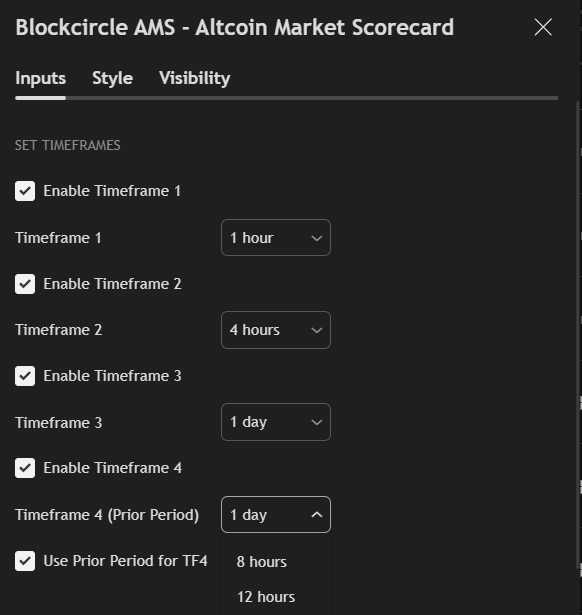
Set Timeframes
Statistical Analysis Section
Min/Max/Avg
- Shows historical range over the lookback period
- If the current score is near the maximum (Max), the market may be overextended
- If the current score is near the minimum (Min), there is a potential reversal opportunity
- Average (Avg) provides a baseline for comparison
Median
- More stable than average, less affected by extremes
- Score above median = Better than typical conditions
- Score below median = Worse than typical conditions
Standard Deviation (Std Dev)
- Measures score variability in absolute points
- High Std Dev (>15): Volatile market conditions
- Low Std Dev (<10): Stable market conditions
Volatility %
- Normalized volatility as percentage of average
- <20%: Low volatility, trends likely to continue
- 20-30%: Normal volatility
- >30%: High volatility, expect rapid changes
P(Score>50/60/70)
- Historical probability of bullish conditions
- P(Score>60) >70%: Historically bullish timeframe
- P(Score>60) <30%: Historically bearish timeframe
- Use for risk sizing: Higher probability = larger position sizes acceptable
Momentum Analysis Section
Bars > 60
- Consecutive periods above the bullish threshold
- >5 bars: Strong sustained momentum
- 3-5 bars: Establishing trend
- <3 bars: Early or weak momentum
Color Coding:
- Green: Strong momentum (>5 bars)
- Yellow: Building momentum (3-5 bars)
- Gray: Weak/no momentum (<3 bars)
Momentum
- First number: Score change from previous bar
- Positive (+): Improving conditions
- Negative (-): Deteriorating conditions
- Trend label:
- “Rising”: 5-bar average > 10-bar average (accelerating)
- “Falling”: 5-bar average < 10-bar average (decelerating)
- “Flat”: No clear trend
Trading Implications:
- +5.0 Rising: Momentum accelerating, trend likely to continue
- -3.0 Falling: Momentum deteriorating, consider reducing exposure
- +2.0 Flat: Improvement but no clear trend yet
Analysis Section
Chart Indicator
- Color-coded dots matching plot lines on chart
- Helps identify which timeframe each plotted line represents
Market Summary
- Plain-language interpretation across all timeframes
- ST (Short-term): intraday to few days
- MT (Mid-term): Days to weeks
- LT (Long-term): Weeks to months
Trading Strategies
Trend Following
- All timeframes bullish: Maximum altcoin exposure
- Mixed signals: Reduce position sizes
- All timeframes bearish: Move to stablecoins/BTC
Mean Reversion
- Score significantly below average with improving momentum: potential accumulation opportunity
- Score significantly above average with declining momentum: consider taking profits and waiting for a 1-week confirmation to derisk
Risk Management
- Use Volatility % to size positions (lower volatility = larger positions)
- Use probability metrics for confidence levels
- Monitor “Bars > 60” for trend exhaustion (>10 bars may indicate overbought)
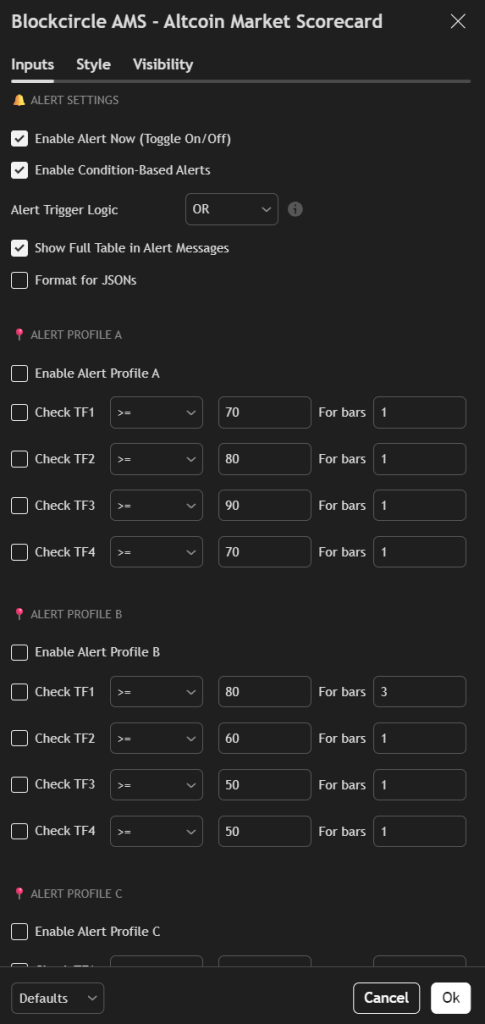
Alert Setup
- Set alerts when score crosses key thresholds (60 for bullish, 40 for bearish)
- Monitor momentum changes (positive to negative or vice versa)
- Watch for extreme readings (>90 or <10) for reversal opportunities