The word conviction is doing something sneaky on a consensus card, and it is not the platform's fault. The number is calculated correctly and labelled accurately. The problem is that when a human being reads the word conviction next to a large percentage, they picture a room full of experienced people nodding at each other. What the number actually describes is a pile of money, which may belong to one person having one idea.
You can prove this to yourself in about a minute using the readings from the tab, and once you have proved it the card becomes genuinely useful instead of quietly misleading.
The division you can check by hand
Take the largest card on the Consensus tab at capture, the Polymarket question on whether JD Vance wins the 2028 US presidential election. It showed 14 whales and 18.6 million dollars, sitting NO at 62 percent conviction. Underneath, the split: YES 38 percent at 7.1 million dollars, NO 62 percent at 11.5 million dollars.
Do the arithmetic. 11.5 divided by 18.6 is 0.618. The conviction figure is the NO side's dollars divided by total whale dollars in the market, rounded. That is the whole formula. There is no weighting by track record, no adjustment for how many distinct wallets contributed, and no count of heads anywhere in it.
Which means the number is entirely insensitive to how many people are behind it. Fourteen wallets each putting in 820,000 dollars produces the same 62 percent as one wallet putting in 11.5 million against thirteen wallets splitting 7.1 million. Those two situations are worlds apart as information, and the conviction bar cannot tell them apart, because it never looked.
Two wallets, six point seven million dollars
The second card at capture makes the point without any hypothetical. The 2026 Balance of Power question on a Democratic Senate and House showed 2 whales and 6.7 million dollars, sitting NO at 51 percent conviction.
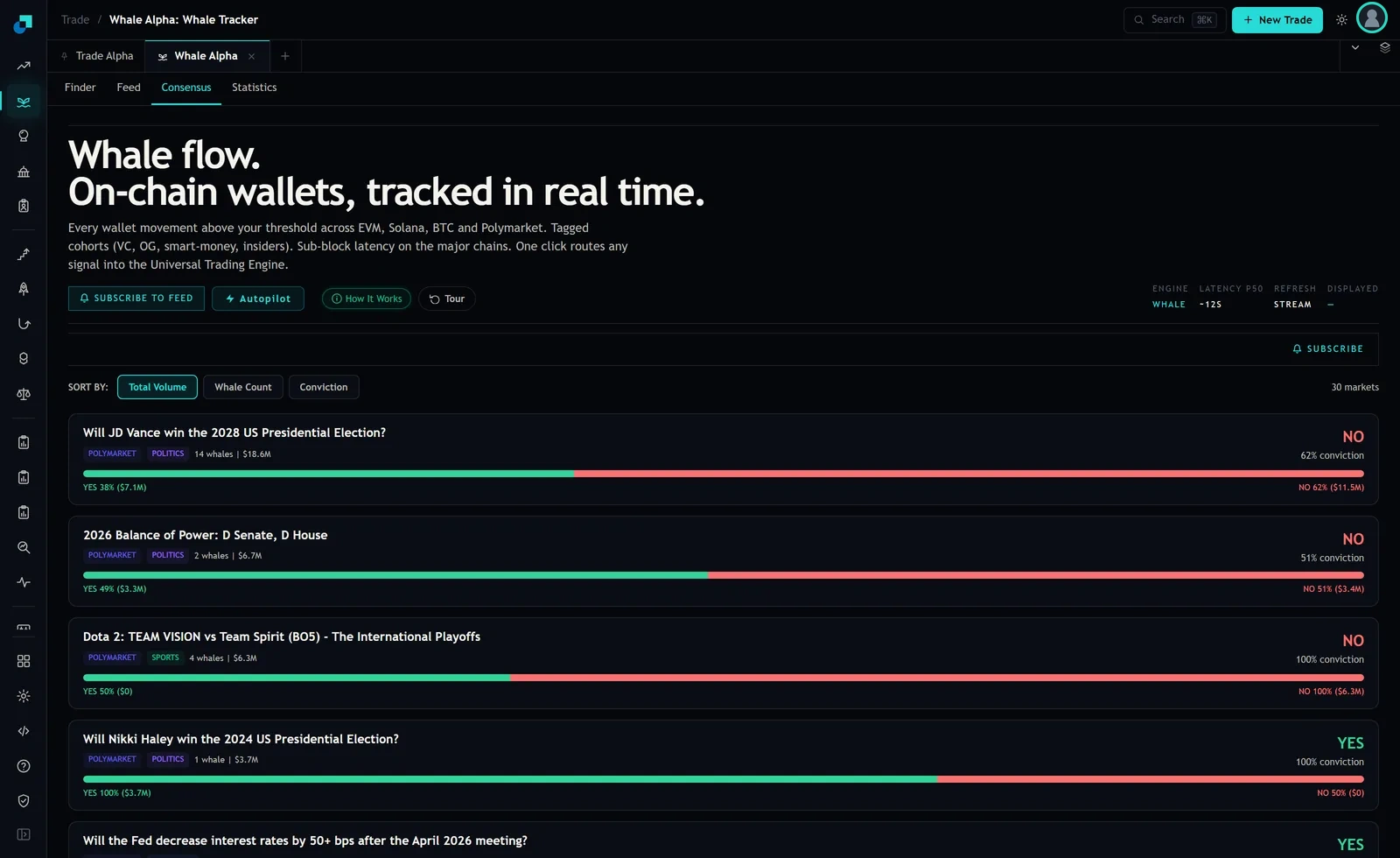
Two wallets. Fifty one percent. That percentage is not a consensus in any sense of the word. It is two people, one slightly larger than the other, pointed in opposite directions. If you had read only the conviction bar you would have taken away "the whales lean NO here", when the honest summary is "two large wallets disagree, and the bigger one is barely bigger".
Now push it to the limit. What does 100 percent conviction have to mean under this formula? It means every whale dollar in that market is on one side. The cleanest way for that to happen, by a wide margin, is for there to be exactly one whale. Not fourteen wallets in perfect agreement, which almost never happens in a market with real two way flow. One wallet, one position, one opinion, and a bar that fills all the way across.
Why one wallet at 100 percent is weaker, not stronger
This inverts the instinct. A full bar looks like maximum information and is usually close to minimum information, for three reasons that stack.
- There is no independence. Fourteen wallets arriving at NO separately is fourteen research processes converging. One wallet at NO is one research process, and if it is wrong, everything you inferred is wrong with it. The whole reason to look at a cohort rather than an individual is that independent agreement is evidence and a single opinion is not.
- The market is thin, which is why one wallet dominates it. A question where a single participant can be one hundred percent of tracked whale money is a question nobody else is bothering to price. Thin markets have wide spreads, and the price you can get may be a long way from the price on the card.
- You cannot see the wallet's reason, and it might not be a view at all. Large single sided positions in prediction markets are sometimes hedges against something the wallet holds elsewhere. Copying the hedge without holding the thing being hedged leaves you with a naked bet that the original owner never intended to take.
There is a fourth problem that only shows up once you try to act. The conviction figure is computed from tracked whale dollars, not from all money in the market. A question can show a lopsided whale reading while the broader order book, full of smaller participants the tracker does not classify as whales, sits somewhere quite different. On a card with fourteen wallets that gap is usually small enough to ignore. On a card with one or two, the whale reading and the market price can disagree substantially, and the price you are offered when you go to trade is set by the market, not by the card.
Sort by whale count and read the card differently
The tab gives you three sort options: total volume, whale count and conviction. Conviction is the default instinct and the least useful of the three for the reason above. Whale count is the one I use, because it sorts by exactly the thing conviction cannot see.
Sorting by whale count puts the crowded markets at the top. Those are the ones where a lean means something, because it survived contact with multiple independent participants. It also demotes the thin, dramatic, single wallet cards that would otherwise sit at the top of a conviction sort purely because there was nobody around to disagree.
Then read the card in this order, which is roughly the reverse of how the eye wants to read it. Whale count first, because it tells you whether this is a survey or an anecdote. Dollar total second, for whether the market is deep enough to enter at a sensible price. Conviction third, because now you know what the percentage is a percentage of. The thirty markets on that tab at capture will thin out fast under this ordering, and the ones left are the only ones worth an hour of your evening.
The threshold I hold myself to
My personal floor is five distinct wallets before a conviction number is allowed to influence anything. Below five, I will still read the card, but as a lead to investigate rather than a signal. Under three, the conviction figure gets ignored entirely and I go look at the individual wallets, because at that point the card is describing specific people and I would rather know who they are.
The Vance card clears that bar comfortably at 14 wallets. The Balance of Power card does not clear it at 2, regardless of how confident 51 percent sounds. Same tab, same visual language, same units, and two completely different kinds of evidence. The bar length is the least informative pixel on the card, and it is the one designed to catch your eye first.