The appeal of event contracts as a macro input is obvious. A scenario weight in a risk model is usually somebody's judgement, defended in a meeting and revised when it becomes embarrassing. A traded probability is at least a number that somebody paid for. The temptation is to take the screen figure, call it the market's view, and drop it into the model as a prior.
That substitution fails, and it fails in ways that are systematic rather than random, which means the error does not diversify across scenarios. What follows is the chain of adjustments that has to sit between the quoted number and the model input, and the record you need to keep of each one.
The screener number is not a mid
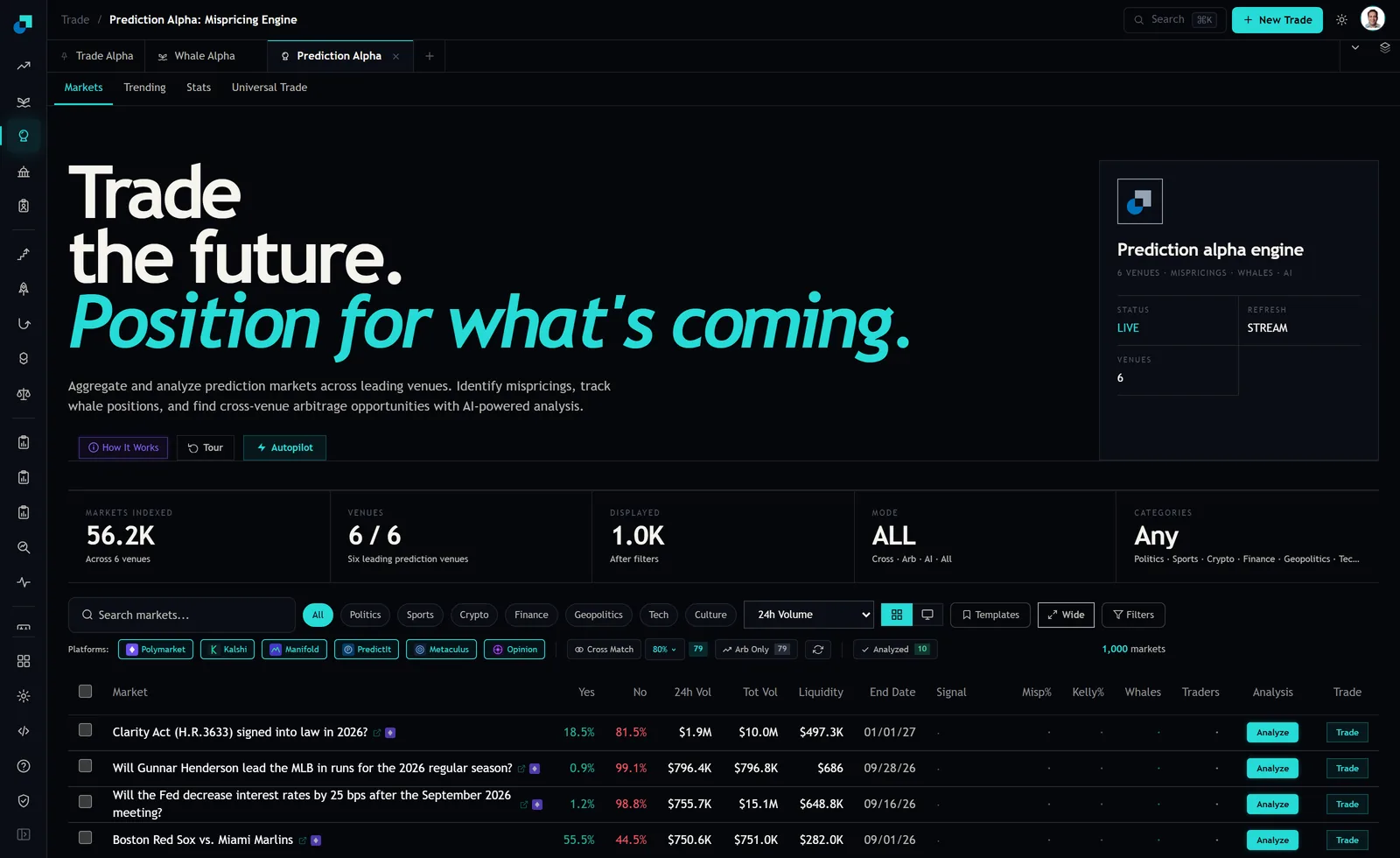
Start with what the figure on the Prediction Alpha markets tab actually is. Across the four rows in my capture, the Yes and No columns read 18.5 and 81.5, 0.9 and 99.1, 1.2 and 98.8, and 55.5 and 44.5. Every pair sums to exactly 100.0.
Two quoted sides of a real book do not do that. The complement is being computed, which means the row is presenting one number twice, and that number carries no information about the width of the market it came from. There is no bid, no ask, no last trade timestamp, and no indication of the size at which the figure was observable.
This is not a criticism of the screener, which is doing the job of surfacing candidates out of tens of thousands of listings. It is a statement about what you are entitled to do with the output. A scenario weight has to be sourced from the venue's own book, at a stated time, with the depth at that time recorded alongside it. If your process cannot produce those three fields, it is not producing a market-implied probability, it is producing a screenshot.
Who was allowed to set the price decides whether it is a price
The module aggregates six venues, and its own coverage list describes them as on-chain permissionless markets, CFTC-regulated US event markets, play-money community markets, academic real-money political markets, a forecasting community with calibrated probabilities, and sports and entertainment prediction markets.
Those are not six instances of the same thing, and the differences are disqualifying rather than adjustable.
- A play-money quote has no budget constraint behind it. The mechanism that makes a market price informative is that being wrong costs the marginal participant something they cannot replace by clicking. Remove that and you have a poll with a leaderboard. It cannot enter a risk model as a probability at any weight.
- A calibrated forecasting community produces a forecast, and a good one may well be better than a price. But it is an aggregation of stated beliefs, not a clearing level, and it is not something you can hedge against or trade around. Treat it as an analyst input, tracked separately, never blended into the same field as a traded number.
- A venue that caps position size caps the marginal participant. If the largest trader permitted is small, the price reflects the balance of small opinions rather than the balance of conviction weighted by capital, and it will be slow to incorporate a large informed view. Confirm the current limits at the venue itself before you weight anything from it, and record what you found and when.
The operational upshot is that the population of venues eligible to supply a scenario weight is smaller than the venue count on the tile, and which venues qualify is a policy decision that belongs in a document, not a judgement made per trade by whoever is at the screen.
Cost drag, in probability points, measured rather than quoted
The second haircut is the cost of acting on the number, and it has to be expressed in the same units as the number itself. A probability of 0.30 that costs you two points round trip to express is operationally a probability of 0.32 on the way in and 0.28 on the way out, and any model that treats it as a clean 0.30 will over-trade the input.
I am deliberately not going to quote fee schedules or tick sizes here, because they change and because the version you need is your own realised figure at your own size and venue, not a published rate card. Measure it instead. Run a deliberately small round trip on each eligible venue, record what you paid against the mid you observed at entry, and convert the total to probability points. That number is a standing input to the process and it should be re-measured on a schedule.
The components to capture are the half spread you actually crossed, the venue's take at your size, the movement your own order caused, and anything charged on the way out or on withdrawal. On thin books the fourth of those dominates the first three combined, which is why the depth figure has to travel with the probability. A 0.9 percent Yes resting on $686 of book, as in the second captured row, has a round trip cost that is a large multiple of the probability itself. That contract carries no usable macro signal at any size a firm would care about.
The tails are where the distortion is largest
The third haircut is the one people skip, and it is the one that quietly biases every scenario set built this way.
The long-running finding across wagering and event markets is that prices in the extreme tails are poor estimates of frequencies, with low probability outcomes trading rich relative to how often they happen. I am not going to attach a coefficient to that, because the size of the effect varies by venue, by category and by period, and a borrowed coefficient is worse than an honest band. What I will say is that the direction is consistent enough that an unadjusted tail price should not be used as a tail weight.
Two of the four rows in my capture were priced under one and a half cents on the Yes side. That is exactly the region where the effect lives, and it is also the region where cost drag is largest as a share of the price, where a single tick is a large relative move, and where the book is usually thinnest. Three separate distortions all peak in the same place, and they all push the same way.
The workable treatment is to use market-implied probabilities as scenario weights only in the interior of the distribution, where the price is a reasonable estimate and the costs are proportionate, and to derive tail weights from your own modelling with the market price used as a sanity check rather than as the input. If a tail contract is trading at a level your model cannot get near, that is a question to investigate, not a number to adopt.
What the memo has to record next to the number
The final discipline is documentary, and it is the difference between a defensible input and a screenshot in a deck. Any market-implied probability that reaches a risk model should arrive with a fixed set of fields attached, and the model should refuse the input if they are missing.
Record the venue and why it is on the eligible list. The exact contract, including its resolution criteria and its end date, because two venues can list the same headline question with different cutoffs and different treatment of ambiguity, and the difference will only surface at settlement. The timestamp and the observed two-sided quote from the venue rather than the aggregator. The depth at which that quote was available, and the size your own position would represent against it. The cost drag applied, and where the measurement came from. The adjustment applied for venue population, if any. And whether a counterpart listing exists elsewhere, which on this platform is uncommon enough to be worth noting explicitly when it does.
The value of that record is not compliance theatre. It is that when a scenario weight turns out to have been badly wrong, you can tell which link in the chain failed. Was the price stale, was the venue population unrepresentative, was the resolution criterion different from the question you thought you were pricing, or was the market simply right about the odds and the world landed in the tail. Those four failures need four different responses, and without the record every one of them looks the same in a post mortem.