Currency hedging is the largest decision in most multi-currency books that nobody owns. It is set once at inception, usually at fifty percent because fifty percent is the number that makes both sides of the committee equally unhappy, and then it sits untouched for years while it quietly contributes more to tracking error than the security selection everyone spends their time on.
Anything that offers to make it a dynamic decision is therefore attractive and dangerous in the same measure. A relative strength engine with a phase field looks like exactly that offer: a categorical read on whether a currency is in an uptrend, mapped onto how much of the exposure you leave open. The framework is worth building. The order in which you build it is what decides whether it survives contact with a bad quarter.
What the phase field is and where it currently exists
Deal with the availability question first, because it determines what can be implemented this quarter and what cannot.
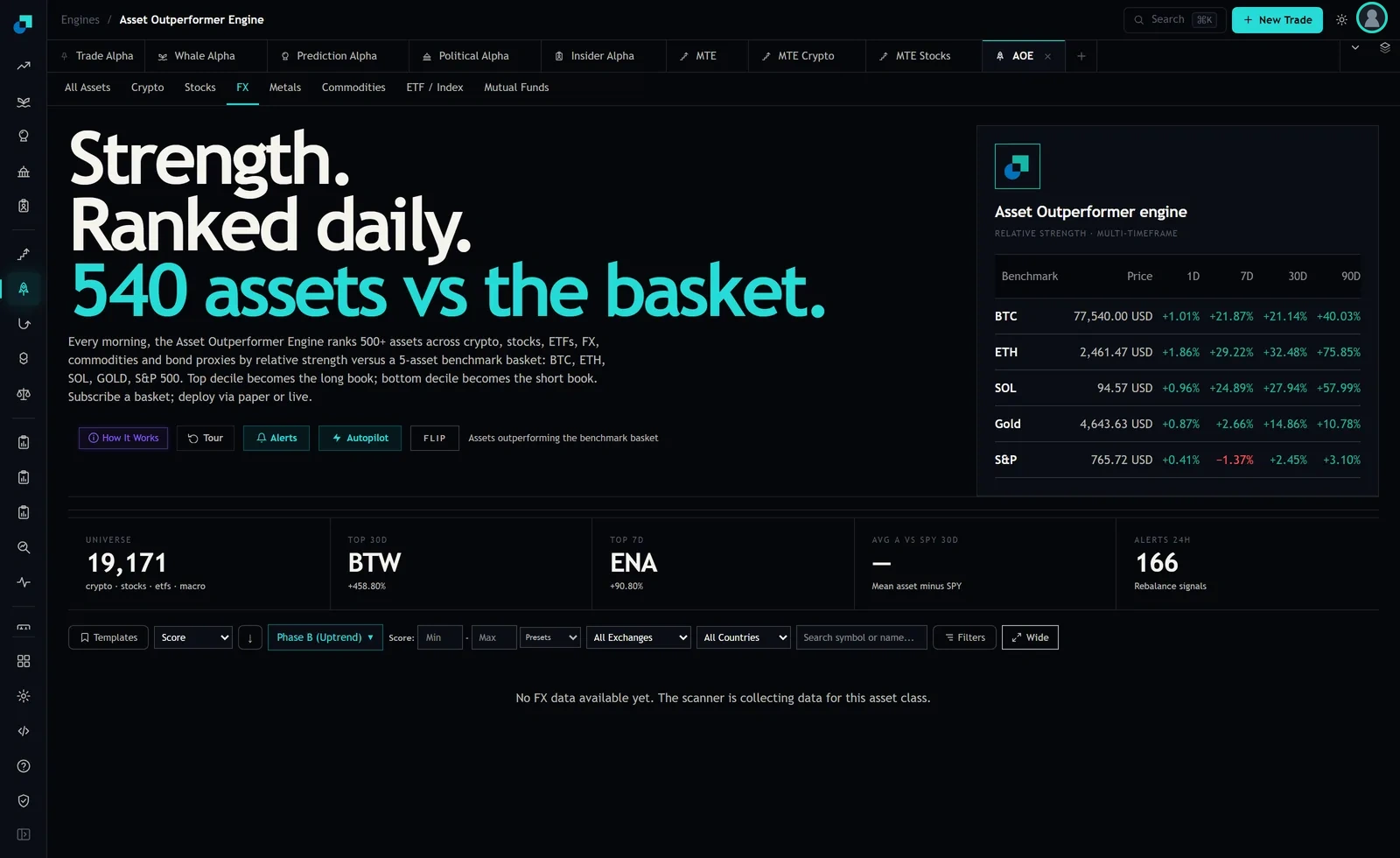
The phase field is real and it is visible on the populated tabs of this engine. Scored rows on the stocks board carry a PHASE B badge, and the toolbar filter that selects them is labelled Phase B (Uptrend), so the field is a categorical trend state attached to each ranked asset rather than a number.
The FX tab is a different situation. At capture, opening it returned a single line of text stating that no FX data is available yet and that the scanner is collecting data for this asset class. There were no currency rows, no scores and no phase readings. So there is no FX phase to map onto a hedge ratio today, and any policy that names one as an input is describing a future state of the product rather than a present one.
That is not a reason to stop. It is a reason to write the policy now, while there is no live signal to argue about, because a governance framework designed in the presence of a tempting number is a framework designed to justify acting on it.
Why the ratio has to be a band rather than a number
A categorical input mapped to a binary output is the version that fails. Hedged when the phase is negative, unhedged when it is positive, produces a book that flips its entire currency exposure on a state change in a field whose construction you do not control, with transaction costs and cash flow consequences on every flip.
The structure that works is a policy ratio with a permitted deviation band around it. Set the policy at whatever the mandate justifies on its own terms, fifty percent being the usual answer and the reasoning behind it being about regret symmetry rather than about forecasting. Then define an active range around it, say plus or minus twenty percentage points, with a hard floor and ceiling.
The signal then moves the ratio within the band and can never move it outside. A strong reading takes you to thirty percent hedged rather than to zero. A weak reading takes you to seventy rather than to a hundred. The book is never fully exposed to a single input being wrong, the turnover is bounded, and the size of the active bet is a number you can state to a client in one sentence.
Add a dwell time. A minimum holding period on any deviation, one quarter being defensible, stops the ratio tracking a field recomputed every six hours. The engine's scan cadence is a property of the engine. It should have no relationship to the cadence of a currency policy decision.
The tracking error arithmetic of being wrong
Before authorising any deviation, price it, because the number is usually larger than the committee expects and it is the number the deviation has to earn back.
Assume, and treat this as an assumption to be replaced with your own estimate rather than as a fact, that the unhedged currency exposure on the foreign portion of the book carries roughly eight percent annualised volatility. A deviation of twenty percentage points from the policy ratio is then an active currency position of twenty percent of that exposure, contributing on the order of 1.6 percent of annualised tracking error, before any correlation with the underlying assets.
Set that against the alpha budget. If the strategy is targeting three percent of tracking error in total, a currency deviation running at 1.6 is consuming half the risk budget on a decision that no part of the research process was built to make. That is the sentence that decides whether the deviation happens, and it should be computed before the signal is available rather than after it has printed something exciting.
The correlation term makes it worse or better and you have to compute it rather than assume it. Currency exposure that moves with the equity exposure adds more than the standalone number suggests, and exposure that moves against it can genuinely reduce total portfolio risk, which is the honest case for a lower policy hedge ratio in some books. Neither can be asserted from the phase field. Both come from your own covariance estimates.
The governance trigger, written before the signal exists
Specify five things and put them in the investment policy statement rather than in a research note, because a research note is not a control.
Who can move the ratio, and it should not be the person who reads the screen. The separation between the signal reader and the ratio setter is the only structural defence against a strong reading being acted on the morning it appears.
What evidence is sufficient. Two consecutive readings at the same state, not one, with the second at least a stated interval after the first. A single reading of a categorical field is indistinguishable from a data glitch, and on a series with no history there is no way to tell the two apart.
How far, and it must be a step size rather than a target. Ten percentage points per move, one move per quarter, is dull and defensible. Anything that lets the ratio travel the full band in one meeting has recreated the binary version with extra paperwork.
What reverses it. Deviations need an expiry, not just an entry rule. A deviation that has been open for four quarters without the reading changing is no longer a tactical position, it is a new policy ratio that was never approved as one, and it should either be ratified or closed.
And what the kill switch is. Name the conditions under which the framework is suspended and the ratio returns to policy automatically: a data outage, a run of readings that flip more often than the dwell time allows, or a drawdown attributable to the currency deviation that exceeds a stated figure. Write the suspension rule while nothing is going wrong.
What has to be true before a screen output touches the ratio
The last section is the one that will save the most money, and it argues against acting at all for a while.
A signal with no out of sample history has no demonstrated relationship to anything. The FX tab's own empty state says the scanner is collecting data, so when rows appear the series behind them will be days or weeks long. A hedge ratio is a multi-year decision with multi-year consequences. Moving one on a series that has not lived through a single regime change is not a tactical decision, it is an untested change to the risk profile of a client's book.
Set the bar explicitly and in advance so it cannot be negotiated later. A minimum length of live, timestamped, out of sample history before the field is eligible as an input. A requirement that the history include at least one meaningful currency drawdown, because a signal that has only been observed in calm conditions has told you nothing about the conditions the hedge exists for. A documented backtest that is honest about the fact that it is a backtest of a field whose construction is not disclosed to you.
Until those are met, run the framework with the input switched off. That sounds odd and it is correct. The band, the step size, the dwell time, the tracking error calculation and the governance trigger are all worth having regardless of what drives them, because most books lack them and would benefit today with the ratio pinned at policy. Build the machinery, leave the input port empty, and be able to show a client exactly what would have to be demonstrated before anything is plugged into it.