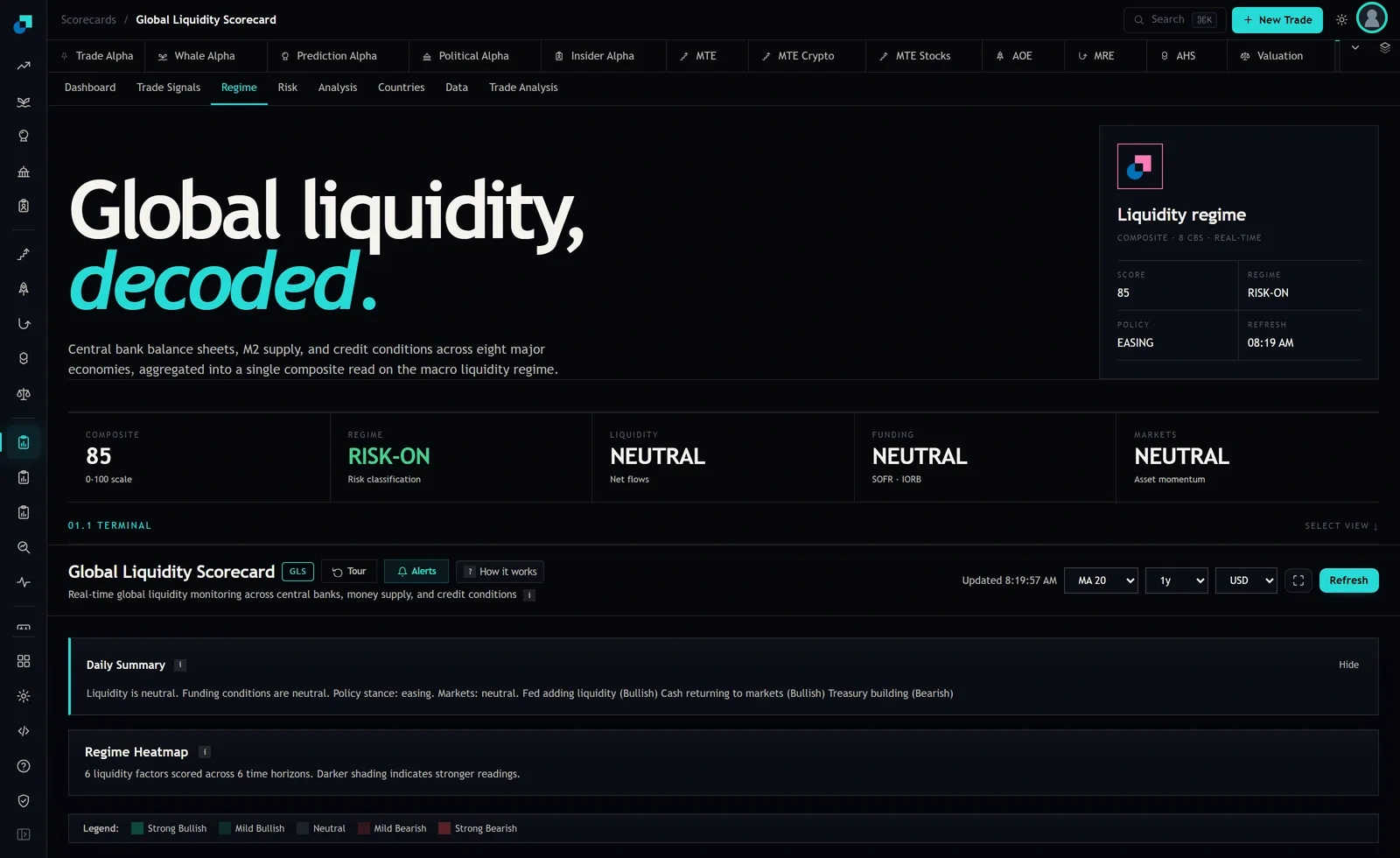
Three of the five fields on the Regime tab read NEUTRAL right now. LIQUIDITY, FUNDING and MARKETS, all three of them, sitting underneath a composite of 85 and a regime label of RISK-ON. The usual response to a screen like that is to decide there is nothing to do and come back next week. That response is a position. It is just an unpriced one, chosen by default rather than on purpose, and defaulting is how most of the damage gets done in a flat tape.
Neutral is a reading, not the absence of one
Look at the strip across the tab. COMPOSITE reads 85 on a 0 to 100 scale. REGIME reads RISK-ON under a sub-label of "Risk classification". Then LIQUIDITY reads NEUTRAL against "Net flows", FUNDING reads NEUTRAL against the SOFR and IORB relationship, and MARKETS reads NEUTRAL against "Asset momentum".
Those three are measurements that came back in the middle of their range. They are not missing data and they are not the module shrugging. Net flows are running near their normal pace. Funding is priced the way funding is priced when nothing is straining. Asset momentum is neither pulling nor dragging. Each of those is a fact about the world, and taken together they say the forces are roughly offsetting at the moment.
The Daily Summary panel below says the same thing in sentences and then does something more useful. It names three drivers with directions attached. Fed adding liquidity, marked bullish. Cash returning to markets, marked bullish. Treasury building, marked bearish. Two pushing one way, one pushing the other, and the net is the neutral you see above. That is a balance of live forces, which is a very different situation from a market where nothing is happening.
The waiting room has a price and nobody quotes it to you
Sitting out until the picture clears feels free. It is not.
Say you run a 20,000 dollar account and you decide to hold it all in cash until the composite and its three component reads agree. Two things are now true. The first is that you are fully exposed to the risk of the state resolving upward without you, and the cost of that is not a small slippage number, it is the entire move. The second is that you have no idea how long you are committing to, because the tab publishes the current state and no duration figure at all. There is no field anywhere on the Regime tab telling you how long a neutral read has historically run. You are signing a lease with no end date.
The mirror image is just as bad. Holding a full aggressive allocation through a neutral read because the headline says RISK-ON means you have sized against the least specific field on the screen while three more specific fields underneath it decline to confirm.
Both of those are decisions. The only difference between them and a deliberate neutral position is that a deliberate one has a number attached and a written reason, so you can tell later whether it worked.
What I actually hold through a neutral read
Split the account before you look at any dashboard, because the split is the part that has to be immune to whatever mood the screen puts you in.
Take the same 20,000 dollars. Fifteen thousand of it is core, and the liquidity read is not allowed to touch it. That is not conservatism, it is the mechanism that stops a wrong macro call from producing a drawdown big enough to make you abandon the process entirely. The remaining five thousand is the overlay sleeve, and the regime read is allowed to move that sleeve between fully deployed and cash.
A neutral read puts the sleeve at its midpoint. Twenty five hundred deployed, twenty five hundred in cash, and no additions. Not because the midpoint is clever, but because it is the only allocation that is consistent with what the screen is telling you. The reads are in the middle of their range. Your sleeve is in the middle of its range. If you find yourself wanting to hold the sleeve at zero while the panel prints neutral, the position you are expressing is a bearish one and you should say so out loud, because you are trading a view the dashboard does not support.
Within the deployed half, neutral is when I hold the boring end of my universe. Large, liquid, things I would be happy owning if the state persisted for another six months. Neutral liquidity is specifically not the environment where the illiquid end of the market gets rescued by a rising tide, because there is no rising tide in the reading.
The four things I stop doing while it lasts
The stops matter more than the holds, because a neutral read is where most retail accounts leak.
I stop adding on strength. A green week inside a neutral regime is not a confirmation, it is a green week. Adding to a position because it moved up, in a state where the momentum read is explicitly neutral, is buying your own recency bias.
I stop trading the flips. If the composite moves from 85 to 79 and back, that is not two decisions, it is zero. I require a changed component read to hold across two consecutive weekly checks before it moves my sleeve. In a genuinely balanced state the panel will wobble, and every wobble you trade costs spread and attention.
I stop widening the universe. The temptation in a flat state is to go looking for something that moves, and the places that move when nothing else does are the places with the worst liquidity. That is how a patient macro framework ends up holding a small cap position it cannot exit.
I stop checking daily. The header shows a refresh stamp of 08:19 AM and the module updates in real time, which is a genuine feature and a trap for anybody with a phone. The inputs the module lists include money supply series that do not move daily. Checking a slow composite eleven times a day does not give you eleven observations, it gives you eleven chances to talk yourself into something.
The thing that ends a neutral read, and where you will see it
Neutral does not usually break at the headline. It breaks underneath, at one of the driver tags, and by the time the composite has moved enough to change the top-line label the tag has usually been sitting there for a while.
So the weekly check is not the composite. It is the Daily Summary line and the three component reads. Write one row a week. Date, composite, regime label, policy label, the three component reads, and the driver tags with their directions. When one of the tags flips from bullish to bearish or the reverse, that is the event, and the question you ask is whether the flip holds next week.
Two consecutive weeks with the same changed tag moves my sleeve one step, from midpoint toward whichever end the change points at. One week does not. That rule is deliberately slow and it will occasionally cost me the first part of a move. What it buys is that I stop paying to react to a state whose defining feature is that it is balanced.
The other reason to keep the log is that you will eventually want to know how long these states run, and nothing on the screen will ever tell you. Six months of one row a week is the only version of that answer you will ever own.