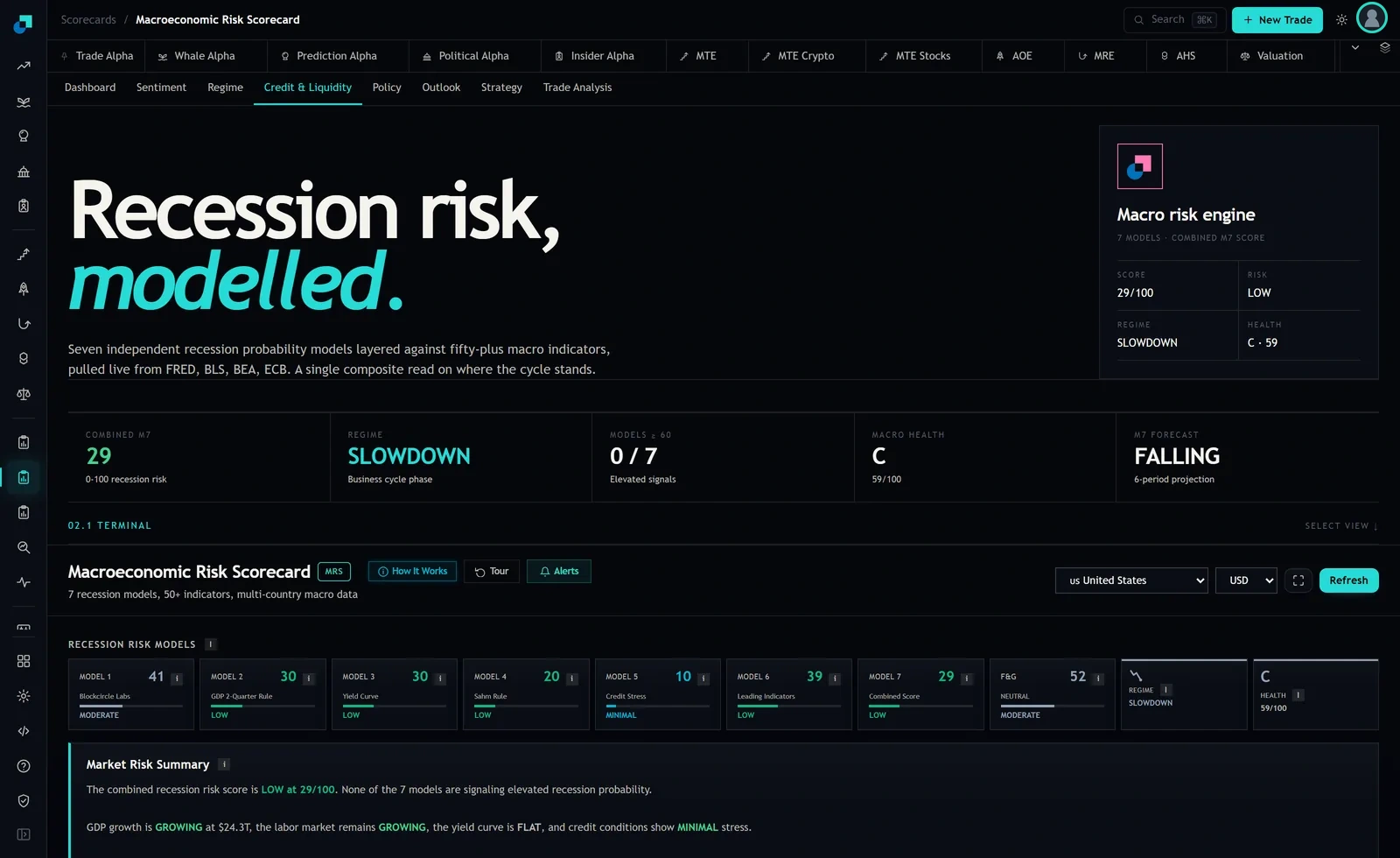
You have two screens open. One is the Macro Risk Scorecard on the Credit and Liquidity tab, where the Credit Stress model reads 10 out of 100 and the page describes credit conditions as showing minimal stress. The other is the funding rate on whichever venue you trade perpetuals on. The useful question is what to do when those two stop agreeing, because they will, and the answer is not the one most people reach for.
Before anything else, be clear about what is on which screen. The scorecard's coverage is macro data. Seven recession probability models over more than fifty macroeconomic indicators from FRED, the BLS, the BEA and the ECB, plus credit default swap spreads, high yield spreads, the dollar index, money supply and central bank balance sheets. Perpetual funding and the futures basis are not in that list. They come from your exchange, and pairing the two is something you do yourself with two tabs open, not something the credit tab does for you.
Two prices, two questions
A credit spread is the extra yield a borrower pays over a government benchmark. It moves when the market's view of getting paid back changes, and it also moves when the price of holding risk changes for reasons that have nothing to do with any particular borrower. It is a question about solvency and about the appetite to warehouse risk.
A perpetual funding rate is a payment between longs and shorts that keeps the contract tethered to spot. It moves when positioning gets lopsided. Positive and rising funding means longs are paying to stay long, which is a statement about crowding and leverage, not about anyone's ability to pay a coupon. The basis, the gap between futures and spot, is the same information in a different wrapper.
So they are not two measurements of one thing. They are measurements of two things that happen to be correlated during the specific episodes everyone remembers, which is precisely why treating one as confirmation of the other feels natural and is usually wrong.
The four combinations, and which one is actually rare
Two readings, each either calm or stressed, gives four cells. Each one means something different for a retail book.
- Credit calm, funding calm. The uninteresting cell and the one you are in most of the time. Nothing here justifies a change. It is worth writing down anyway, because a baseline you recorded while nothing was happening is what makes the next reading legible.
- Credit stressed, funding calm. The subject of this article. Traditional credit is repricing and crypto leverage is not responding. Most often this means the credit move is about something specific to credit markets, a supply wave, one troubled sector, a rates path being repriced, and it has not yet turned into a broad reduction in the willingness to hold risky assets.
- Credit calm, funding stressed. Almost always a crypto-native story. A crowded trade, a large liquidation, a token-specific event. The macro tab has nothing to say about it and you should not go looking there for an explanation.
- Both stressed. The cell that deserves respect. Two largely separate mechanisms pointing the same way is the closest thing to independent confirmation available to you, and it is genuinely uncommon.
The mistake I see most often is treating cell two as a countdown to cell four. Sometimes it is. Often the credit move resolves and nothing propagates. The disagreement is not a timer.
Why crypto leverage can stay calm through a credit scare
There is a structural reason this happens and understanding it stops you from waiting for a confirmation that is not coming.
Funding responds to the positioning of the people trading that contract right now. It is a fast, shallow, local measurement. If the crowd in perpetuals is not currently stretched, a widening in high yield spreads has no mechanical channel through which to move funding at all. Nothing forces it. The transmission from traditional credit to crypto positioning runs through people deciding to reduce risk, and people do that on a timeline of weeks, unevenly, if at all.
The reverse is also true and worth stating. A violent funding reset can happen in an afternoon with no macro input whatsoever, because all it takes is enough leveraged positions in one direction and a move against them.
Two instruments with different mechanisms, different participants and different speeds. Expecting them to confirm each other on a schedule is asking for a property neither one has.
What a disagreement is worth on a five figure account
Here is the part that touches your actual account, and it is smaller than the analysis above might suggest.
A credit warning that funding does not confirm is a reason to slow down, not to reverse. Concretely, on an account in the low tens of thousands, that means three things. Stop adding to the most speculative position, which is usually the smallest and most volatile thing you hold. Let incoming cash sit rather than deploying it on your usual schedule. And reduce leverage if you are carrying any, because leverage is the position that turns a disagreement between two screens into a forced decision made at the worst possible moment.
What it does not justify is selling core holdings and paying the spread, the fees and, in a taxable account, the realised gain to do it. On a five figure balance those costs are real money and they are certain, while the warning is a probability at best. If the disagreement resolves into cell four, you will have time to act then and you will act with better information.
The other genuinely useful move costs nothing. Write both readings down with the date, along with which cell you think you are in and what would move you to a different cell. Do it weekly. After a few months you will have a record of how often your reading of a disagreement was followed by anything at all, which is the only way you will ever find out whether this cross-check earns its place in your routine or is a habit that makes you feel informed.
The reading that should actually change your behaviour
If you take one operational rule from this, make it about cell four rather than cell two.
When the credit reading has climbed on the scorecard and stayed elevated across several weekly observations, and funding on your venue has independently moved to reflect a crowded and stressed position, you have two witnesses with different jobs telling the same story. That is the configuration where reducing risk is defensible in advance rather than in hindsight, and it is rare enough that you can afford to respond to it seriously when it appears.
Everything short of that is a single witness. The model row on the scorecard makes this concrete. Alongside Credit Stress at 10 you have the GDP two quarter rule at 30, the yield curve at 30, the Sahm rule at 20, leading indicators at 39 and a combined score of 29, with the models at or above 60 counter at 0 out of 7. One tile moving inside that row is a smaller event than it looks like when it is the only thing you are staring at, and the funding screen you opened to check it is answering a question the credit tile never asked.