Stablecoin supply is the most quoted number in crypto and, in the form it usually gets quoted, one of the least useful. "Stablecoin supply just made a new high" is passed around as a straightforwardly bullish input on the theory that more dollars on chain means more dollars available to buy. The theory is fine. The measurement is the problem, because total supply is a sum across three places that behave nothing like each other, and only one of them is money that can hit a bid this week.
The three places are stablecoins sitting on exchanges, stablecoins locked into DeFi positions, and stablecoins sitting idle in wallets. Same token, same dollar peg, three completely different meanings for your positioning. Sorting the figure into those buckets sometimes reverses what the headline told you.
Only one bucket can bid on Tuesday
Start with exchange balances, because this is the bucket the phrase "dry powder" is actually about. A stablecoin sitting in an exchange account is one click from a market order. No approval, no bridge, no unwind, no gas decision. If that balance is growing, someone has moved money into position to buy and has not bought yet. That is a genuine forward-looking read, and it is the only one of the three that is.
DeFi-locked stablecoins are the opposite. A stablecoin supplied to a lending market, sitting in a liquidity pool, or posted as collateral against a borrow is money that already has a job. It is earning a yield its owner chose over the yield of holding your favourite token. To buy with it, that owner has to notice, exit the position, accept whatever exit friction exists, and then move it. Growth in this bucket is not pent-up demand for altcoins. It is closer to the reverse. It is capital that has looked at altcoins and preferred a rate.
Idle wallet balances are the ambiguous middle and the biggest bucket by count of addresses. Some of it is genuine sidelined capital. A lot of it is not capital at all in any sense you can trade against. It is treasury float, market maker inventory that is already spoken for, cross-border payment balances, exchange cold storage attributed to a non-exchange label, and dust. This bucket is where most of the confident narratives get built, and it is the bucket where confidence is least warranted.
What the On-Chain tab hands you and what it does not
I want to be exact about this rather than let you assume a control exists. The scorecard's On-Chain tab, as it stands, opens on an On-Chain Health Score of 84, labelled Very Strong, with four component bars underneath reading Hash Rate 100, Active Addr. 36, Tx Volume 100 and Miner Rev. 100. That is a network-health composite. It is not a stablecoin venue breakdown, and there is no three-way exchange/DeFi/idle split on the screen for you to read off.
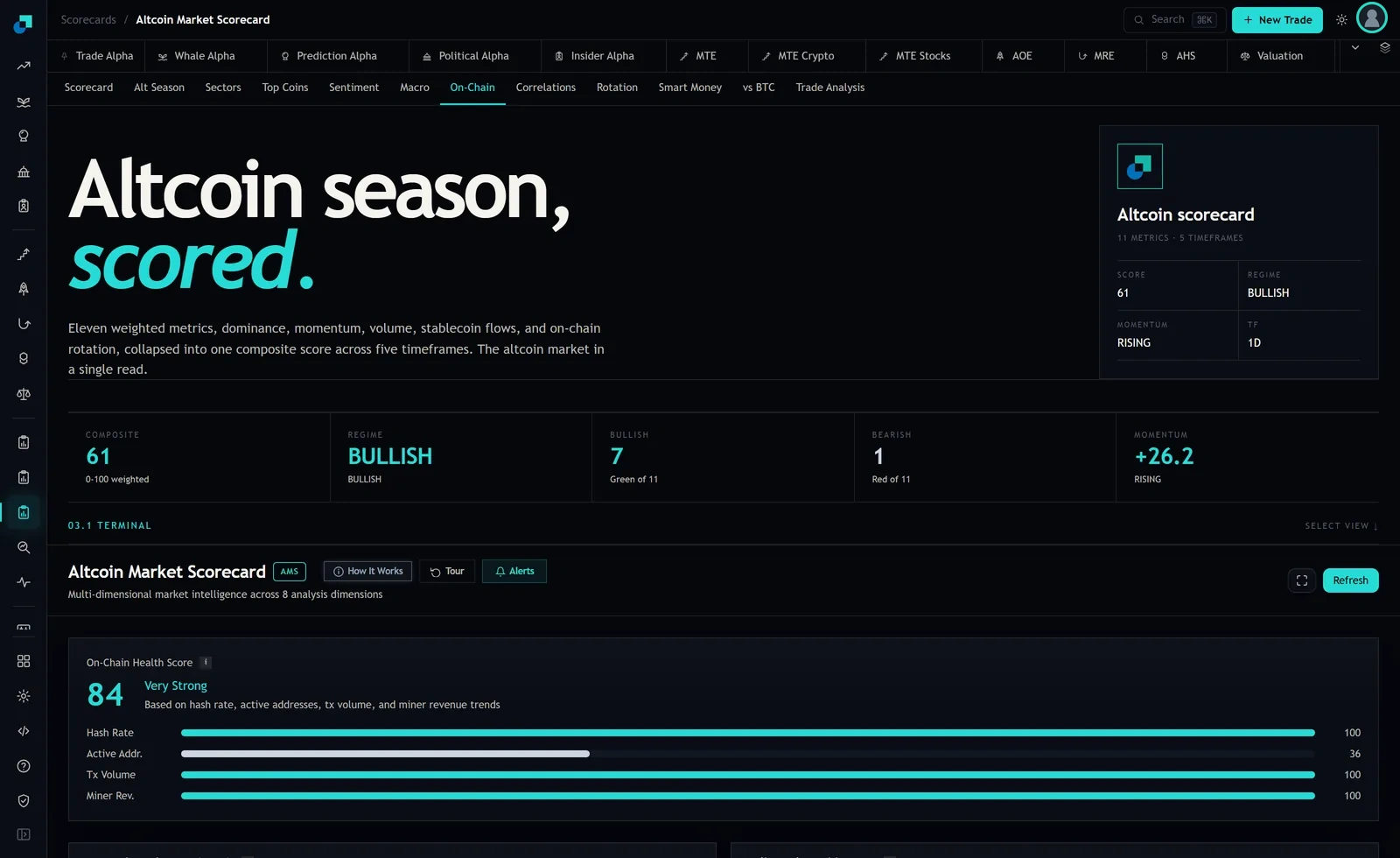
What the module does do with stablecoins is fold them in higher up. Stablecoin Flows and Exchange Reserves both appear in the eleven weighted metrics behind the headline composite, which on this capture reads 61 with a Bullish regime, 7 of 11 metrics green, 1 red and momentum at plus 26.2. So the flow information is in the score. It is just already blended, weighted and collapsed by the time you see it, which is exactly what a composite is for and exactly why a composite cannot answer a question about location.
That leaves you with a decision to make rather than a panel to read, so here is how I make it.
The same rising line, three readings
Suppose total supply is up meaningfully over a month. Before you treat that as fuel, work out which of these three it is.
- Rising, concentrated on exchanges. Buying power has been staged. This is the version that deserves the bullish reading, and it is the version that decays fastest, because staged money either gets deployed or goes home within weeks.
- Rising, concentrated in DeFi. Yields somewhere have gone up and capital chased them. This tells you about rate competition, not about appetite for risk assets. Read it as a headwind for the tokens competing with those rates, not a tailwind.
- Rising, concentrated in idle wallets. Usually the least informative of the three and often the most mechanical. New mints frequently land in issuer or market maker wallets before they go anywhere. A supply high that never leaves those wallets is an accounting event.
The trap is that the headline chart looks identical in all three cases. One line, going up. Every downstream conclusion depends on a breakdown the line does not contain.
How to build the split without a dashboard that does it for you
You do not need anything exotic. You need a public block explorer with address labels and about twenty minutes, once a month, for the one or two stablecoins that actually matter to your market.
Take the issuer's total supply for the chain you care about. Pull the labelled exchange addresses and sum them. That is bucket one. Pull the major lending and AMM contract balances for the same asset and sum those. That is bucket two. Everything left over is bucket three by subtraction, and you should treat it as a residual rather than as a measured quantity, because that is what it is.
Then write down three numbers, dated, in a file you keep. The absolute levels are close to meaningless on their own. The changes are the point. Next month you compare, and what you are looking for is not "supply is up" but "the exchange bucket is up 9 percent while the other two are flat", which is a completely different sentence and one you can act on.
Two warnings from doing this badly. Label sets are incomplete and they lag, so an address that quietly became an exchange wallet last quarter will sit in your idle bucket and inflate it. And multi-chain assets will double count you into nonsense if you sum across chains without checking how the bridged versions are represented, which is a large enough problem to deserve its own treatment.
When the split changes what I do and when it changes nothing
Be honest about the size of the edge here, because it is real but narrow. This is a conditioning variable, not a trigger. I have never bought a token because exchange stablecoin balances rose, and I would be suspicious of anyone who says they have.
What it does change is sizing at the margin and how much weight I give to a bullish composite. When the scorecard is bullish and the growth in stablecoins is sitting on exchanges, the two agree and I am comfortable at my normal size. When the scorecard is bullish and the stablecoin growth is all locked in DeFi at an attractive rate, those two facts are in tension, and tension is a reason to be at the low end of my range rather than the high end.
And when the growth is all in the residual bucket, I do what the data deserves, which is nothing. A number I built by subtraction, out of addresses nobody has labelled, is not strong enough to move money. Saying so is more useful than dressing it up.