A single-index de-risking rule has one structural weakness that no amount of threshold tuning repairs. It fires once, on one series, and by the time that series has moved enough to clear a threshold set high enough to avoid constant false positives, the repricing is already well advanced and your exit is competing with everybody else's.
Splitting the credit read into two stages addresses that directly, provided the two series actually reprice in a stable order. The title of this piece states the ordering as a fact. It is better treated as a hypothesis, and the first half of this article is about deciding whether it holds in your data before you build anything on it.
What a single credit tile can and cannot resolve
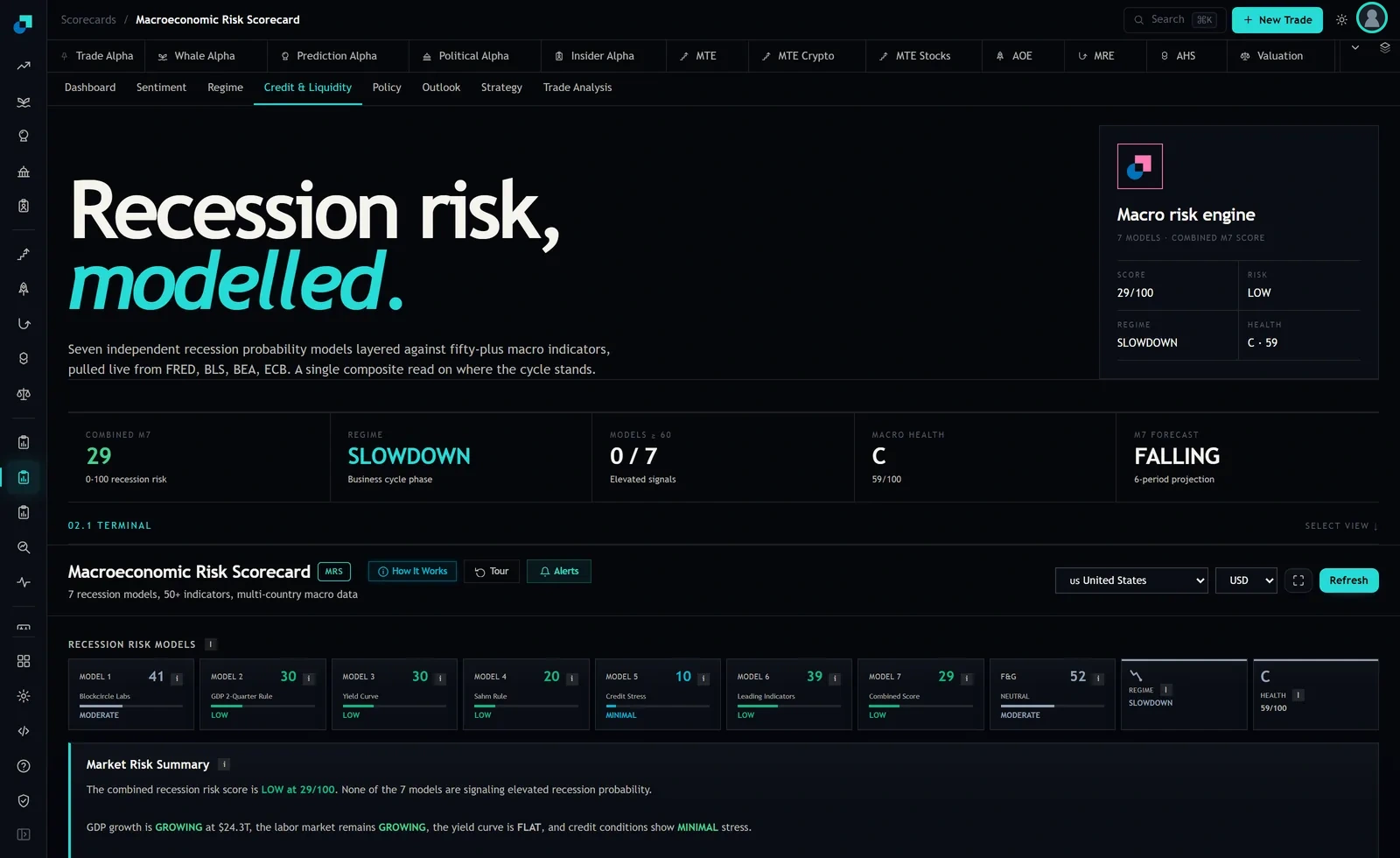
The Macro Risk Scorecard collapses credit into one model slot. At the time of writing the Credit Stress tile reads 10 and is tagged MINIMAL, sitting alongside 41 from Blockcircle Labs, 30 on the GDP two quarter rule, 30 on the yield curve, 20 on the Sahm rule, 39 on leading indicators and a combined score of 29. The module's stated coverage names credit default swap spreads and high yield spreads among its inputs.
That design is right for what the scorecard is doing, which is producing a comparable cross-model read. It is the wrong granularity for a sequencing rule, because a composite by construction cannot tell you which of its components moved first. If your investment process depends on ordering, the ordering has to be reconstructed from the underlying series outside the composite. I would rather say that plainly than imply the tile resolves something it does not.
Use the tile for what it is good at: a stable, comparable state read that sits in your monthly pack and gives the investment committee a consistent reference point across meetings. Build the sequencing work separately, from the index series themselves.
Two competing stories, pointing in opposite directions
There is a respectable structural argument for investment grade moving first. The holder base is mandate-constrained and benchmark-driven, much of it operating under rules that force action on ratings and duration rather than on discretion. Those holders reprice on process, and process is fast and mechanical. Investment grade is also more rate-sensitive, so a repricing of the policy path lands there first and arrives in high yield only once the growth implication is drawn.
There is an equally respectable argument the other way. High yield behaves more like equity, its holders are more discretionary and more willing to move on a view, and the marginal issuer in that index is the one whose refinancing arithmetic breaks first. On that story, high yield is the early warning and investment grade is the confirmation that the problem has become systemic rather than idiosyncratic.
Both stories are coherent. They cannot both be right about the same period, and which one dominates plausibly depends on whether the shock originates in rates or in growth. That conditionality is the reason to measure rather than to assume, and it is also the reason a rule fitted on one kind of episode will disappoint in the next.
Establishing the ordering before you trade on it
The protocol is short. The discipline is in fixing the choices in writing before the first chart is drawn.
- Choose one investment grade option-adjusted spread series and one high yield series, both published and both with long histories. Write down which ones and never silently swap them, because a change of index is a change of experiment.
- Define an episode mechanically: a widening of at least a stated number of basis points from a trailing low, within a stated window. Both numbers go in the document before you look.
- For every episode, record the date each series first crossed its own threshold and take the difference in days. You now have a distribution of lead times, not a lead time.
- Report the sign consistency, meaning the fraction of episodes where the ordering ran the way your rule assumes. A rule built on an ordering that holds in six cases out of ten is a coin flip with extra steps.
- Split the sample by whether the episode coincided with a large move in rates. If the ordering flips between the two buckets, you have learned the most valuable thing in the exercise and your trigger needs a conditioning variable.
Two hazards to name explicitly. Option-adjusted spreads on the two indices are computed against different duration profiles and different call structures, so a mechanical threshold in basis points is not equivalent risk across the two. And index composition drifts as issuers are upgraded and downgraded, which means a widening can reflect migration rather than repricing. Both are documentable adjustments and neither is a reason to abandon the work.
The two-stage trigger and the parameter that decides everything
Assume your measurement supports an ordering. The structure is then straightforward: stage one fires on the leading series and reduces exposure partially, stage two fires on the confirming series and completes the reduction.
The design parameter that matters is not either threshold. It is the size of the first tranche. That single number encodes the trade you are making between acting early on a noisier signal and acting late on a cleaner one, and it should be set from your measured sign consistency rather than from comfort.
The arithmetic is worth doing explicitly for the committee. If stage one fires and the ordering holds, you have exited a portion of the position before the crowded part of the move, and the saving is the difference between the two execution levels applied to that tranche. If stage one fires and nothing follows, you have paid round-trip transaction costs on that tranche plus whatever the position earned while you were out. Set the tranche where the expected saving covers the expected cost at your measured hit rate, and write the calculation down. It is the artefact you will need when someone asks why the rule exists.
Add an expiry. If stage two has not fired within a stated number of days, the stage one reduction reverses automatically. Without an expiry, a two-stage rule quietly becomes a one-way ratchet that leaves the book underweight after every false alarm, and that drift will not show up in any single decision.
Capacity, crowding, and the case where this stops working
The premise of acting on the first series is that you are ahead of the flow. That premise is size-dependent. A tranche that clears in an afternoon at normal cost in calm conditions can take days at materially wider levels once a widening is under way, and credit is a market where liquidity thins precisely when the rule wants you to transact.
Measure the capacity before you commit to the rule, not after. Take the tranche size, look at the traded volume in your chosen instruments during previous stressed windows, and form a view on what fraction of a day's volume you would represent. If the answer is uncomfortable, the honest fix is a smaller tranche or a more liquid expression, not a wider threshold.
Crowding is the second-order version of the same problem. A sequencing rule that becomes widely adopted compresses the lag it depends on, because participants act on the leading series in anticipation. The edge in this kind of rule is not permanent and the measurement should be repeated annually with the same fixed definitions, so that a compressing lead time is visible as a trend rather than discovered during an episode.
What goes in the file
Everything above exists so that a decision taken under pressure can be explained afterwards without reconstruction. Three documents do that work.
The specification: index choices, thresholds, tranche size, expiry, conditioning variable, all dated, with the version history preserved. The evidence: the episode table, the lead time distribution, the sign consistency, the sub-sample split, and the date the measurement was last refreshed. The log: every firing, whether stage two followed, the executed levels, and the realised cost in basis points against a no-action counterfactual.
The third one is the document that gets skipped and it is the one that determines whether the rule survives its first bad year. A two-stage trigger will produce false alarms by design, and a committee that has been shown the expected false alarm rate in advance, in writing, responds to the third one very differently from a committee meeting it for the first time.