Take the same list of insider clusters and sort it two ways. Sort by the number of distinct people who bought, and the top of the list is a set of companies where four or five different insiders each committed a modest amount. Sort by aggregate dollars, and the top is a set of companies where one person wrote a very large cheque. These are not two views of the same thing. They are two different signals that happen to share a data source, and the one you put at the top of your screen determines what you spend your week looking at.
My answer, for an account measured in thousands rather than millions, is to rank on breadth and use dollars as a filter rather than as the sort key. Here is the reasoning, including where it is wrong.
What a dollar ranking is actually sorting on
Aggregate dollars is a sum, and sums are dominated by their largest term. In practice a dollar-ranked cluster list is a list of single large purchases with a few small ones attached, and the large purchase usually comes from one of two kinds of buyer.
The first is a ten percent owner, which is frequently a fund rather than a person. A fund adding to a position it already holds is executing its own mandate. It may have a thesis, but the thesis is portfolio construction, and it can be an index-tracking mechanic or a follow-on from a financing round the fund participated in. The second is a chief executive on a large package, where a two million dollar purchase is a smaller share of their net worth than a fifty thousand dollar purchase is for a non-executive director.
Neither is worthless. Both are one decision by one person, and one decision is easier to be wrong about, easier to be motivated by something other than the business, and easier to arrange for appearances.
What breadth is worth and how it fools you
Breadth counts independent decisions. Four directors buying in the same quarter is four separate people, each with their own money, their own tax situation and their own reason, arriving at the same conclusion within a few weeks of each other. That is harder to arrange and harder to rationalise as coincidence than one large purchase.
It fools you in three specific ways, and you can defend against all three.
The first is that the buys were not independent at all. A board sits through the same presentation, opens the same trading window after the same earnings release, and buys in the same week. That is one piece of information reaching four people, not four judgements. It is still a real signal, but it is one signal, and you should size it as one.
The second is related parties counted as separate filers. An insider and their spouse's account, an insider and a family trust, two entities controlled by the same person. A naive count of filings inflates breadth. Count people, not filings, and read the ownership footnotes when a name looks duplicated.
The third is compensation mechanics leaking into the count. Vesting dates are shared across a cohort, so a whole executive team can appear to acquire shares in the same week for reasons that have nothing to do with conviction. Restrict the count to code P, open-market purchases, and this problem mostly disappears.
The reconciliation, dollars measured against something
Neither ranking is useful in the raw. Dollars only mean something relative to a denominator, and there are two denominators worth the trouble.
The first is the person. A director's purchase compared to their previous purchases, and to their existing holding, tells you whether this is a habit or a departure. The Form 4 gives you shares owned following the transaction, so the arithmetic is available on the filing itself. Someone increasing their holding by half is making a statement. Someone adding two percent to a large stake is topping up.
The second is the tape. Compare the cluster's total dollars to the stock's average daily dollar volume. A cluster totalling a tenth of one day's volume is a rounding error that will not move anything and that most of the market will never notice. A cluster totalling several days of volume in a small cap is a meaningful share of the available float changing hands into hands that do not usually sell. That second case is rarer and it is where I have found the setups worth taking.
Run both denominators and the two rankings converge more than you would expect. The clusters that look good on breadth and also clear a size-relative-to-volume test are a short list, which is the point.
What the base rate says, and what it does not
Be clear about what any of this can deliver. The module's own performance view, at the time of writing, scored 20,000 filings and showed a seven day forward return of +0.25% against SPY at +0.07%, with a win rate of 46%. The longer horizons had no scored filings behind them at all. Read that as the honest base rate for an undifferentiated insider filing, which is close to nothing, and understand that every ranking decision in this post is an attempt to select a subset that behaves differently from that average.
Nobody can promise you the subset does. What you can do is make the selection rule explicit, write it down before you look, and keep a record of what it showed you and what happened next. The alternative, which is what most people actually do, is to scroll a dollar-sorted list and take whatever is at the top, which is a rule too, just an unexamined one.
The setting to change this week
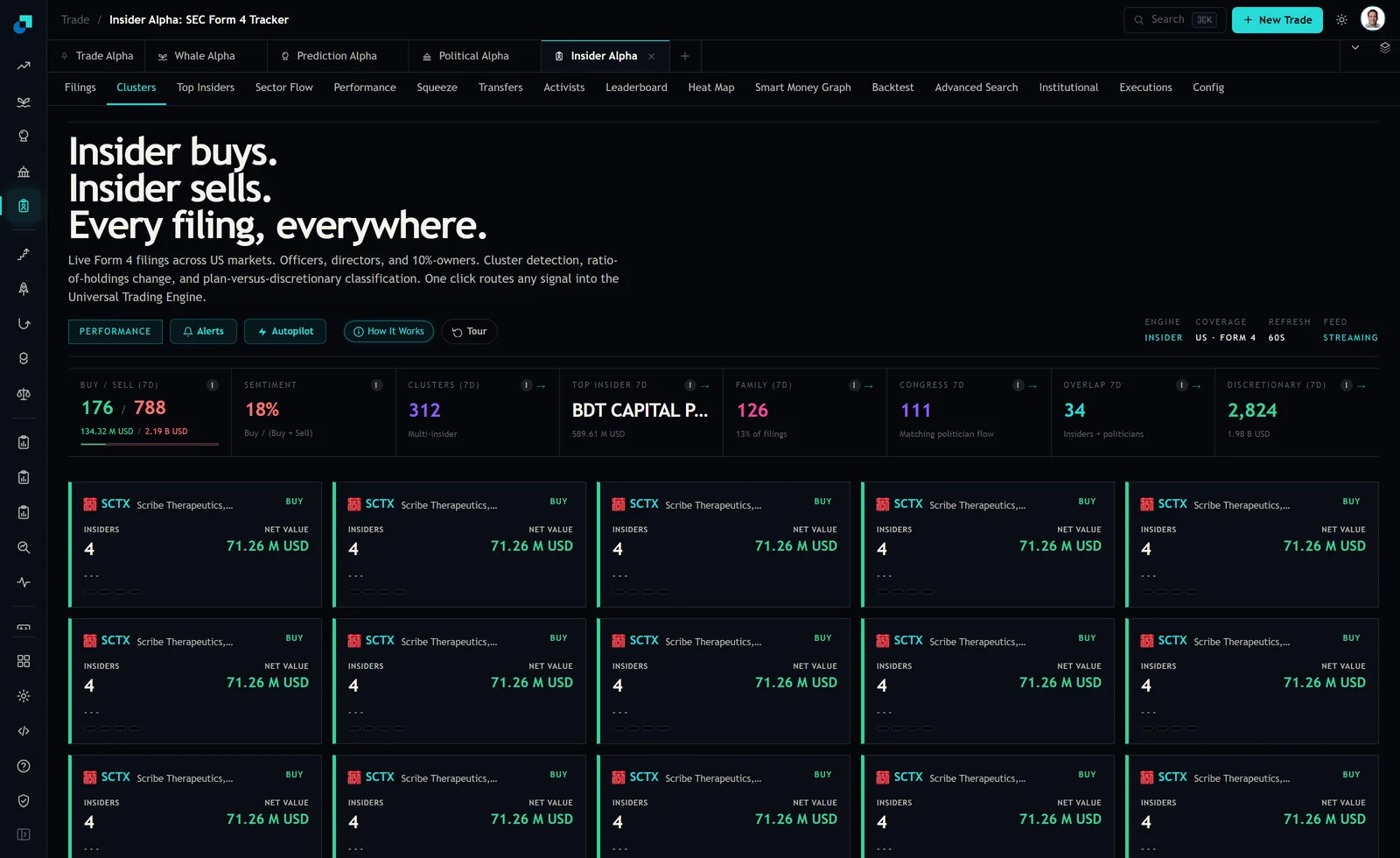
Change your default sort from aggregate dollars to distinct buyers. Then apply, in this order, a code P restriction, a minimum of three distinct people counted as people rather than filings, and a total cluster value of at least a few days of the stock's average dollar volume. What survives will be a handful of names a week, sometimes none.
Keep one column for the dollar figure anyway, because it still matters for one practical reason. If the cluster total is small relative to the stock's daily volume, then whatever the insiders know, the market can absorb your entry and theirs without either of you moving the price, and your fill will look like the quote. If the cluster is large relative to volume, expect the opposite, and expect it on the way out as well.