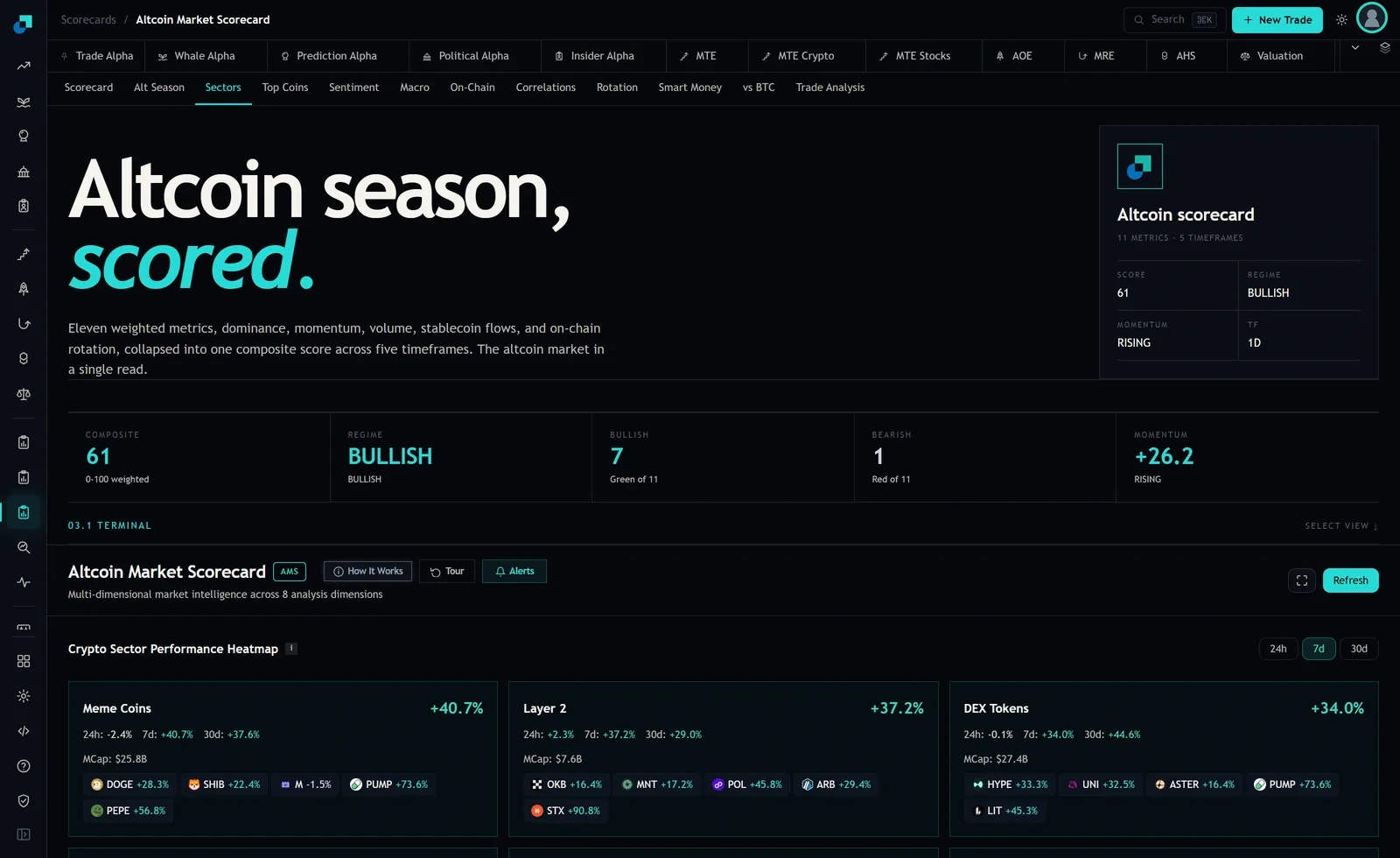
Open the Sectors tab on the altcoin scorecard with the timeframe toggle on 7d and the first three cards read Meme Coins +40.7 percent, Layer 2 +37.2 percent, DEX Tokens +34.0 percent. Three sectors, three green numbers, one comfortable conclusion: the alt market is broad and you should be in it. Then read the constituent chips underneath each card. PUMP is listed at +73.6 percent inside Meme Coins. PUMP is listed at +73.6 percent inside DEX Tokens. Same token, same number, two rows.
That is not a bug and it is not dishonest. It is what a sector label is: an opinion about what a thing is, and PUMP has a plausible claim to both descriptions. But it changes how much information those three cards carry, and it is the cleanest available demonstration of the difference between a bucket that is real and a bucket that is a marketing category with a percentage attached.
One token, two cards, two confirmations you did not earn
Here is the practical damage. You are deciding whether to add alt exposure. You look at the heatmap, you see meme coins strong and DEX tokens strong, and you register that as two independent signals pointing the same way. They are not independent. At least one name is inside both, and it is the strongest name on either card by a wide margin. Strip PUMP out of the picture and you have not lost one data point out of ten, you have lost the single largest contributor to two separate rows.
Only three cards fit on the screen at capture, so two overlapping memberships is a floor rather than a count. If you scroll the full heatmap and check every chip against every other card, expect to find more. Tokens that are simultaneously an L1 and an L2 story, exchanges tokens that are also DEX tokens, AI labels applied to anything with a GPU in its documentation. Nobody is being sneaky. Labels are just cheap, and there is no rule anywhere that a token belongs to exactly one of them.
Three buckets, three completely different naming principles
Look at what each of those three labels is actually naming, because they are not the same kind of thing.
DEX Tokens is named after a business. The members are tokens attached to venues where people trade, and venues where people trade collect something when volume goes up. Whether any individual token in that bucket captures that revenue is a separate question you have to answer name by name, but at least the bucket points at a mechanism that a change in the world would run through.
Layer 2 is named after a technical architecture. That is one step further from a cash flow. Two tokens can share an architecture and have nothing in common commercially, because the interesting question for an L2 is who uses it and what they pay, not what its proof system is. The bucket tells you what the software is. It does not tell you what the demand is.
Meme Coins is named after the absence of a mechanism. That is not an insult, it is the definition. The bucket's shared driver is attention, and attention is real and it moves prices, but it does not aggregate the way revenue does. The card reads +40.7 percent for the week and inside it one member reads minus 1.5 percent while another reads +73.6 percent.
The two questions that separate a bucket from a hashtag
I run these two, in this order, on any sector label before I let it into a decision.
Question one: if this label were deleted tomorrow, would anything about the tokens inside it change? If a bucket is real, deleting the name does not delete the shared driver. Trading venues still compete for the same order flow whether or not anyone calls them a sector. If a bucket is marketing, the label is the only thing the members share, and deleting it leaves you with a list of unrelated tokens that happened to be tagged during the same news cycle.
Question two: can I name the one thing that would move every member at once, in a sentence, without using the sector name in it? This is harder than it sounds and it is the question that does the work. For a venue bucket you can say it: total trading volume across on-chain venues. For an architecture bucket you struggle, because the honest answer is usually a different sector's demand. For an attention bucket you cannot do it at all without circling back to the label itself, which is the answer.
A bucket that fails both questions is not useless. It is a sentiment gauge. Meme coin performance is a genuinely informative read on how much risk appetite is loose in the market, and I look at it for exactly that. What it is not is an exposure you can size, because there is no shared driver underneath it to be right or wrong about.
Bucket size decides what the percentage means
The cards also print a market capitalisation, and it changes the reading more than most people notice. Meme Coins shows a combined 25.8 billion dollars. DEX Tokens shows 27.4 billion. Layer 2 shows 7.6 billion.
A 37 percent week in a 7.6 billion dollar bucket and a 40 percent week in a 25.8 billion dollar bucket are not the same event. The smaller bucket needs far less capital to move, which means the percentage is a weaker piece of evidence about how much money is arriving. It also means the percentage is more fragile, because a bucket that small can be dominated by one name having a week. Layer 2 shows STX at +90.8 percent against members at +16.4 and +17.2 percent, which is exactly that shape.
So when you compare cards, compare like sizes. Ranking a 7.6 billion dollar bucket against a 27.4 billion dollar bucket on percentage alone quietly ranks them on how easy they are to move.
What to do with a bucket you have decided is marketing
Three concrete changes, all of which you can make this week.
First, before you use two green cards as confirmation of each other, check the chips for overlap. It takes fifteen seconds. If the strongest name appears twice, treat the two cards as one observation, not two, and be especially careful if that name is already in your account.
Second, decide in advance which buckets you are willing to hold as exposure and which you only read as a mood gauge. Write the list down, because the temptation in a strong week is to promote an attention bucket to an investment thesis on the strength of the percentage. If you cannot answer question two for a bucket, it does not get position size, it gets attention.
Third, when you do buy inside a bucket you consider real, buy the mechanism rather than the label. In a venue bucket that means asking which of those five names actually earns from volume and on what terms, one name at a time, from the project's own documentation. The heatmap is a map of where money moved last week. It was never a claim about why, and the label on the card is the part of it that carries the least information.