There is a particular kind of wallet that sits at the top of every volume ranking I have ever looked at, and it has never once made me a dollar. It pushes eight figures through itself in a week. It touches several venues. It has never had an opinion about anything. It is a market maker, an operations wallet, or somebody's arbitrage loop, and the tile that promoted it to the top of my screen was measuring the single property of a wallet that is least connected to whether the person behind it is any good.
This matters because a mover tile is the most eye-catching thing on a whale page and the easiest to misread. It looks like a leaderboard. Leaderboards rank people by how well they did. A volume tile ranks them by how much they did, which is a different question with a different answer, and the gap between those two questions is where most of the money gets lost by people who think they are following smart money.
What a volume ranking is actually measuring
Gross volume over a window is the sum of the notional value of every fill a wallet put on, in both directions. A wallet that buys two hundred thousand dollars of something and sells it back an hour later for two hundred thousand dollars has moved four hundred thousand dollars and made nothing. If it does that fifteen times a day, it has moved six million dollars and still made nothing, minus fees. Nothing in the arithmetic subtracts. There is no penalty for round tripping, no adjustment for holding period, and no sign attached to the result.
Whale Alpha is explicit about this if you read the module's own list of what it ranks wallets on. Realised PnL across the selected period is one entry. Cross-venue aggregate exposure is a separate entry. Win rate and average return per trade is a third. Those are three different columns because they are three different facts, and a tile headlining flow is reading the exposure family, not the PnL family. The product is not hiding anything. The reader is just collapsing three measurements into one impression.
The wallet that tops the list every week
Profile the repeat offenders and they fall into a few types. The first is the maker: quotes both sides, holds nothing overnight, earns a spread that is invisible in position data because it never appears as a directional bet. The second is the router: a bridge, an exchange hot wallet, or a treasury address that moves size on behalf of other people entirely. The third is the leveraged churner, which is the dangerous one, because it does have directional opinions, it does take real risk, and its volume is inflated by leverage rather than by capital. A wallet running ten times leverage on a hundred thousand dollar account generates the same weekly flow as an unlevered million dollar account and carries a completely different survival profile.
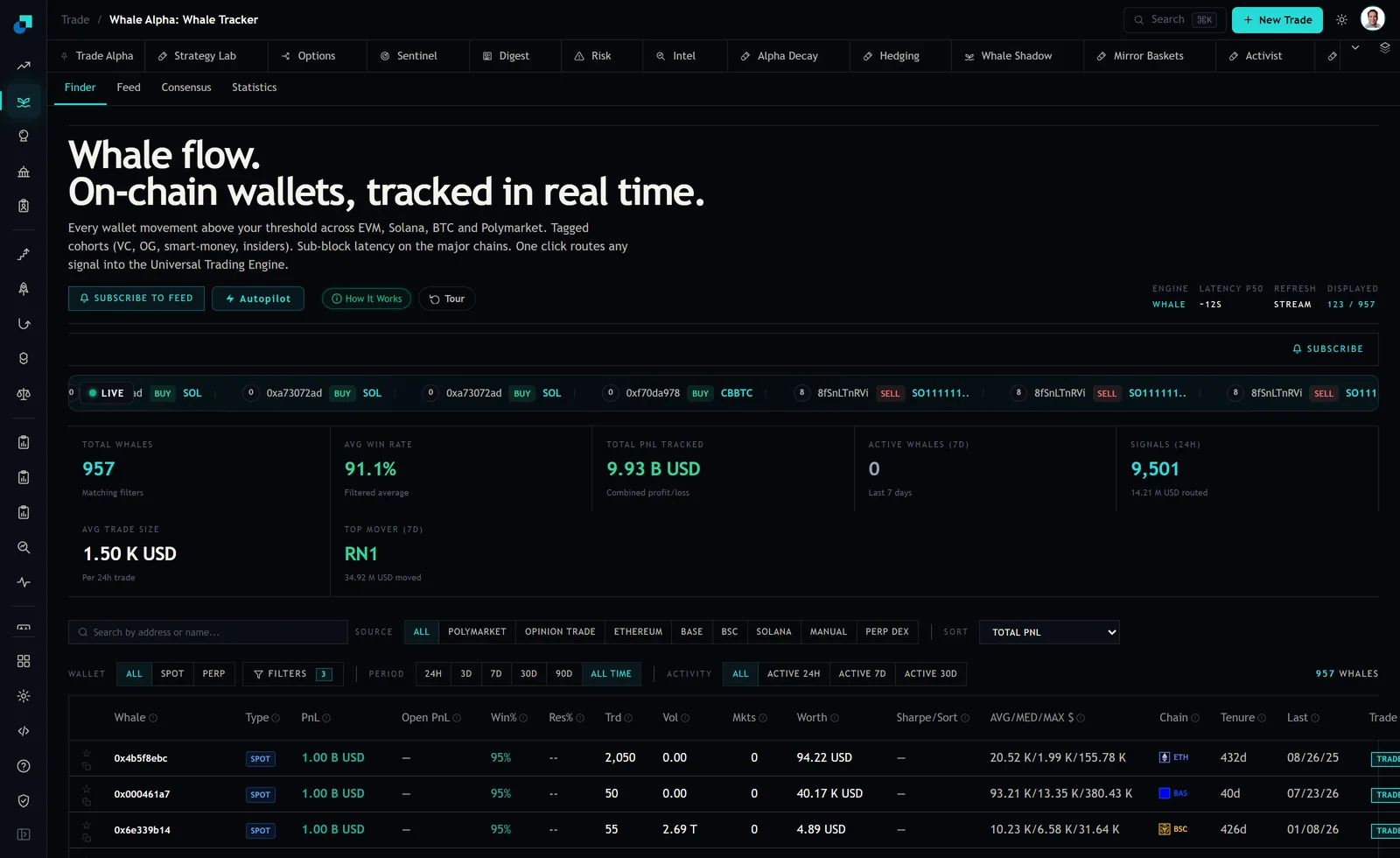
Look at the ticker in that screenshot for a moment. The rows are individual actions, a buy here, three sells there, from addresses shown truncated to eight characters. Nothing in a stream of fills tells you whether the wallet behind them is up or down. That is the whole problem in one image. Flow is visible instantly and cheaply. Profit is not visible at all until somebody computes it over a defined window, and the window changes the answer.
Fifty prints and twelve and a half million dollars
The Feed tab gives you a clean worked example. At capture its twenty four hour tile read 12.5 million dollars of total whale volume across 50 transactions, from 28 active wallets. Divide it out. That is an average print of about 250,000 dollars and fewer than two prints per wallet per day.
Now ask what you actually learned. You learned that the tracked cohort was awake and that the typical action was a quarter of a million dollars. You did not learn the direction, because entries and exits both count. You did not learn the outcome, because an exit at a loss adds exactly as much to that 12.5 million as an exit at a profit. And you did not learn concentration, because one wallet doing twenty prints and twenty wallets doing one each produce the same headline.
The same page carried an average whale win rate of 12.1 percent for that window. Twelve percent. Sitting directly underneath a twelve and a half million dollar volume figure. If the volume number were telling you anything about quality, those two tiles would not be able to coexist on one screen.
Four questions that turn a mover into a candidate
When a wallet catches my eye on flow, it does not go on a follow list. It goes through this, and most of them do not survive it.
- Is the realised PnL over the same window positive, and by how much relative to the volume? A wallet that moved four million dollars to earn eight thousand is a fee business, not an opinion. I want the PnL to be a meaningful fraction of the flow, not a rounding error on it.
- What does the holding period distribution look like? If the mass sits under an hour, whatever edge exists there is latency edge, and you are not going to get it through a feed with a twelve second median. Positions measured in days are the ones a retail follower can physically act on.
- How many trades produced the PnL? One enormous winner and forty small losers is a lottery ticket that already paid. The win rate and average return per trade columns are there precisely so you can catch this.
- What does the risk classification say about concentration, leverage and drawdown? A high flow wallet flagged for leverage is telling you the volume is borrowed, and borrowed volume is exactly the kind that stops appearing one week without warning.
The check that kills the most candidates is the first one. Volume divided into PnL is a crude efficiency ratio and it separates the two populations almost immediately. Makers and routers sit near zero. Directional wallets with an actual read sit somewhere you can see with the naked eye.
What the mover list is genuinely good for
I have not stopped looking at flow rankings, because they do one job well. They tell you where the money is currently pointed, which is a map of attention and liquidity rather than a list of people to copy. If a name I hold starts appearing repeatedly in large prints, that is worth knowing regardless of who is behind them, because it tells me the book on that name just got heavier and my own exit assumptions may need revisiting.
Used that way the tile is honest. It is a flow instrument, it reports flow, and flow is genuinely information. The failure is entirely in the reading, in the moment where a busy person sees a big number next to an address and fills in the missing word. The tile said moved. It did not say made. Nothing on the screen is lying to you, and the fix costs one extra click into the wallet's realised PnL for the same period before you decide it deserves any of your money.