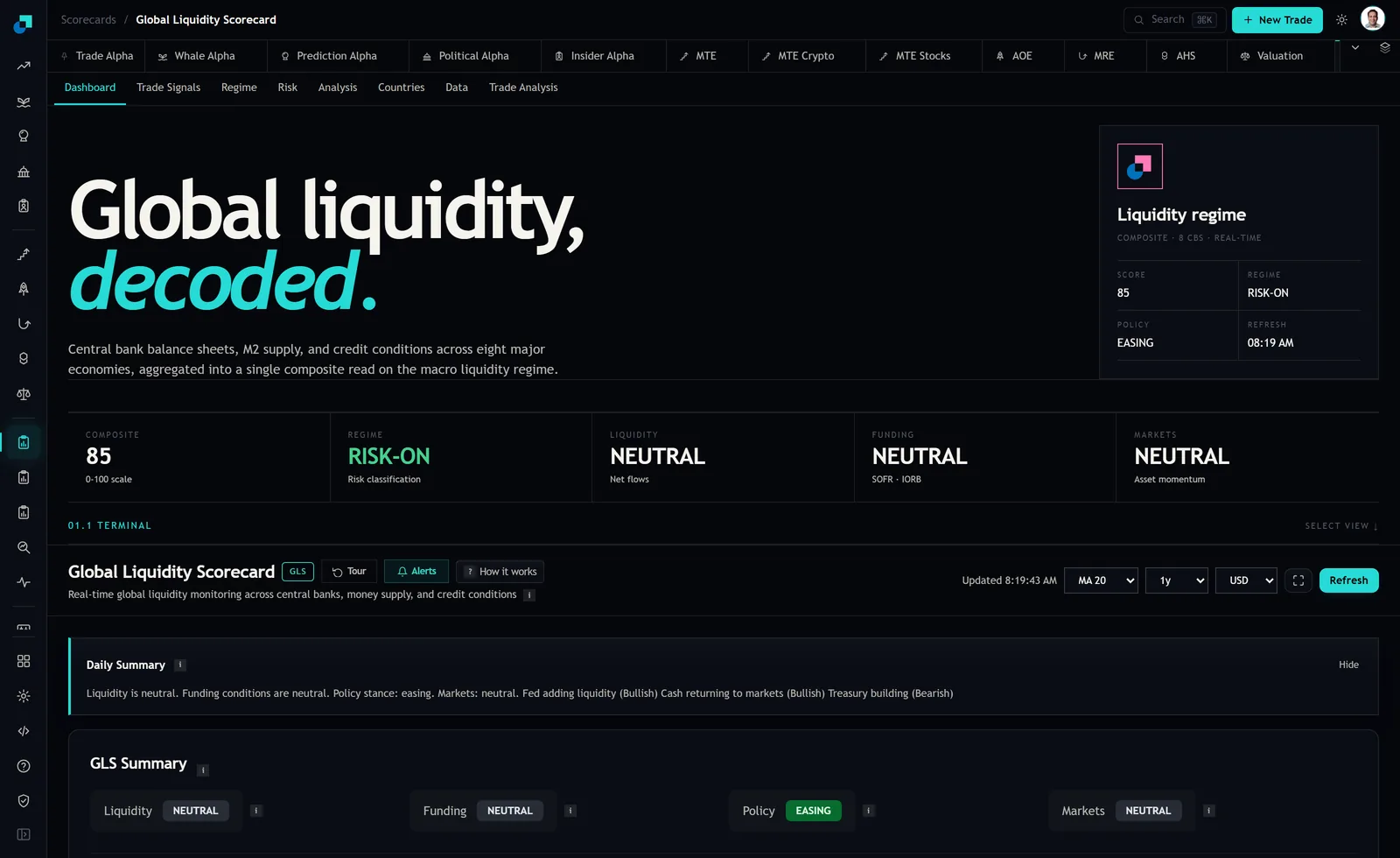
Nobody trades a raw macro composite. The daily series is too jumpy to look at, so you smooth it, and the moment you smooth it you have made a choice that determines every turn date you will ever quote from it. Two people looking at the identical Global Liquidity Scorecard history, one smoothing over ten days and one over two hundred, will give you turn dates months apart and both will be reading the chart correctly. The disagreement is not about the data. It is entirely about the window.
This is worth understanding before you use a liquidity read to do anything, because the window is usually the setting people think least about and it has more effect on your entry date than the composite value itself.
The lag is about half the window, and that is not a rule of thumb
A simple moving average of length N is the average of the last N readings. Its centre of mass sits roughly halfway back through that window, at about (N plus 1) divided by 2 periods ago. So when the underlying series genuinely turns, the moving average keeps going in the old direction for roughly half the window length before it rolls over with it.
Work it through with three common settings on a daily series.
- A 10 day window rolls over roughly 5 trading days after the underlying turn. Call it a week.
- A 50 day window rolls over roughly 25 trading days after. Call it five weeks.
- A 200 day window rolls over roughly 100 trading days after. Call it five months.
Same series, same turn, three declared dates spread across almost half a year. If you have ever read someone confidently state that liquidity turned in a particular month and wondered why it did not match what you were looking at, this is usually the whole explanation.
Do not smooth below the speed of the data
There is a second constraint that matters more on a macro composite than on a price chart, and almost nobody applies it.
GLS blends inputs that publish at wildly different frequencies. Credit spreads and USD liquidity indicators move continuously. Central bank balance sheet statements arrive weekly or monthly depending on the institution. Money supply is monthly and lands weeks after the month it describes. That means large parts of the composite are literally constant for days or weeks at a stretch.
If you smooth that series over five days, the only thing that can vary within your window is the fast market priced leg. Your five day average of a global liquidity composite is, in practice, a five day average of credit spreads with a large constant added to it. You have not built a fast liquidity signal. You have built a noisy credit spread proxy and labelled it liquidity.
The practical floor is this. Your smoothing window should be at least as long as the publication interval of the inputs you actually care about. If the balance sheet leg is what you are trying to track and it updates weekly, ten days is the shortest window that means anything. If the money supply leg is what you care about, you are in monthly territory whether you like it or not, and a window under about thirty days is decoration.
Matching the window to how long you hold
The ceiling comes from the other end, and it is simply the holding period you intend.
The lag eats your trade. If you plan to hold a position for a quarter, that is roughly sixty trading days. A 200 day window hands you the turn signal a hundred days after the fact, which is after your intended holding period has already finished. A 50 day window costs you twenty five days, which is more than a third of the trade, gone before you have entered.
The arithmetic I use is to keep the lag under about a fifth of the intended hold. That gives you a rule you can apply in one step: the window should be no longer than about four tenths of your holding period, measured in the same units.
- Holding for a quarter, roughly 60 trading days. Window up to about 25 days.
- Holding for six months, roughly 125 days. Window up to about 50 days.
- Holding for a year or more. A 200 day window is defensible, and here it is genuinely the right tool.
Cross that against the floor from the previous section and the answer for most people running a retail account with a multi month view lands somewhere between twenty and fifty days. Which is, not coincidentally, the range where a macro liquidity read is slow enough to be about liquidity and fast enough to be about now.
What each window costs you in real money
Short windows do not just give earlier signals. They give more signals, and most of the extra ones reverse.
Every declared turn you act on is a round trip. On a retail brokerage account that is two spreads, any commission, and in a taxable account a realised gain or loss with the paperwork that follows. Say you are moving 5,000 dollars of exposure and the all in round trip cost is a quarter of a percent. That is roughly 12 dollars. Sounds like nothing.
Now count the frequency. A 10 day window on a composite with a fast daily leg will cross back and forth repeatedly inside a single genuine trend. Twenty round trips in a year at 12 dollars is 240 dollars, on a 5,000 dollar position, which is close to five percent of the capital spent on the privilege of reacting. A 50 day window on the same data might give you three or four state changes in that year. The slow window is not just calmer, it is materially cheaper, and the cost difference is often larger than the timing advantage the fast window was supposed to buy.
Two things I would do this week if you are using a liquidity read at all. First, write down which window you are using, in a note, next to the position it informs. If you cannot name the window, you do not have a signal, you have a vibe. Second, keep your own column of the daily composite reading in a spreadsheet. It takes ten seconds a day, and after two months you can smooth it at three different windows yourself and see, on your own history, how many turns each one declared and how many of those held. That comparison is worth more than any opinion about the right setting, including mine, because it is measured on the period you actually traded.
The mistake I would most want to talk you out of is switching windows after the fact. When a signal is going against you, the temptation to check whether a longer window still agrees is enormous, and if you look you will always find one that does. Pick the window from your holding period, before the position, and leave it alone. Changing the lens because you dislike the picture is not analysis, and it converts a rules based read into a discretionary one without you ever deciding to.