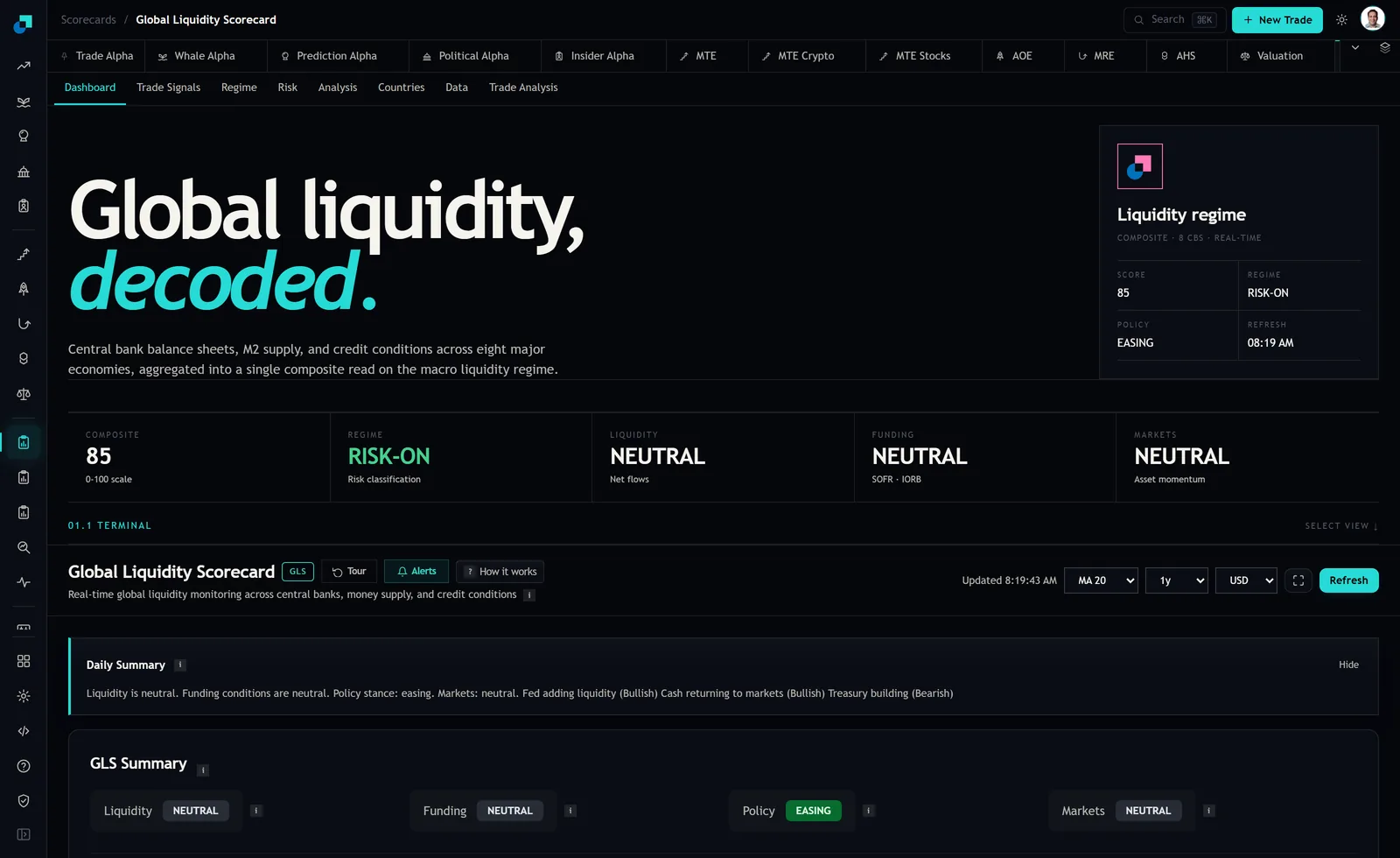
The Global Liquidity Scorecard header does something quietly useful. It prints the composite, and then it prints the regime and the policy stance as separate fields right next to it. At the reading I captured, all three lined up: composite 85, regime RISK-ON, policy EASING. When they line up, there is nothing to decide. The whole reason those fields exist as separate tiles is that they do not always line up, and the day they disagree is the only day the dashboard is telling you anything you could not have guessed.
Most people handle disagreement badly. They either take the composite and ignore the split, which throws away the most informative thing on the screen, or they freeze and do nothing, which is a decision they never wrote down and cannot review later. Neither is necessary. There is a defensible order to read these in, and it comes from how each piece of the underlying data is produced.
Three questions wearing one number
GLS lists its inputs as the aggregate central bank balance sheet, global M2 money supply, USD liquidity indicators, credit spreads, and the composite score built on top of them, across eight central banks. Sort those by what they are actually asking and you get three questions, not five inputs.
- How much liquidity exists. That is the balance sheet and money supply side. It is a stock. It is large, slow, and published on a lag.
- What it costs to get hold of. That is the credit spread and USD liquidity side. It is a price, set continuously by people with money at risk right now.
- Where the people setting the rules are pointed. That is the policy read, EASING in the capture. It is an intention, announced, and it changes at meetings.
A stock, a price, and an intention. Written that way it is obvious they can disagree, and it is obvious they carry information at very different speeds.
Why the price of money resolves the tie first
My order is funding first, policy second, quantity last. That is not a claim about a measured hit rate and I am not going to dress it up as one. It falls out of how the three are produced.
Funding conditions are prices. Credit spreads reprice every session because somebody has to take the other side of a trade at a number they can live with. Nobody has to wait for a release, a meeting, or a revision. If lending against collateral gets harder, that shows up in a spread the same week, and often the same day.
Policy is an announcement. It is real and it matters, but it is discrete and it is deliberately telegraphed. By the time a stance reads EASING, the market has usually priced most of it, which is exactly why an easing stance can sit next to a market that will not rally.
Quantity is a measurement, and measurements arrive late. Money supply describes a month that has already ended, published weeks after the fact and subject to revision. It is the most fundamental of the three and the least useful for a decision you are making on a Tuesday.
So when they conflict, believe the fastest, cheapest to falsify piece first. That is funding. It is the one that is being voted on with real money continuously.
The disagreements you actually see, and what each one means
Four combinations account for nearly everything.
Policy easing, funding tightening. This is the one that costs people money, because the headline says the central bank is friendly and the spreads say credit is getting more expensive anyway. It usually means policy is reacting to something rather than leading it. Treat this as the most dangerous split on the board, and treat any risk-on framing built on the policy tile alone as unsupported.
Policy tightening, funding easy. The gentler split. Rules are getting stricter but nobody is struggling to fund. Historically this is the state that lasts longest and hurts least, and it is where a lot of grinding, unloved rallies live. It does not license leverage, but it also does not require you to sell.
Quantity high, funding tightening. A large stock of liquidity that has stopped being cheap to access. The stock number keeps the composite elevated while the thing that would actually let you deploy is deteriorating. This is the split that makes a composite look most misleading, because the slow input holds the score up.
Quantity falling, funding fine. Balance sheets shrinking with no stress in prices. Usually orderly, usually absorbed. This is the one where impatient people sell too early and then watch nothing happen for four months.
The five minute version, and the size decision at the end of it
Here is the loop, and it genuinely is five minutes if you do not go looking for a story.
- Read the three header fields and write them down as three separate words, not as one score. Composite, regime, policy. If all three agree, stop, you have learned nothing new, go do something else.
- If they disagree, name which of the three questions is dissenting. Stock, price, or intention.
- If the dissent is on the price side, meaning funding is worse than the rest of the board, act on the funding read.
- If the dissent is on the quantity side only, meaning the slow published data is the odd one out, do nothing on it this week. It is describing a month you have already lived through.
- Write the reading and the date in the same place you keep your trade notes, one line. This is the part everybody skips and it is the only part that compounds.
What that turns into for an account you actually run is a size adjustment, not a direction call. A macro composite is not a reason to buy anything specific and it will not tell you what. It is a reason to be carrying more or less of what you already decided you want.
Concretely, on a portfolio where a full position in a risk asset is 8 percent for you, the split reads change the multiplier and nothing else. All three agreeing on the constructive side is where a full position is defensible. Funding dissenting against a friendly policy read is a half position, and the half you leave off is not a hedge, it is cash. Funding dissenting against a high composite that is being propped up by slow quantity data is where I stop adding entirely and let existing positions run to their own stops.
The trap is treating a split read as a reason to build an elaborate offsetting structure. On a retail account that structure costs real money in spread and fees every time you touch it, and a macro read that resolves over weeks does not pay for that. Fewer units of the same thing is almost always the better expression, and it has the useful property that it costs you nothing when the composite turns out to be early.