Screenshots of dashboards end up in investment committee packs constantly, and almost all of them are doing no work. A picture of a liquidity composite proves that somebody opened a page. It does not record what was concluded, who disagreed, what the position was sized against, or what observation would have changed the answer. Six months later, when the position has gone against you and somebody asks how the decision was made, the screenshot is worth nothing at all.
What follows is the structure I use to convert a reading from the Global Liquidity Scorecard into a page that does the work. It is deliberately short. A macro overlay memo that runs to four pages will not be read, and one that is not read cannot be dissented from, which defeats the point.
What the document is actually for
Three purposes, in order of how often they get forgotten.
First, it forces the reading to be stated precisely enough that it cannot drift. Verbal macro views mutate. Nobody lies about them, they just gradually reshape toward whatever happened. A written reading with a date on it is immune to that.
Second, it captures dissent at the moment it existed. The person who disagreed in the meeting will either be right or wrong, and either way the fund learns nothing unless the disagreement was recorded before the outcome was known.
Third, it establishes what would make the view wrong. This is the part that gets cut for length and it is the only part that makes the memo falsifiable rather than decorative.
Section one: the reading, quoted rather than paraphrased
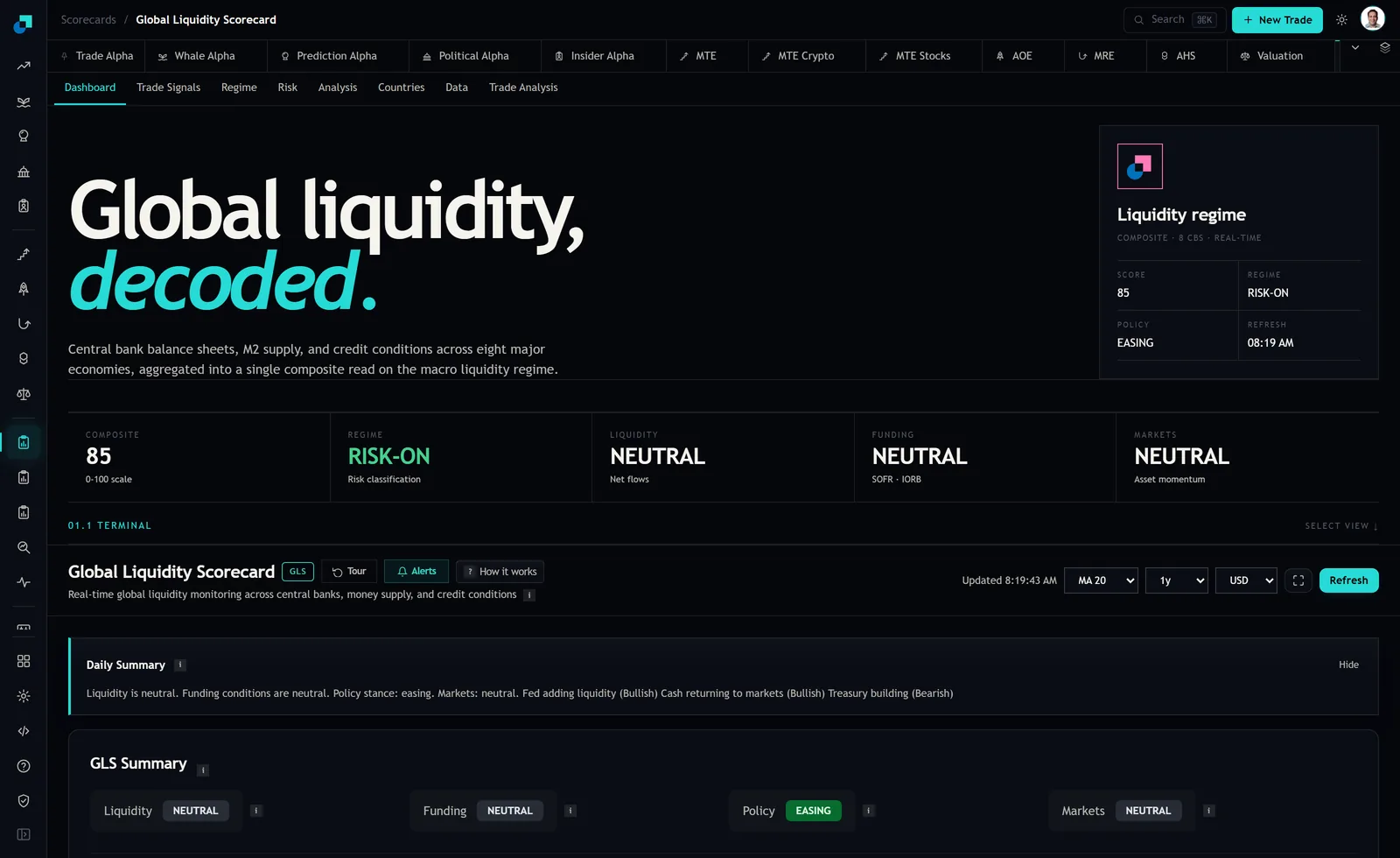
Quote the panel exactly. Composite 85 on a 0 to 100 scale. Regime RISK-ON. Policy EASING. Recompute stamp 08:05 on the capture date. Coverage eight central banks, being the Fed, ECB, Bank of Japan, People's Bank of China, Bank of England, Swiss National Bank, Bank of Canada and Reserve Bank of Australia. Input families as published: aggregate central bank balance sheet, global M2 money supply, USD liquidity indicators, credit spreads.
Then add the one field the panel does not give you, which is the effective as-of date. A composite blending monthly money supply with daily credit spreads has an effective vintage governed by its slowest weighted input, not by its recompute time. State that in a clause. Reviewers who understand macro data will look for it, and its absence is the first thing that undermines a memo in front of an audience that knows what it is reading.
Section two: drivers, with the attribution a reviewer can check
Two or three lines, no more. For each driver, name the input family, say which direction it is pushing, and say when it last actually changed.
That third element is the discipline. It is entirely possible to write three confident driver lines about a composite where nothing underneath has updated since the previous memo, and if you are not forced to state the last change date you will not notice you have done it. A driver that has not moved is not a driver of this month's reading, it is a description of the standing state.
Distinguish also between the level and the change on each family. A balance sheet that is large and flat and a balance sheet that is smaller but growing are opposite impulses that can produce similar composite contributions. If your memo says liquidity is supportive without saying whether it is supportive because there is a lot of it or because more is arriving, you have written a sentence that cannot be acted on.
Section three: dissent, recorded before the outcome is known
A named line per objection, with the objector attached. Anonymous dissent is worthless, because you cannot go back and ask what they were seeing.
The format that works is: who, what they think is wrong, and what they would need to see to change their mind. That last clause matters because it turns an objection into something testable. "I think the funding leg is being ignored" is a mood. "I think the funding leg is deteriorating and I would want to see three consecutive sessions back inside the normal band before I supported adding" is a position, and it can be settled by data rather than by seniority.
If there was no dissent, write that there was no dissent. A blank section reads as a section that was skipped. An explicit line saying the committee was unanimous is itself a data point, and an uncomfortable one to read back after a bad outcome, which is precisely why it is worth writing.
Section four: the decision, expressed as a change to something specific
Macro overlays go wrong in documentation when the decision is written as a view rather than as an action. "Constructive on risk" is not a decision. Something like the following is.
| Field | What goes in it |
|---|---|
| Instrument or sleeve | The specific book the overlay touches, not "the portfolio" |
| Direction | Add, reduce, or hold, stated as one word |
| Magnitude | The size change in basis points of NAV, not in adjectives |
| Effective from | A date, so the attribution window is unambiguous |
| Review trigger | The calendar date or the condition that brings this back to committee |
Magnitude in basis points is the field people resist and it is the one that makes the memo attributable. If you cannot say how large the tilt is, the performance analyst cannot separate it from everything else and the overlay will never be evaluated, which means it will run forever on the strength of the fact that nobody could measure it.
Section five: the condition that makes this wrong
One sentence, observable, and dated. The test of a good one is that a person who was not in the meeting could check it without asking anyone what was meant.
Bad: "we would revisit if liquidity conditions deteriorate." Nothing in that can be evaluated. Better: "we would reduce this tilt if the composite closes below a stated level on five consecutive readings, or if the funding leg breaches its trailing band for three consecutive sessions while the composite is unchanged." Now there is something a risk report can flag automatically, and the tilt has an exit that was defined by the people who put it on rather than by whoever is in the room on the day it is hurting.
The reason this section is non negotiable is what it does to the meeting six months later. Without it, the conversation is about whether the macro call was reasonable, which is unresolvable and turns into a discussion about who was more confident. With it, the conversation is narrow: did the falsification condition trigger, and did we act on it. Those are two yes or no questions, and a process that can answer them honestly improves. One that cannot will keep having the same argument about liquidity every quarter for as long as the fund exists.