The number in a rate decision is usually the least informative part of it. By the time the meeting arrives the market has spent weeks pricing the likely outcome, and a decision that matches what was priced costs almost nothing to absorb. What moves your account is the residual, the part of the announcement nobody had positioned for. That is why an unchanged rate delivered alongside a harder tone can hurt more than a quarter point hike that every desk had already pencilled in.
It is not a subtle idea, but it is consistently taught backwards. Most coverage treats the rate as the headline and the statement as commentary. For pricing purposes the order is reversed, and getting that order right is worth more to a retail investor than any refinement to which indicator they follow.
Only the unpriced part of a decision costs money
Work through the arithmetic on a hypothetical. Suppose the market has assigned a high probability to a hike and positioned accordingly. The hike arrives. The people who were going to sell have already sold, the hedges are already on, and the instrument that was going to reprice repriced over the preceding fortnight. The day of the meeting is quiet because the information content was close to zero.
Now suppose instead the rate is left alone, which is also broadly expected, but the accompanying language drops a qualifier that had been signalling patience and replaces it with one that signals concern about inflation. Nothing happened to the policy rate. Something material happened to the expected path of the policy rate, and every asset priced off that path has to move at once.
The label for that second case is a hawkish hold. The rate is unchanged and the implied future is tighter than the one the market was carrying. The reason it stings is precisely that the headline looks like a non-event, so nobody had reduced exposure into it.
Where the tone lives, and why a screenshot will not show it to you
The Macro Risk Scorecard puts Policy fifth in its tab row, after Dashboard, Sentiment, Regime and Credit and Liquidity, and the module's stated coverage includes Federal Reserve policy, Treasury yields and inflation data alongside interest rate forecasting and yield curve analysis. So the raw material sits inside the module's scope.
What the module does not do, and what no dashboard can do, is hand you a tone reading. Tone is a change in wording between two documents. It is read, not computed, and the reading is yours. I want to be straight about that rather than imply a panel exists that scores it for you.
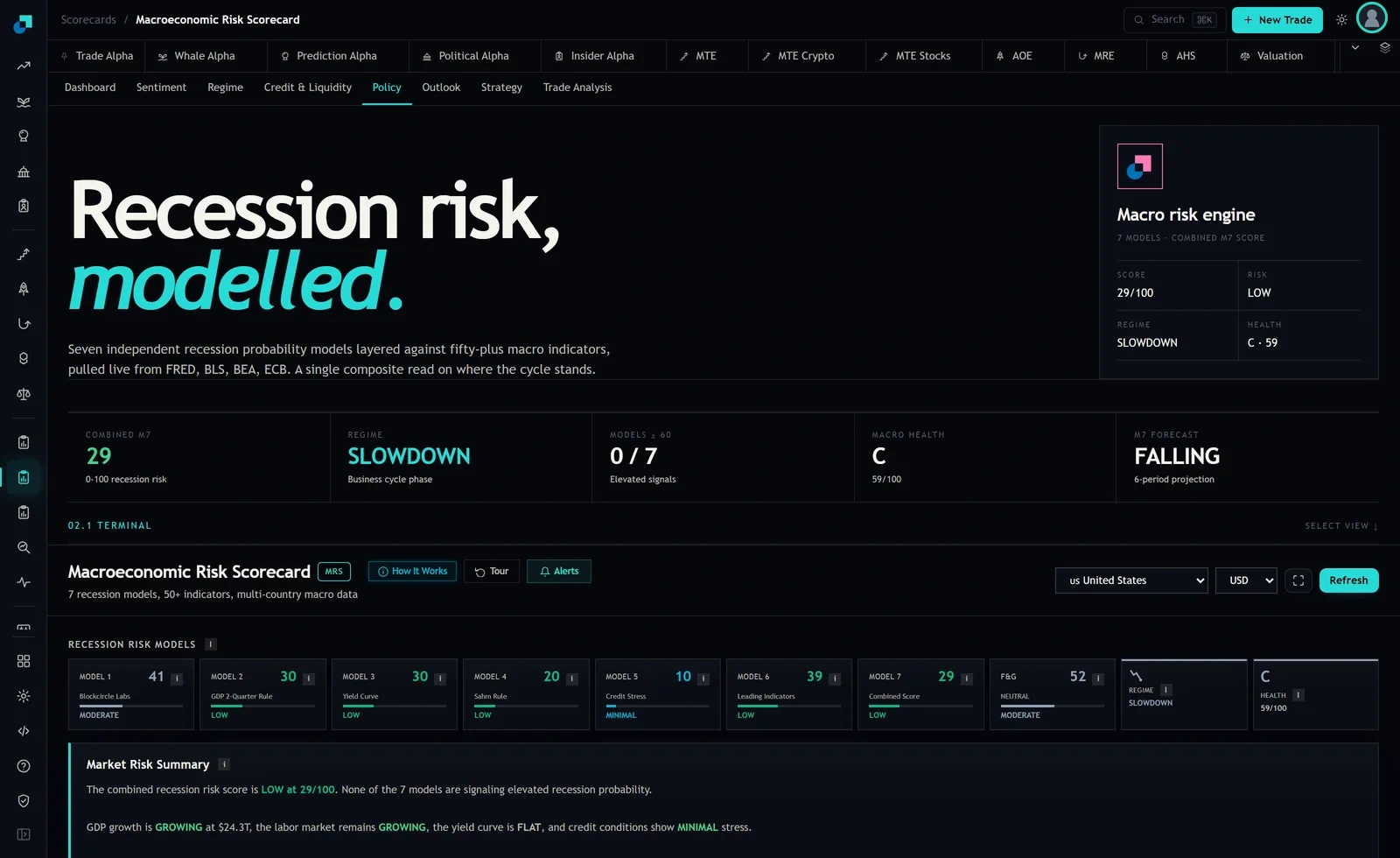
Read that header as the background and the meeting as the foreground. The header tells you what kind of environment you are holding risk in. The meeting tells you what just got repriced inside it. Confusing the two is how people end up making a portfolio-level decision on the basis of one afternoon.
Reading a tone change with free tools and forty minutes
You do not need a terminal for this. You need the last statement and the current one, side by side, and the discipline to look at wording rather than at the summary somebody else wrote.
- Save the statement text after every meeting into the same document. This takes a minute and it is the entire foundation. Without the previous version you have nothing to compare against and you are back to reading headlines.
- Paste the two versions into any tool that shows you a difference between two blocks of text. Most word processors do this natively. What you are looking for is small: an adjective added, a qualifier removed, a verb tense changed.
- Read the vote. Dissents are a leading indicator of where the argument inside the committee is going, and they are stated plainly.
- Watch the description of the economy separately from the description of policy. A statement can soften on growth and harden on inflation in the same paragraph, and those pull in opposite directions.
- Write down, before the press conference, what you would consider hawkish and what you would consider dovish. Doing this afterwards is worthless because you will fit the definition to the market's reaction.
Forty minutes of that beats any amount of commentary, because you are looking at the primary document rather than at somebody's compression of it. The habit also compounds. After four or five meetings you start to notice which phrases the committee treats as load-bearing.
Why the first thirty minutes are a trap for a retail account
Here is the part that costs real money. The reaction to a decision is not a single move, it is a sequence of moves, and the early part of that sequence is dominated by participants who can transact faster and cheaper than you can.
Spreads widen around the announcement. A market order into a wide spread is a guaranteed cost, paid immediately, on top of whatever the directional call turns out to be worth. On a four thousand dollar position a spread that briefly triples is not a rounding error, and you pay it going in and again coming out.
The other half of the trap is that the initial direction is frequently reversed once the press conference qualifies the statement. Trading the statement and then trading the reversal means paying twice to end up roughly where you started, with a realised loss and, in a taxable account, a tax event you did not need.
The practical rule I use is that a rate decision changes what I do next month, not what I do in the next hour. If a tone shift genuinely alters my view, that view will still be valid the following morning, and I will be able to act on it at a normal spread. If it will not still be valid the following morning, it was never a view, it was a reaction.
What a hold does to the rest of the macro read
A hawkish hold is a change in the expected path. It is not, by itself, a change in the economy, and the distinction shows up clearly if you look at what the scorecard is actually built on. The module describes seven recession probability models over fifty-plus indicators pulled from sources including FRED, BLS, BEA and the ECB, and those indicators are published on their own schedules. Employment data, output data and inflation prints do not update because a committee changed an adjective.
You can see the separation on the page as it stands. The models row reads 41 from Blockcircle Labs, 30 on the GDP two quarter rule, 30 on the yield curve, 20 on the Sahm rule, 10 on credit stress, 39 on leading indicators and 29 as the combined score, with the written summary on the page saying none of the seven models are signalling elevated recession probability. A tone change at a meeting does not move any of those numbers that afternoon. It changes the discount rate applied to assets, which is a different mechanism entirely.
So the sensible sequencing for a retail portfolio is to let the meeting inform your expectations about financing costs and to let the published data inform your view on the cycle. When those two start pointing the same way, you have something worth acting on. When only the tone has moved, what you have is a repricing, and the correct response to a repricing you did not anticipate is usually to leave your allocation alone and to note, honestly, that you were positioned for a path that did not survive contact with the statement.