Here is a failure that survives most valuation review processes because it is invisible inside any single model. Your industrials analyst discounts at 8.5 percent. Your software analyst discounts at 11 percent, having run a fresh beta regression and added a size adjustment. Your emerging markets analyst discounts at 14 percent with a country premium taken from a source nobody else uses. Each model is internally coherent. Each was reviewed and signed. And the combined list of upside to fair value, the list the allocation meeting actually looks at, is meaningless.
It is meaningless in a specific and correctable way. The ranking is not ordering companies by attractiveness. It is ordering them by whose discount rate was lowest, with a company specific residual on top. Given that the discount rate range across a typical multi sector team is several percentage points wide, and given the sensitivity arithmetic below, the residual is usually the smaller term.
What a per-analyst rate does to a ranked list
Run the arithmetic once and the problem stops being theoretical. Ten year model, 100 of free cash flow, 6 percent growth, 2.5 percent terminal growth. At 8.2 percent the present value is 2,359. At 10.2 percent it is 1,715. That two point spread in the discount rate, which is well inside the range a team of analysts will produce unprompted, moves fair value by about 27 percent.
Now consider what upside to fair value means on a list where that spread is present. A name showing 30 percent upside from an analyst using 8.2 percent and a name showing 5 percent upside from an analyst using 10.2 percent may be identically attractive. Or the second may be more attractive. You cannot tell from the list, and neither can the person chairing the meeting, because the discount rate is not a column on the list. It is buried three tabs into each model.
Every desk I have seen that fixed this fixed it the same way: the rate stops being an analyst output and becomes a house input. The analyst's job moves entirely to the cash flows, which is where their company knowledge actually has an edge, and away from the cost of capital, where it does not.
The three layers a house rate needs
A workable policy has three layers, each documented separately so that a change to one does not silently move the others.
Layer one, the base. A risk free rate by currency, tenor matched to the modelling horizon, plus a single house equity risk premium. Specify the source series for both, by name, in the policy document. The premium is the more consequential choice and the one most likely to drift, because several published series exist and they disagree. Pick one, cite it, and treat switching as a policy amendment rather than a research decision.
Layer two, the country adjustment. An explicit country risk premium table covering every jurisdiction in the investable universe, with a stated derivation method. The method matters more than the levels. Sovereign spread scaled by relative equity volatility is one defensible construction. Whichever you use, the constraint is that it must be a function of observable inputs, so that when someone asks why one country carries 300 basis points more than another the answer is a formula rather than a judgement.
Layer three, the sector beta. House betas by sector, refreshed on a schedule, applied to every name in that sector. Not per company regressions. The argument for per company beta is precision, and it does not survive contact with the standard errors involved: a single stock regression on sixty monthly observations carries enough estimation error to swamp the difference between two companies in the same industry. Sector betas are estimated on a much larger cross section and are more stable, and stability is the property you need when the output feeds a cross sector ranking.
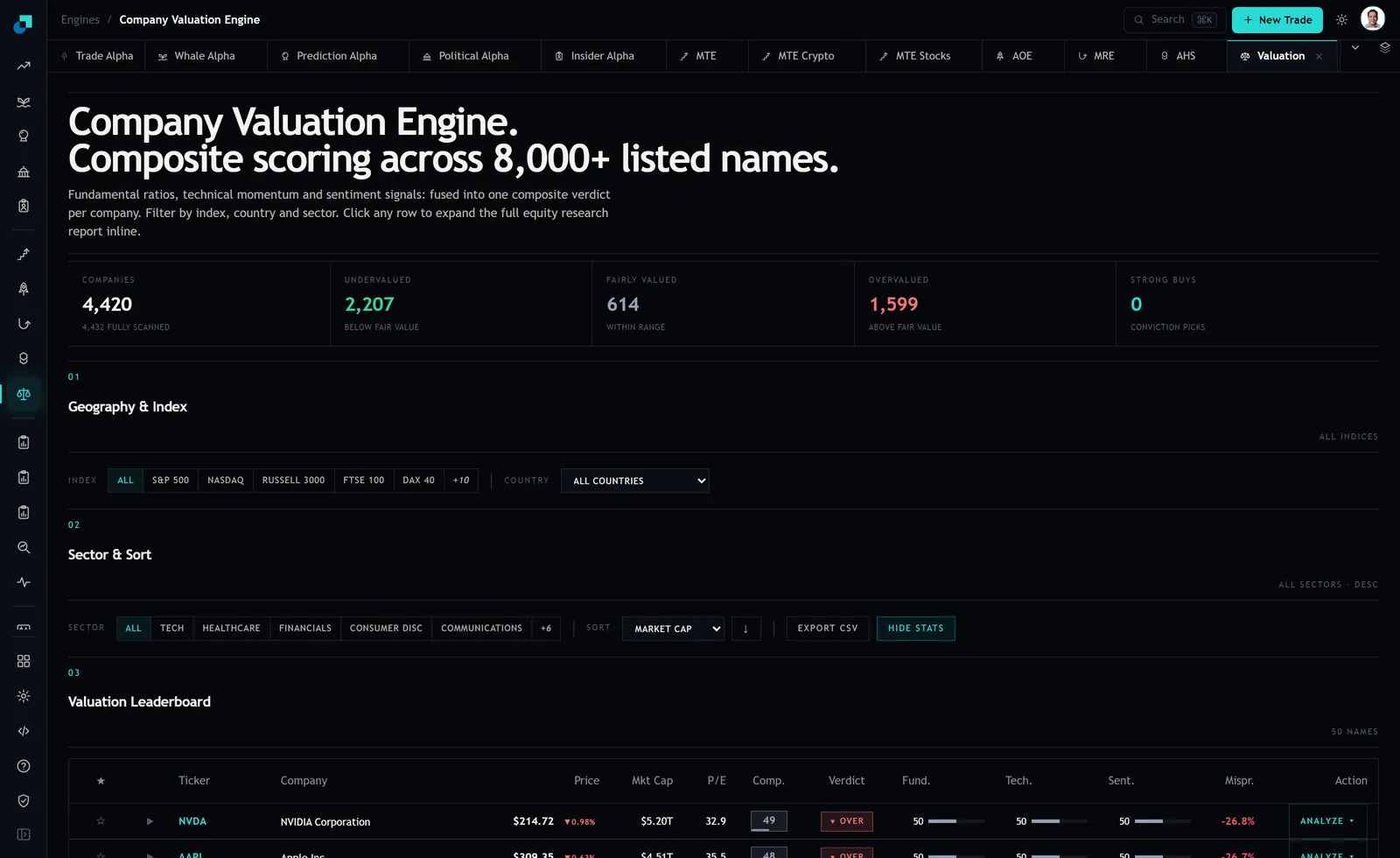
That panel is a good illustration because it makes the cross border comparison one click away. The Company Valuation Engine screen filters by index, country and sector and then ranks names on a single composite, and the same discipline applies to any internal leaderboard you build: the moment two jurisdictions appear in one ordered list, a country premium policy exists whether you wrote one down or not. The only question is whether it is documented or improvised.
Keeping the country layer from becoming a slider
Country risk premia attract abuse because they are the least observable input in the stack and the easiest to justify after the fact. Two controls have worked in my experience.
The first is that the premium is set centrally and versioned, and models reference the version rather than a typed number. When the table updates, every model inherits the change, and the change appears in each model's log with its fair value impact. This turns a country premium revision from an invisible drift into a documented event with a measurable effect on the book.
The second is a hard rule that the country premium is applied to the discount rate or to the cash flows, never to both. Double counting country risk by haircutting the cash flows and then discounting at a country adjusted rate is one of the most common findings in valuation review, and it is almost always accidental. Pick one, write it into the policy, and check for it in review.
There is a further subtlety worth specifying: whether the premium follows the listing or the revenue. A company listed in one market earning three quarters of its revenue in another is not exposed to the country risk of its exchange. My preference is revenue weighted exposure, computed from the segment disclosures, precisely because it is auditable. If you choose the simpler listing based approach, say so explicitly, because otherwise two analysts will silently use different conventions and you are back where you started.
Review cadence and what happens between reviews
Rates that never change are as dangerous as rates that change constantly. The first quietly becomes wrong, the second becomes an input analysts can influence by asking at the right moment.
The cadence I would defend is annual for the structural layers and mechanical for the observable one. Sector betas and the equity risk premium get a scheduled annual review with a written committee decision. The risk free rate updates on a stated rule, for instance quarter end observation of the specified tenor, applied without discussion. Country premia sit in between: recomputed on the documented formula quarterly, but with a materiality gate so that small moves do not churn every model in the book.
Between reviews, the answer to "the market has moved, should we update the rate" is no, and having that answer written down in advance is the entire value of the policy. Discount rates that update mid quarter in response to market moves import market direction into fair value, which defeats the purpose of computing a fair value at all.
The exceptions process and what it should cost
A policy with no exception path gets circumvented rather than followed, so build one and make it expensive in attention rather than forbidden.
An exception request should state which layer is being overridden, the proposed value, the specific characteristic of the company that the house layer fails to capture, and the fair value impact of the override in percent. That last field is the one that does the work. An analyst who discovers that their proposed 150 basis point override moves fair value by 18 percent tends to reconsider whether the override is really about the company.
Approvals should sit with whoever owns the policy, not with the analyst's line manager, and every live exception should appear on a standing list reviewed at the same cadence as the policy itself. When the same exception appears for six names in one sector, that is not six exceptions. That is a sector beta that is wrong, and the correct response is to amend the policy rather than to keep approving deviations from it.
The list of live exceptions is also the most useful document you will have in a post mortem. When a position goes wrong and someone asks whether the valuation was aggressive, the ability to say that this name was modelled entirely on house parameters with no overrides is a complete answer. The ability to say that it carried three overrides, all in the direction of a higher fair value, is also a complete answer, and it is better to find that out before the loss than after it.