The usual order of operations is backwards. Somebody hears prediction markets are interesting, picks a venue on the strength of a podcast, does the identity check, moves a few hundred dollars in, and only then starts looking for something to trade. By that point the money is on one platform and the search has quietly narrowed to whatever that platform happens to list.
The Prediction Markets Index exists to be read before any of that. It tracks 115,179 markets across venues and ranks them by 24-hour volume, and reading it costs you nothing and commits you to nothing. Half an hour there decides whether the account is worth opening at all, and if so, which one.
The screen is free, the account is not
Be honest about what an account costs you before you decide it is worth having. There is an identity check, which means handing documents to a company you have not traded with yet. There is a funding rail, which usually means a transfer with its own fee, its own delay and its own reversal rules. There is a balance that has to sit there to be useful, which is capital not doing anything else. There is a withdrawal path you should test with a small amount before you trust it with a real one. And there is a tax record to maintain, per venue, for the life of the account.
None of that is prohibitive. All of it is a fixed cost, which means it only makes sense if there is a repeatable stream of trades on the other side of it. One interesting question is not a stream. The index is where you find out whether you have a stream or a whim.
Read the venue tag before you read the question
Sort by 24-hour volume and go down the list. Manchester City to win at $7,594,119. A question on whether the US and Iran ceasefire is extended by April 22, 2026, at $7,274,185. Swiatek against Rybakina at the Cincinnati Open at $4,985,814. Then Dota 2 at $4,740,521, Dota 2 again at $4,227,593, Chelsea at $4,050,826, and another eleven or so rows before the volumes drop under two and a half million.
Now ignore the questions entirely and read the venue tag on each row. It says POLYMARKET on every single one of them, eighteen deep. That is one reading, on one day, on one sort, and it is still the most useful thing on the page for somebody deciding where to open an account. It tells you the top of the turnover distribution on this index is concentrated on one venue, so a second account is not going to buy you access to the deepest markets. It buys you access to different markets, which is a completely different reason to open one.
The second thing to read is the mix. In that top group there is a football fixture, a geopolitical question, a tennis match, a run of Dota 2 and Counter-Strike matches, and more football. If what drew you here is politics or macro, notice that exactly one row in the top handful is that kind of question. The volume is real and it is mostly somewhere you were not planning to trade.
Three readings that decide whether a category is fundable
Turn that into a test you can actually apply, category by category, before you deposit anything.
First, count. Set a volume floor you would need before you would consider a market tradable at your size, then count how many markets in your category clear it. Not how many exist. Out of 115,179 tracked, plenty of categories have hundreds of listings and almost nothing with turnover. If the count that clears your floor is in single digits, funding an account for that category means competing for a handful of contracts against people who are there full time.
Second, read the calendar. Look at how far out the end dates sit on the markets that cleared step one. Your capital is committed from entry to resolution with no early exit guaranteed, so a category whose contracts all resolve six months out is asking for a much longer commitment than the position size suggests. Match that against how long you are willing to leave money parked on a venue you have just met.
Third, check whether the category exists anywhere else at all. This is the one that decides between one account and two. If everything you want is on a single venue, open one account and stop. Two accounts is double the fixed cost and it only pays if the second venue lists something the first does not, or lists it at a price the first does not.
The day the index came back empty
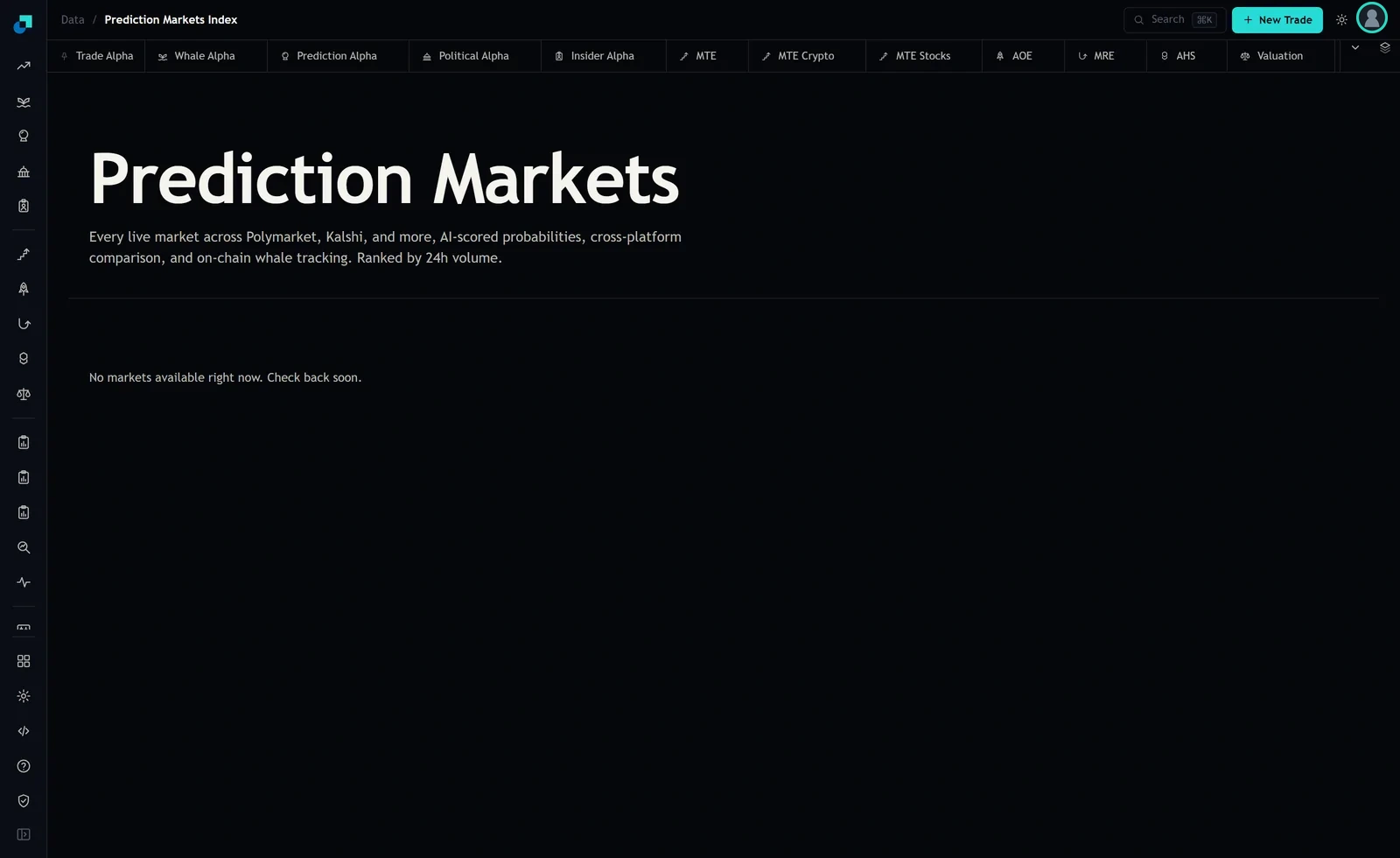
The screenshot above is not a mistake and I left it in on purpose. When I went to capture the index, it returned nothing. The header and the description were there, the feed said no markets available right now, and that was the whole page.
Two useful lessons come out of that. The first is about dependency. A research page having a bad minute is a nuisance if you are reading, and it is a real problem if a page like that sits between you and a decision you make with money. Before you build a routine on any aggregator, know which part of it you actually depend on. For screening, none of it is load bearing, because you can come back tomorrow. For anything closer to execution, the venue is the thing that has to be up, not the summary of it.
The second is about sampling. One reading of a volume sort is one day. Sports and esports fixtures dominate on the day their matches run, and a category can look dead on a Tuesday and busy on a Saturday. Run your pass at least twice, several days apart, ideally once on a weekday and once on a weekend, before you conclude anything about where the activity lives. It costs you two twenty-minute sessions and it is the cheapest correction you will ever make to this decision.
The account worth opening second, and the one worth skipping
By the end of the pass you should be able to write two or three sentences down. Which category you are actually going to trade, how many markets in it clear your volume floor, how far out they resolve, and whether more than one venue carries them. If you cannot write those sentences, you have not finished the screen, and depositing now is just buying yourself the feeling of having started.
When the answer is one venue, open one account and put the effort you saved into the questions themselves. When the answer is genuinely two, open the first, trade it small for a month, and confirm the second is carrying something the first does not before you go through onboarding again. And when the pass returns a category with a handful of thin markets resolving next spring, the honest conclusion is that this is a research interest rather than a trading account, and the index will still be there for free when that changes.