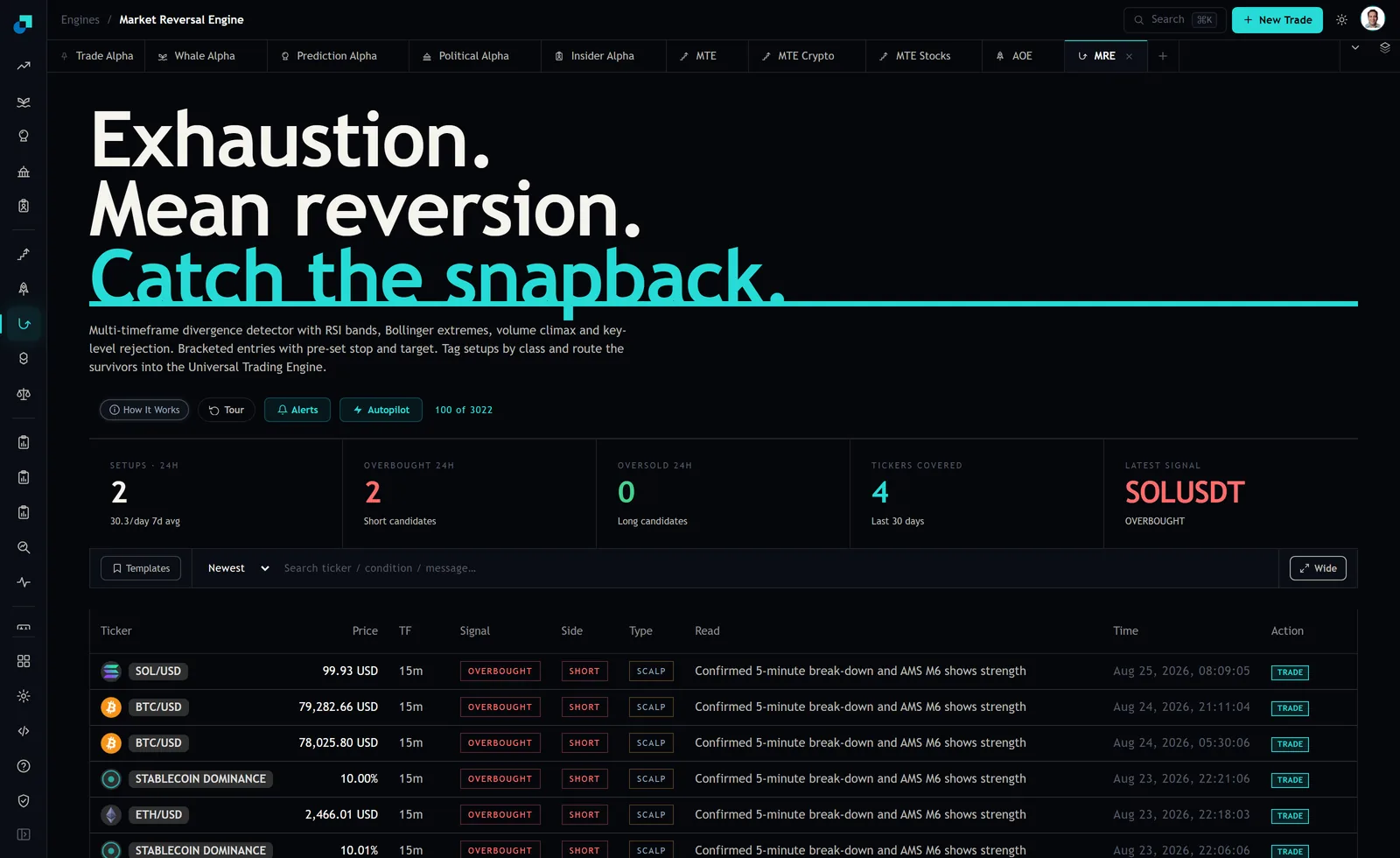
MRE does not hand you a direction and wish you luck. The module describes bracketed entries with a pre-set stop and target, and the TRADE button on the end of each setup row carries those levels through with it. That is a deliberate design and it removes the most expensive decision in discretionary trading, which is the one you make while a position is moving against you.
It also creates the temptation that this piece is about. The levels arrive as suggestions on a screen, they are editable, and the stop always looks a little tight in the moment. So people widen it. Here is what that does to the arithmetic, in numbers you can check with a calculator.
What ships with the setup
A bracket is three orders that live and die together. The entry, a stop on the losing side, a target on the winning side, with the two exits linked so that a fill on either cancels the other. The important property is not any individual level, it is the ratio between them, because that ratio and your hit rate are the only two things that determine whether the setup makes money over a hundred repetitions.
The Type column tells you which family of bracket you are looking at. Every visible row in the capture is tagged SCALP on a 15m timeframe, which is the tightest end of the range: a stop close to entry, a target close to entry, and a holding window measured in bars rather than days. The module also mentions tagging setups by class and routing survivors into its Universal Trading Engine, so the class label is the thing the automation keys off. Rewriting the levels by hand on a class you intend to automate later means you are hand-testing one thing and automating a different one.
The arithmetic of widening a stop by half
Work in R, where one R is the distance from entry to the original stop. Say the bracket ships with a stop at 1R and a target at 1.5R, and say your own log across a few dozen of these shows the target hit 45 percent of the time. Expectancy is 0.45 times 1.5, minus 0.55 times 1, which is plus 0.125R per trade.
Now widen the stop by half, to 1.5R, and leave the target where it was. You now risk 1.5 to make 1.5. For that version to be as good as what you started with, you need a hit rate p where 1.5 times the quantity 2p minus 1 exceeds 0.125. Solve it and p has to clear 54.2 percent.
Read that carefully, because it is the whole argument. Widening the stop by fifty percent requires your hit rate to improve from 45 percent to 54 percent just to break even against the original bracket. A nine point improvement in hit rate is enormous. Nothing about giving a losing trade more room delivers that. It delivers a smaller number of losses, each of them half again as large, and the two effects very nearly cancel before you have paid a penny of extra cost.
The version of this people actually do is worse than the version I just modelled, because they widen the stop after entry, on the trade that is already losing. That is not a strategy change, it is a strategy change applied only to the losing subset, which converts your worst outcomes into your worst outcomes plus fifty percent and leaves the winners untouched.
Pulling the target in is the same mistake wearing a different hat
The other edit is the friendly-looking one. Leave the stop at 1R, bring the target in from 1.5R to 1R, and watch the hit rate go up. It genuinely does go up. That is why the edit feels good.
Run the same calculation. At a 1R stop and a 1R target, expectancy is 2p minus 1, and to beat 0.125R you need p above 56.25 percent. So pulling the target in from 1.5R to 1R requires the hit rate to climb from 45 percent to over 56 percent, an eleven point jump, to leave you no better off than before you touched it. The hit rate will rise when you shorten the target, but it will not rise by eleven points, and you will feel like a better trader while making less money. That combination is remarkably durable and it is why people keep doing it.
Both edits share a structure worth naming. Each one improves the number you can see immediately, the frequency of green trades, at the cost of the number you only see after fifty trades, the expectancy. Preset brackets exist to stop you making that trade with yourself.
The one number you are supposed to change
Size. Not the levels, the quantity, and the arithmetic runs the other way from the levels.
Decide what a single loss is allowed to cost you in dollars, then let the stop distance determine notional. If you are willing to lose 50 dollars and the bracket's stop sits 0.6 percent from entry, then your notional is 50 divided by 0.006, which is roughly 8,300 dollars. If you were willing to lose 150 dollars, the same bracket implies 25,000 dollars of notional.
Two things fall out of that and both surprise people. The first is that a tight scalp bracket implies a large notional for any given dollar risk, which for most retail accounts means leverage or means the trade is simply too big to take. The second is what that notional does to your costs. At 25,000 dollars of notional and an all-in round trip of fifteen basis points, you pay about 37 dollars in costs against 150 dollars of risk. A quarter of your risk budget, gone to the venue, before the setup has an opinion.
That ratio is the thing to compute once, this week, with your real fee schedule. It tells you which setup classes are tradeable at your venue and which ones are not, and it is a far better filter than any judgement you will make about an individual row.
When the bracket genuinely does not fit
There are real reasons to decline a bracket, and none of them involve moving a level.
If the implied notional exceeds what your account can carry, the answer is to skip the setup, not to widen the stop until the size looks comfortable. Those two feel similar and are not. Skipping costs you an opportunity. Widening costs you the expectancy on every trade in that class from then on.
If the stop sits inside the normal spread at the hours you trade, the bracket is not implementable for you at that venue, and no adjustment fixes it. If your venue rounds to a tick or a minimum order size that pushes the effective stop meaningfully away from the level, the same applies. And if the setup is stale, which on a 15m row means more than a few bars past the timestamp in the Time column, the bracket was computed around a price structure that no longer exists.
What you are allowed to do is decide the class is not for you and stop taking it. That is a decision made once, in advance, across every setup of that type, and it is defensible in a way that editing the stop on the trade currently hurting you never is. Keep a log with the shipped levels and your outcomes for thirty or forty trades, and let the class earn or lose its place on the evidence. The point of a preset bracket is that it gives you something consistent enough to measure.