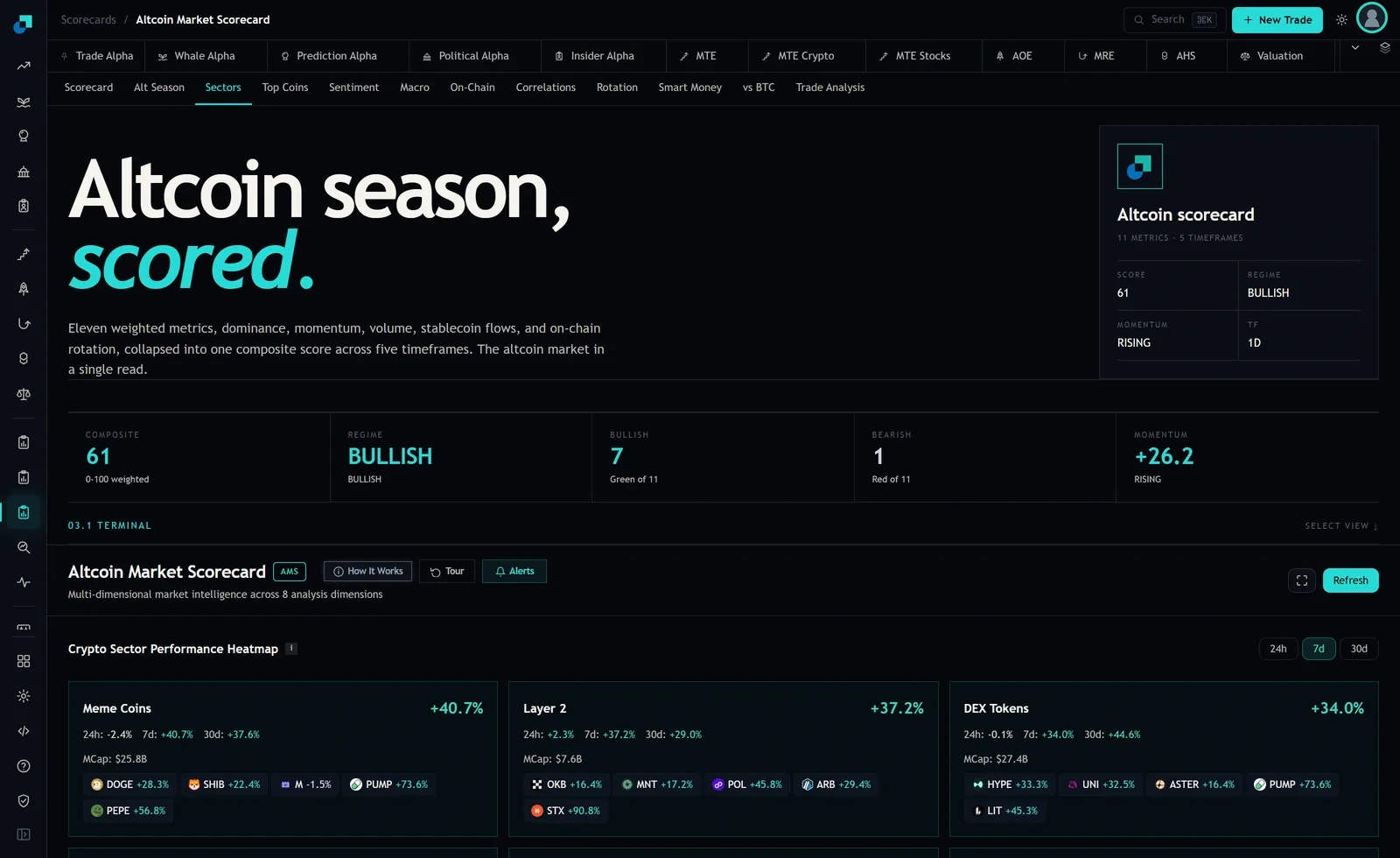
You have decided a sector is working. DEX Tokens reads +34.0 percent for the week on the heatmap, which is enough to make you want exposure. Now comes the part nobody writes about, which is that you cannot buy the card. You have to buy one or more of the names underneath it, and on that card those names read HYPE +33.3 percent, UNI +32.5 percent, ASTER +16.4 percent, PUMP +73.6 percent and LIT +45.3 percent.
Pick ASTER and you got half of the sector. Pick PUMP and you got double. Same sector, same week, same correct call about which bucket to be in, and a spread of 57 points between the best and worst outcome available inside it. Which name you chose mattered more than which sector you chose, and that is the normal case rather than the exception.
Rank against the sector, not against Bitcoin
The reflex comparison in crypto is against Bitcoin. It is the wrong denominator once you have already decided to hold a sector, because it mixes two decisions together. Whether alts beat Bitcoin is a question you answered when you took alt exposure at all. The question in front of you now is which member of this bucket to hold, and the right denominator for that is the bucket.
Do the subtraction on the chips. In DEX Tokens against its +34.0 headline: PUMP +39.6, LIT +11.3, HYPE minus 0.7, UNI minus 1.5, ASTER minus 17.6. In Meme Coins against +40.7: PUMP +32.9, PEPE +16.1, DOGE minus 12.4, SHIB minus 18.3, M minus 42.2. In Layer 2 against +37.2: STX +53.6, POL +8.6, ARB minus 7.8, MNT minus 20.0, OKB minus 20.8.
Those columns are more useful than the raw returns, because they separate the part of a token's week that came from being in the right bucket from the part that came from being that specific token. A name at plus 30 percent in a bucket that did plus 40 is not a strong token, it is a weak token in a strong week, and it will be a weak token in the next weak week too.
The odds on a blind pick inside a green bucket
Count how many listed members beat their own card. Meme Coins, two of five. Layer 2, two of five. DEX Tokens, two of five. Six of the fifteen tokens listed across three strongly green sectors kept up with the number that made the sector look attractive.
So a name pulled at random out of a winning bucket had a bit better than a one in three chance of matching what the heatmap advertised. That is not an argument against sector work. It is an argument against treating a green card as a green light on anything inside it, which is how the card gets used most of the time.
It also explains a familiar and demoralising experience: being right about the theme, being early enough, holding through the week, and finishing well behind the number everybody else is quoting. Nothing went wrong with your analysis. You took the sector bet and then took a second, larger, unacknowledged bet on top of it when you chose the ticker.
The shortlist rule and the check that kills a one-week fluke
Here is what I do with those relative numbers. Rank the members by their return minus the bucket's return. Take the top two. Discard anything below the bucket, including names you like, because a member that lagged its own sector in the sector's good week has told you something specific and you should let it.
Then run one check before you buy either of them, because a single week of relative strength is often nothing. Every card carries three windows: 24h, 7d and 30d. Meme Coins showed minus 2.4, +40.7 and +37.6. Layer 2 showed +2.3, +37.2 and +29.0. DEX Tokens showed minus 0.1, +34.0 and +44.6.
Read those rows carefully. In Meme Coins and Layer 2 the seven day figure is larger than the thirty day figure, which means most of the month happened in the last week and the weeks before it gave some back. In DEX Tokens the thirty day figure is larger than the seven day figure, so the strength has been accumulating for longer than the week you are reacting to. That is a slower, better shaped move to buy into, and it is visible on the card without any extra work.
Apply the same logic to your two shortlisted names by pulling their charts for the last month, not the last week. If a name's entire relative strength is one candle, you are not buying a leader, you are buying a headline.
When owning three of them beats picking one
There is a case where the correct answer is to stop picking, and it is common enough to name. If you cannot tell in advance which member is going to be the outlier, and honestly most of the time you cannot, then holding several members equally gets you the average of the bucket instead of a one in three shot at it. Across those three cards, the equal weighted average of the listed chips was +35.9, +39.9 and +40.2 percent. In two of the three buckets that average beat the headline on the card.
The constraint is cost, and it is a real one on a small account. Every extra line costs you a spread on the way in and a spread on the way out, and the spread is worst on exactly the small names a bucket average depends on. Work it out before you split: take the amount you are willing to put into the sector, divide by the number of lines, and check the ticket against your venue's fee schedule and minimum order size. If splitting a position five ways means five tickets where the round trip cost is a meaningful fraction of a percent each, you have converted a diversification benefit into a fee, and three lines is usually the sensible ceiling for an account of a few thousand dollars.
The case where you should not pick at all
One more filter, and it overrides everything above. Before you shortlist, check whether the bucket's strength is one name. Average the chips, remove the single best performer, average again. In Layer 2 that takes the average from +39.9 to +27.2 percent, so roughly a third of the bucket's week came from STX alone at +90.8 percent.
When that is the picture, the sector call you thought you were making does not exist. You are choosing between buying a token that is already up 90 percent in a week, which is a momentum trade with a specific and unpleasant risk profile, and buying the members that did not move, which is a bet that the label drags them up later. That second bet is the one people make without noticing, and the heatmap offers no evidence for it at all. Sectors are not physically obliged to converge.
If you want the exposure anyway, size it as the single-name bet it actually is rather than as a diversified sector position, and decide now what the price is at which you accept the bet was wrong. That decision is far easier to make while the card is green than it will be in three weeks.