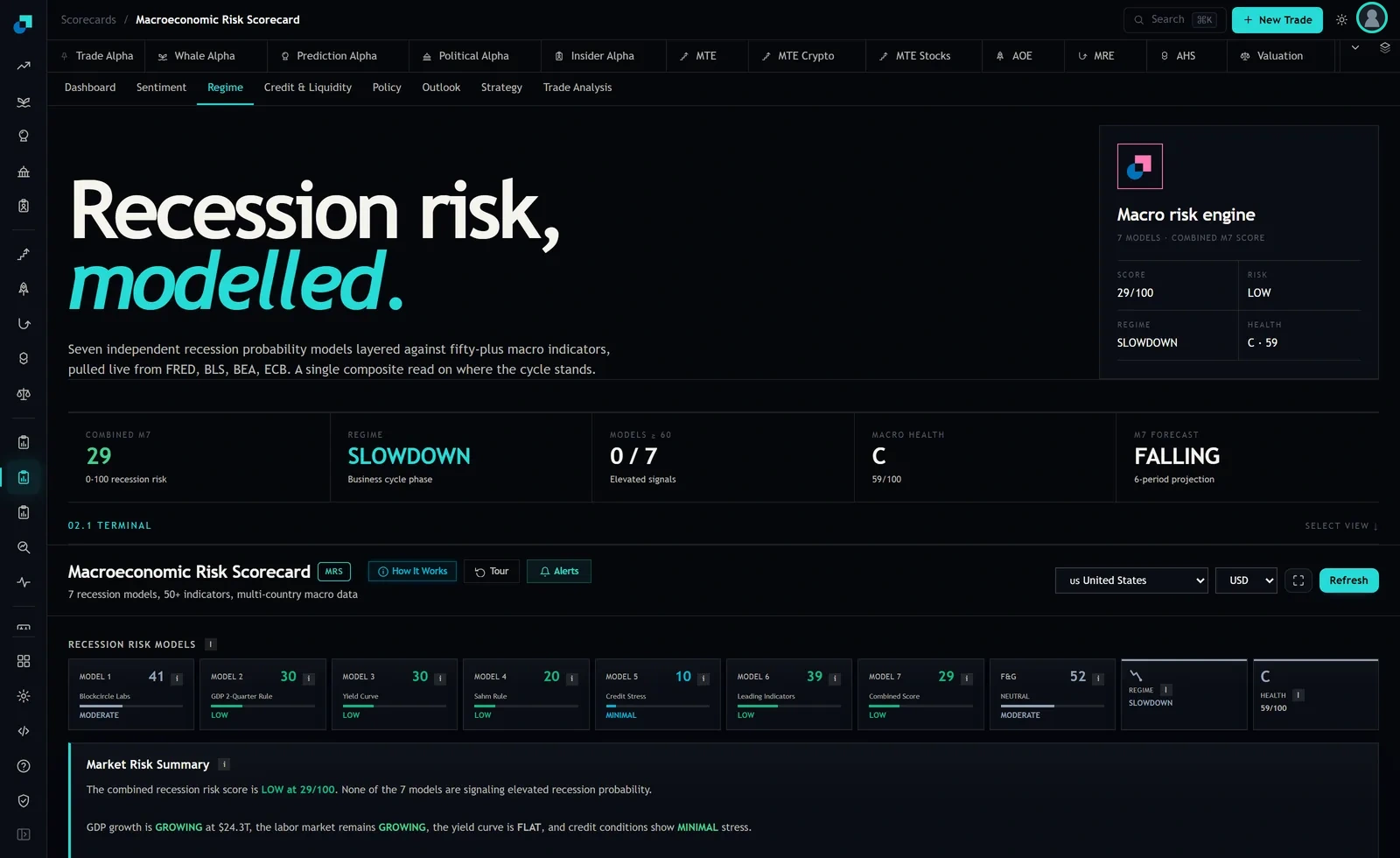
The regime tile on the Macroeconomic Risk Scorecard reads SLOWDOWN, and the line under it says business cycle phase. Suppose that word changes on a Tuesday. The question that lands on the desk is not whether the new label is correct. It is how many observations the new label has to survive before it is allowed to move a mandate, and whether the number you use can be defended to a committee six months later.
Most desks answer that implicitly and badly. Either the label moves the book on sight, which turns a slow-moving statistical construct into a trading trigger it was not built to be, or it moves nothing until somebody senior is persuaded, which is still a dwell rule, just one with an undocumented and variable length that happens to correlate with whoever spoke last. Both fail the same review question, which is what your rule was before the label changed.
The statistic this rule wants, and why I will not hand it to you
The clean way to set a confirmation window is empirical. Take every fresh label in the history, ask what fraction of them reverted inside a quarter, and set the window where the reversion rate stops falling fast. That is the right shape of analysis and I am not going to give you the answer, because I do not have it and neither does anyone quoting one at you without showing their label series.
The regime tab, as it stands in front of me, publishes a current state. One phase word, the combined M7 score of 29 out of 100, a risk band, a health grade, and the count of models at or above 60. It is a point-in-time read. I am not going to assert that the page exposes a label history, a transition log or a reversion statistic, because that is not something the capture confirms, and product behaviour I have not seen is exactly the sort of thing that gets written into a policy document and then discovered to be false in the worst week of the year.
Two further problems sit behind the missing number even once you have the series. The first is that regime transitions are rare events. A decade of monthly observations contains a lot of rows and very few transitions, and a reversion rate computed on a handful of episodes carries a confidence interval wide enough to contain most of the policies you were choosing between. The second is revision. The indicator set behind this score is built on FRED, BLS, BEA and ECB series that revise for years, so a label history reconstructed from current-vintage data is not the history you would have seen in real time. It is the history with the answers filled in.
Dwell time is a price, so price it
Drop the search for the true window and treat this as what it actually is, which is a cost problem with two sides you can both measure on your own book.
Acting early costs a round trip on a position you did not need to take, plus the tracking error of sitting off benchmark for however long the false label persisted. Waiting costs the portion of the move that occurs inside the confirmation window. Neither of those requires you to forecast anything. Both are arithmetic once you write down your own numbers.
Work it through on a concrete book. Say a regime change shifts fifteen percent of gross, and your all-in round trip on that sleeve, commission plus half-spread plus realistic impact, is twenty five basis points on traded notional. Each direction costs about 3.75 basis points of NAV, so a full round trip on a label that reverts costs roughly 7.5 basis points of NAV. A policy that generates four false flips a year is spending about thirty basis points annually before it has been right about anything. Against that, one extra observation of delay costs you whatever fraction of the regime move happens in that interval, which you can estimate from your own realised history rather than from a vendor claim.
The window worth choosing is the one where the marginal reduction in false flips, valued at your 7.5 basis points, stops exceeding the marginal move you forgo by waiting. You cannot solve that on day one because you do not yet have the false flip rate. You can bound it. If your sleeve size and cost stack make a false flip cheap, a short window is affordable and you should not pretend otherwise for the sake of looking disciplined. If moving fifteen percent of gross costs you sixty basis points round trip because you trade in size in instruments with real impact, the arithmetic demands patience whatever your conviction about the label.
Confirm faster in one direction than the other
Symmetric dwell rules are tidy and wrong for most mandates, because the loss function is not symmetric. The cost of a false de-risk is bounded, measurable, and shows up as a performance drag you can explain. The cost of a late de-risk is path dependent, arrives alongside redemptions, and is the sort of thing that changes the client base rather than just the quarterly number.
So a defensible structure is a short window for reducing risk and a longer one for putting it back. One confirming observation to cut, three to restore, with the sleeve size chosen so the drag is tolerable. That is a deliberate bias, not a free option, and the honest version states the cost in advance. An asymmetric rule underperforms a fully invested benchmark across a long expansion. It should be described that way in the strategy document, with a rough annual drag attached, before it has cost anyone anything. The alternative is explaining it for the first time in a quarter when it is already down thirty basis points.
The other clause worth writing now concerns what happens mid-window. If the label flips back before your confirmation count is met, the counter resets to zero. Without that clause a rule that requires three observations quietly becomes a rule that requires three observations at any point in the past year, which is not a confirmation window at all.
The log that turns your policy into a measurement
Everything above becomes empirical the moment you have your own dated series, and building it is a five minute monthly job that nobody wants to own. Assign it anyway.
One row per observation, with the observation date, the label, the combined score, the count of models at or above 60, and whether you acted. That last column is the one people leave out and the one that pays. It lets you compute, after a couple of years, both the reversion rate you needed at the start and the realised cost of the window you chose, which is the difference between a dwell rule you can argue for and a dwell rule you have simply grown used to.
Count the window in observations rather than in months. Publication cadence varies, macro releases cluster and get delayed, and a rule phrased in calendar time silently changes its own strictness depending on the month. Two consecutive observations is a rule. Sixty days is a rule with a moving definition.
The clauses that get the rule through the meeting
A dwell policy is a governance artifact as much as a risk one, and the version that survives contact with an investment committee has five things written down before the label ever moves. What counts as an observation. How many consecutive confirming observations are required, separately for de-risking and for re-risking. What resets the counter. Who can override the window, and the requirement that any override is recorded with its reasoning on the day it is taken rather than reconstructed afterwards. And the expected failure mode, stated plainly, which is that a confirmation window guarantees you will be late to every genuine turn and is designed to be.
That last sentence is the one that does the work in the room. A committee that has agreed in advance that lateness is the purchase price for fewer whipsaws will not treat the first late entry as a model failure. A committee hearing it for the first time after the fact will, and correctly, because at that point it is not a policy, it is an excuse.