A regime overlay that is right eventually can still be a losing proposition, and the reason is entirely mechanical. The label goes from one phase to another, you shift the book, the label goes back, you shift the book back. Position-wise you are exactly where you started. Cash-wise you are not, and the gap is the number this article is about, because it is the number that decides whether regime following is worth running at your size at all.
Most desks underestimate it by a factor of two or three, and they do so in a consistent direction, which is that they cost the trade and forget everything around the trade.
The cost stack, all of it, not the commission line
Start with the sleeve. Call it fifteen percent of gross moved on a regime change, which is a fairly typical size for an overlay that is meant to be a risk control rather than a strategy in its own right. On a one billion dollar book that is one hundred and fifty million dollars of notional in each direction.
Now build the cost per direction properly. Commission and fees, small and easy. Half the quoted spread, which is the price of demanding immediacy and is the line most models get right. Market impact, which scales with participation rate and is the line most models get wrong, because it is estimated from average conditions and regime turns are not average conditions. Delay cost between the label printing and the order working, which for a monthly macro input is measured in hours or days rather than milliseconds and can dwarf everything else on the list. Financing and borrow changes if the shift involves derivatives or shorts. And for taxable vehicles, realised gains, which have no line in anyone's TCA report and are frequently the largest item.
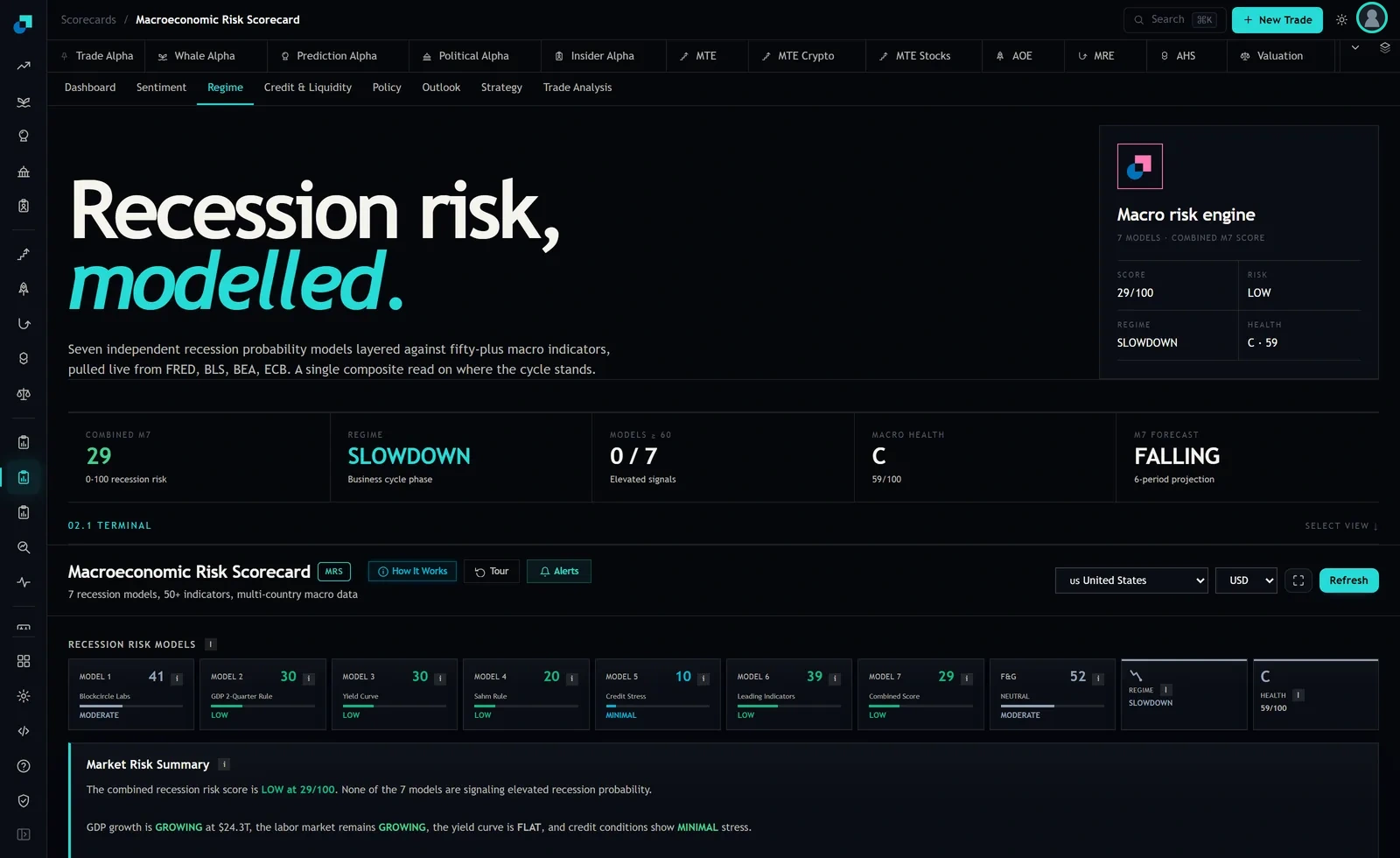
Add those up honestly and twenty five basis points on traded notional per direction is a reasonable working figure for liquid exposure moved without urgency. It is optimistic for anything less liquid, for anything moved in a stressed tape, and for anything moved in size relative to daily volume. Take that twenty five and it costs 3.75 basis points of NAV to move the sleeve one way, 7.5 basis points for a completed round trip, and 15 basis points for a flip out and back followed by a second flip out and back. Two whipsaws in a year is a fifteen basis point hole before the overlay has contributed anything.
The break-even hit rate, written down
That fifteen basis points is only meaningful set against what a correct call is worth. Define the terms narrowly so the arithmetic stays honest. Let C be the round-trip cost of a false flip in basis points of NAV, 7.5 in the example. Let G be the value captured on the sleeve when a regime call is correct, again in basis points of NAV, net of the same trading costs, and note that G is something you measure on your own realised history rather than something a scorecard can promise you.
Over a sample of flips where a fraction p are correct, expected value per flip is p times G minus one minus p times C. Set that to zero and the required hit rate is C divided by the sum of G and C.
Now put numbers on it. If a correct call is worth 30 basis points of NAV on the sleeve, you need 7.5 divided by 37.5, which is twenty percent. That is a low bar and regime following looks attractive. If a correct call is worth 10 basis points, you need 7.5 divided by 17.5, which is forty three percent, and now you are asking a macro label to be right nearly half the time on a sequence of decisions that are far from independent. If costs double because you trade in size or in stress, the same 10 basis point payoff needs a sixty percent hit rate, and at that point the overlay is a coin flip with a fee attached.
The uncomfortable implication is that the viability of a regime overlay is set mostly by the payoff per correct call and your cost stack, not by the quality of the regime model. Two desks running the identical label on the identical signal can land on opposite sides of break-even purely on execution and sleeve sizing. That is worth saying out loud in a manager meeting, because it explains why the same approach genuinely works for one book and genuinely does not for another without either party being wrong.
Flip frequency is the variable you actually control
You cannot make the label flip less often. You can make your book respond to fewer of the flips, and that is a design decision with four standard levers.
- Hysteresis. Require the new label to hold for a set number of consecutive observations before you act, and reset the counter if it flips back inside the window. This directly removes the short flips, which are the ones that are pure cost, at the price of entering every genuine move late.
- Proportional response. Move a third of the sleeve on the first confirming observation and the rest on the second. Halves the cost of a flip that reverts immediately while keeping some participation in a real turn. It is the cheapest of the four to implement and the most commonly skipped.
- Cheaper expression. Express the regime view in index futures or a liquid overlay rather than by reweighting the underlying book. A ten basis point round trip and a fifty basis point round trip produce different break-even hit rates on the same signal, and the instrument choice moves the answer more than any refinement to the model will.
- Netting against existing flow. If the book is already trading for other reasons, time the regime shift into that flow rather than as a standalone program. This is real and it is also the lever most easily overstated, since the netting benefit only exists to the extent your other flow happens to point the same way.
Note what none of those levers do. They do not improve the label. They lower the cost of being wrong, which changes the break-even hit rate, which is the only thing standing between an overlay that adds and one that quietly bleeds.
Where the arithmetic gets worse as you get bigger
Everything above holds fixed the assumption that impact is constant, and it is not. Impact rises with the participation rate, so a book that has grown by a factor of three is not paying three times the cost, it is paying more than three times, and the sleeve that was economically sensible at five hundred million can be uneconomic at two billion with the same signal and the same discipline.
Worse, the impact estimate you use is almost certainly calibrated on ordinary days. Regime flips do not arrive on ordinary days. They cluster around macro releases and policy events, which is when spreads widen and depth thins, and it is also when every other systematic macro participant is receiving a correlated instruction from their own model. Crowding is at its highest at precisely the moment your cost assumption is at its most optimistic. If your TCA says twenty five basis points on an average day, budget meaningfully more for the days a regime label actually turns, and be aware that you will not find out how much more until it happens.
There is one honest way to bound this before it bites, which is to reconstruct your last several regime shifts from your own execution records and compare realised implementation shortfall against the pre-trade estimate. If the realised number is consistently the higher one, your break-even hit rate is higher than the one in your policy document, and every conclusion downstream of that number needs recalculating. That is not a pleasant exercise and it is the one that decides whether a regime overlay is a risk control or an expensive habit.