The Market Reversal Engine pushes new signals out on three channels, email, Discord and Telegram, alongside the live dashboard. People tend to pick one on the basis of which app they already have open, which is a reasonable way to choose a newsletter and a poor way to choose the delivery path for something that stops being tradeable while you are in a meeting.
The right way round is to start with how long the signal is worth anything, then pick a channel that reliably beats that window. Those are two different questions and only the first one has a clean answer.
How long a reversal alert is actually worth something
The expiry window comes from the timeframe, and you can derive it in one step. Every visible row in the capture is stamped 15m in the TF column and SCALP in the Type column. A scalp on a 15-minute chart is a trade whose whole life is a handful of bars, and whose entry was defined at a specific price on the bar that just closed.
Once the market has moved a meaningful fraction of the distance between that entry and the target, the trade you are taking is not the trade the engine described. The stop is the same distance away in absolute terms and the reward left is smaller, which means the risk to reward you actually get degrades continuously from the moment of the signal. Nothing announces when it has degraded past the point of being worth taking. It just quietly does.
For a 15m scalp, treat the useful window as a small number of minutes. For a signal on a daily timeframe, the same logic gives you hours, because the entry to target distance is far larger relative to what price does in any given minute. That is the whole argument in one line: the shorter the timeframe, the more of the trade's value a delivery delay consumes.
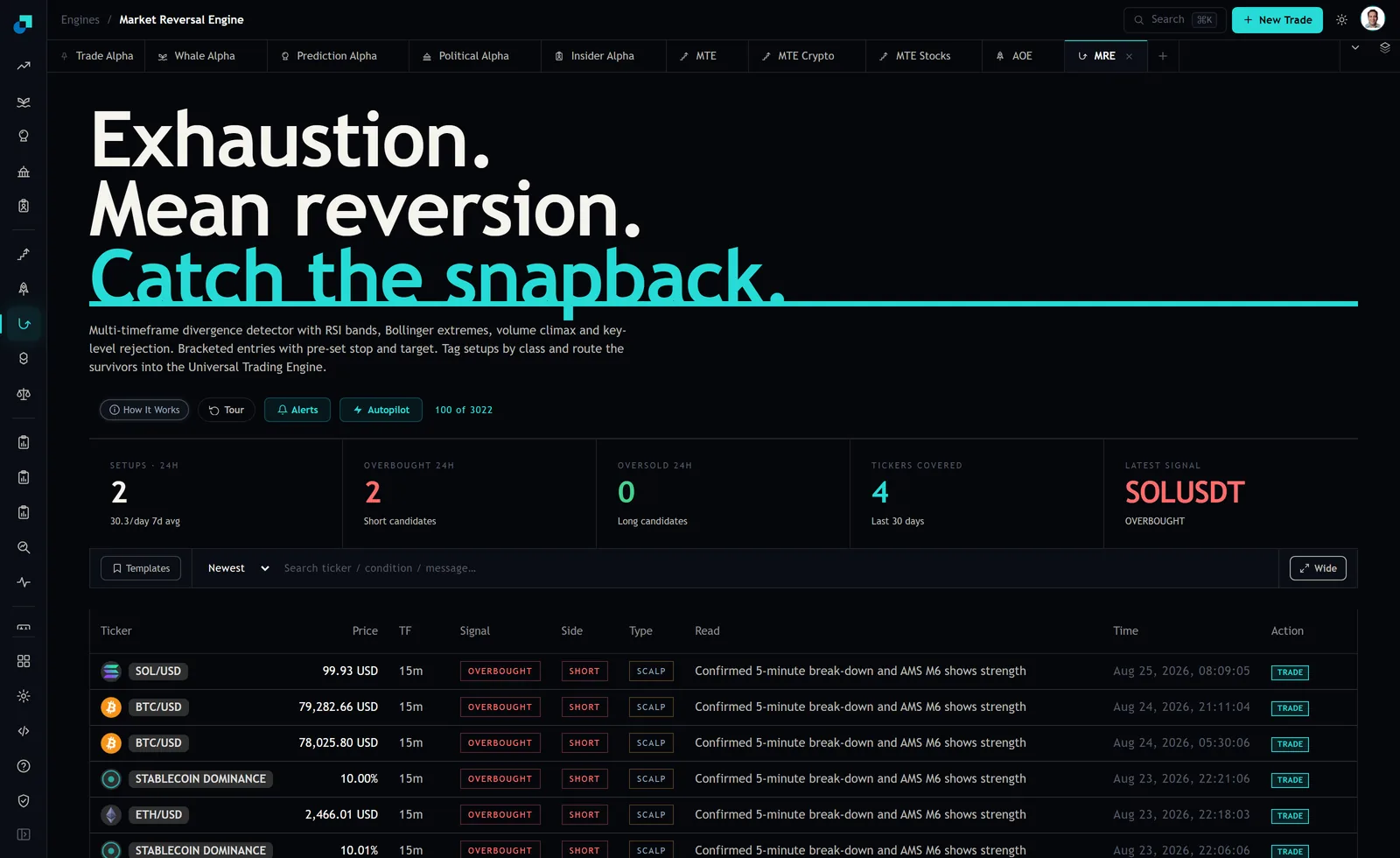
Look at those timestamps again. 05:30 in the morning. 22:06, 22:18 and 22:21 at night. This is a market that does not keep your hours, and a channel choice that works during your working afternoon is not the same as one that works at half past five.
What the platform states, and what it does not
Be precise about the published claim, because everything else in this article is your measurement rather than a quoted figure. MRE scoring updates on every supported timeframe close, and new reversal signals surface in the live feed within seconds of computation, then go out by email, Discord and Telegram to subscribers.
That tells you the feed is fresh. It does not tell you how long each channel takes to reach your phone, and there is no per-channel delivery table to quote. Nor could there be a meaningful one, because the last leg runs across infrastructure the platform does not own: your mail provider, your messaging app, your phone's notification settings, and whatever your operating system decided to do about battery optimisation this week.
So the delivery gap between channels is not a published number. It is a property of your setup, and the only version of it that matters is the one you measure yourself.
The ten-signal test that gives you your own numbers
This takes one afternoon of attention and then answers the question permanently.
Turn on all three channels at once. For the next ten signals, record two timestamps: the value in the Time column on the row, and the time each channel's notification actually landed on the device you would have been holding. Three arrivals per signal, thirty rows total.
Then read the result the right way. Take the worst delivery per channel, not the average. An alert channel is a thing you depend on under time pressure, and its typical behaviour is irrelevant compared with its bad behaviour. A channel that is usually quick and occasionally eleven minutes late is an eleven minute channel, because you cannot know in advance which kind of day you are having.
Two things to control while you do it. Run the test at the hours signals actually fire, including the unsociable ones, because notification behaviour differs overnight in ways that have nothing to do with the sender. And test on the specific device you would act from. A delivery time measured on a desktop with all three apps open tells you nothing about a phone in your pocket, and the phone is the realistic case.
Pairing channels to timeframes
Once you have the numbers, the pairing rule writes itself, and it is a rule about timeframes rather than about which app is best.
For any scalp-class signal on a short timeframe, you need a push channel, meaning one that rings a device you are carrying. Discord and Telegram are both built for this and email is not. Email is store and forward by design. It waits in queues, gets sorted by filters, and on most clients arrives when the client next decides to check. Every one of those behaviours is correct engineering for correspondence and wrong for a signal with a few minutes of shelf life.
For daily-timeframe reversals, email is genuinely fine and arguably better. The window is hours, so the delivery characteristics stop mattering, and email gives you a searchable, permanent, plain-text record of every signal you were sent, which is the raw material for reviewing your own decisions later. I keep the daily ones in email precisely because I want the archive.
The dashboard is the third mode and it is the one people underrate. If you are actively trading a session, the live feed is the lowest-latency path available to you, because there is no delivery leg at all. Alerts are for the signals that fire when you are not looking. Do not use them as a substitute for looking.
The failure that is not latency at all
Most missed alerts are not slow. They are silent, and the causes are unglamorous.
On Discord, a busy server plus default notification settings means the message arrives on time and never makes a sound. If you route alerts through Discord, put them in a channel where you have explicitly set notifications for all messages, and check that the phone app agrees with the desktop app about that. This is the single most common way people conclude a channel is slow when it was actually muted.
On email, a filter or a promotions tab quietly reclassifies the sender after some change upstream, and you find out a week later. Whitelist the sender and, more usefully, notice if you have not received an alert in a suspiciously long time. Silence from an alert channel is ambiguous by nature: it means either nothing fired or nothing arrived, and those are very different situations.
On any phone, focus modes and battery optimisation will hold notifications for an app that is not in your allow list. If you have decided a 05:30 signal is worth being woken for, that decision has to be implemented in the phone's settings, not just held as an intention. And if it is not worth being woken for, then the honest conclusion is that overnight scalps are not part of your strategy, which is a perfectly good answer and better than the version where you find out at breakfast.