Copying a whale sounds like a two step operation. They trade, you trade. In practice there are three separate delays stacked between their fill and your order resting on a book, and until you know roughly what each one costs you, you cannot tell whether the thing you are copying still has anything left in it by the time you arrive.
None of these legs is a secret and none of them is anybody's fault. Two of them you cannot shorten at all. One of them you can delete this afternoon, and most people reading a live feed are paying it without noticing.
Leg one is the chain and nobody shortens it
Before anything can be detected, the trade has to exist somewhere observable. On an Ethereum style chain that means being included in a block, which is roughly twelve seconds, and if you want any confidence that the block is not about to be reorganised you wait for more than one of them. On a venue with its own matching engine, which is where most of the activity on these feeds lives, the equivalent is the venue confirming the match and exposing it through an API.
This leg is physics as far as you are concerned. No vendor can compress it, and any product claiming to show you a trade before it settled is showing you something other than a settled trade. Budget for it and move on.
Leg two is detection, and the surface you read it on
This is the leg vendors compete on and it is also the leg that gets described most misleadingly. Blockcircle's whale engine header reports a P50 detection latency of about twelve seconds. P50 is the median, which means half of all events are detected faster than that and half are slower, and the page will never show you how much slower the slow half runs.
Then comes the part almost nobody accounts for, which is the surface you are actually looking at.
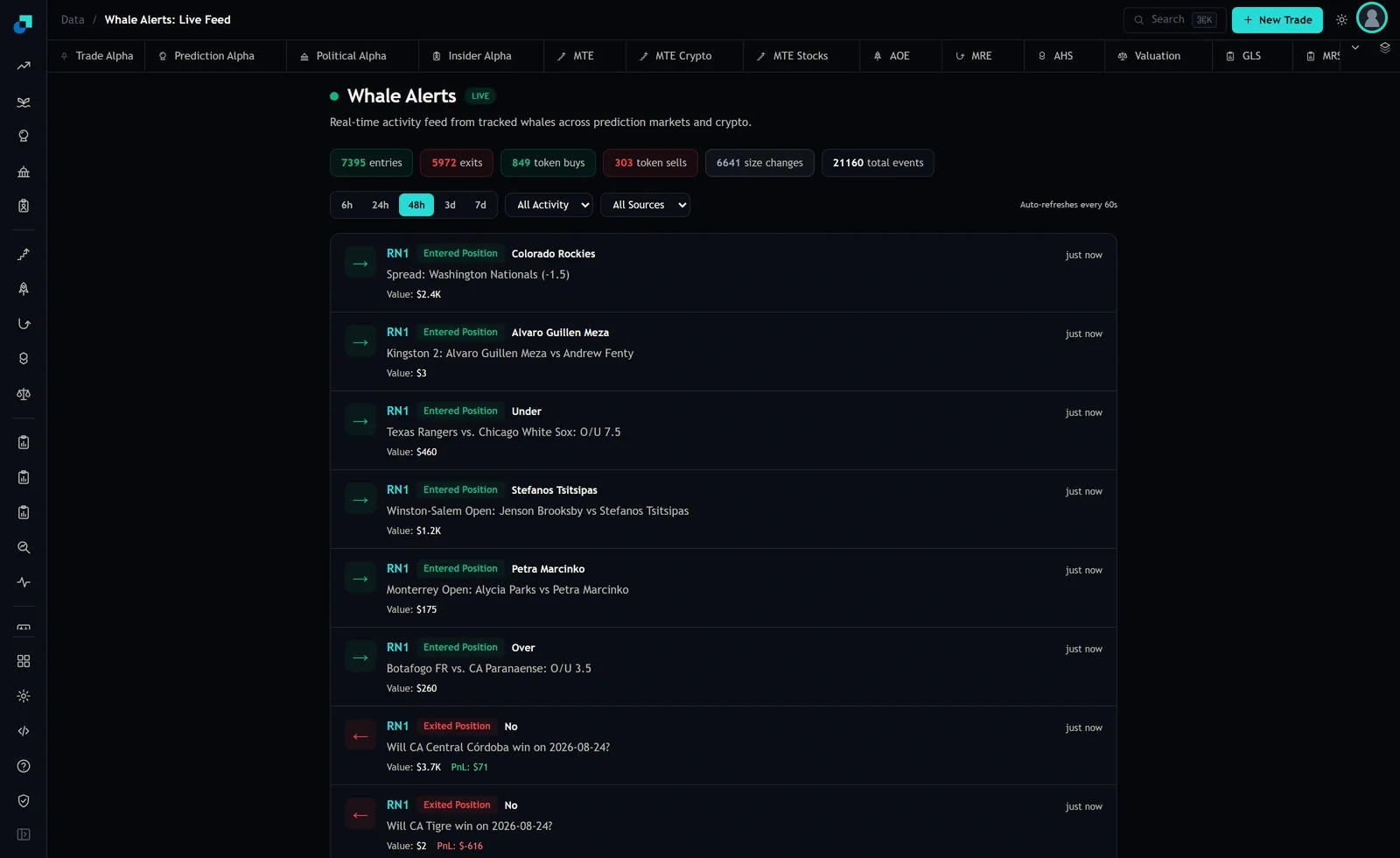
Sixty seconds. If you are watching this page and waiting for a row to appear, the repaint interval can cost you up to a full minute after detection has already happened. That is longer than the chain and the detection put together, and it is pure overhead. An alert delivered to a push channel skips the repaint entirely, which makes subscribing rather than watching the single largest free improvement available on this whole list.
The other thing worth noticing on that capture is that every row's time column reads just now. That is friendly and it is useless for measurement. You cannot compute your own delay from a feed that will not give you the event time to the second, which means the measuring has to be done with your own clock.
Leg three is you
Reading the row, deciding whether it is worth acting on, switching to the venue, finding the market, sizing the order and submitting it. Be honest about this number rather than optimistic. For someone already sitting at the screen with the venue open and funded, thirty seconds is a good outcome. If you have to think, or look up what the market actually is, it is a minute or two. If funds need to move first, it is not seconds at all, it is however long a transfer takes.
There is no clever fix here beyond preparation. Being pre-funded on the venue, having the market already open, and having decided in advance what you will do if a row of a given shape appears, is the difference between thirty seconds and five minutes, and it costs nothing except doing it beforehand.
Adding it up, and why the median hides the bad half
On a good path, with a push alert and everything ready: roughly twelve seconds of block, roughly twelve seconds of detection at the median, near zero for the alert, and thirty seconds of you. Call it a minute.
On the ordinary path, watching the page instead of subscribing: the same twenty four seconds, plus up to sixty of repaint, plus a minute of finding your way to the venue. Call it two and a half minutes.
Both of those assume the detection leg lands at its median. It will not always, and the tail is the part that matters, because detection systems slow down under load and load arrives with volatility, which is precisely when the events you care about happen. The honest planning number is not the median at all. It is the median for typical days and an unknown, larger figure for the days that matter, and the correct response to an unknown is not to pretend it is small.
Pricing your own delay in dollars
Seconds are the wrong unit. What matters is how much the price moved during them, and that varies enormously by market. Two minutes in a deep, slow market costs nothing. Two minutes in a thin market that the whale's own order just moved can cost more than the trade was ever going to make.
Measure it yourself, because it is your number and nobody else can produce it. For the next twenty copies, write down three things: the price when you read the row, the price when your order filled, and the direction. The average of those differences, in percent, is your decay tax. Once you have it, the decision rule becomes simple arithmetic. If your decay tax is 1.5 percent and the edge you believe you are copying is worth 2 percent, you are working for a quarter of a percent and paying fees out of it.
Keep the losers in that sample. The temptation to drop the trade where you arrived four percent late because it was an unusual day is exactly what makes the average useless.
Three changes that actually move the number
In order of how much they are worth relative to the effort.
- Subscribe instead of watching. The sixty second repaint is the largest single delay on the ordinary path and a push channel removes it outright. Nothing else on this list is close.
- Filter hard before you look. The alerts capture had events of $2.4K, $460, $175, $260 and $3 sitting in the same stream as a $3.7K exit. Reading noise costs seconds you have already established you do not have, and a $3 event carries nothing worth a two minute chase.
- Use resting limit orders rather than chasing. You have already lost the race by construction, so stop trying to win it. A limit at the price you would actually accept converts a latency problem into a price problem, and the price problem is the one you control. Sometimes it does not fill, which is the correct outcome for a trade whose entire premise was arriving early.
The uncomfortable conclusion underneath all of this is that for fast moving markets the copy trade may simply not be available to you at these delays, and no amount of tightening changes that. That is worth knowing early rather than discovering across forty trades. Where the delay genuinely does not matter is in positions with a horizon of days or weeks, where two minutes is noise and the information in the whale's position is about direction rather than timing. Those are the copies worth making, and knowing your own decay tax is how you tell which is which.