A signal row can carry a target and a stop as fields. Whether those fields can become actual resting orders sitting at a venue while you are asleep is a completely separate question, and it is answered by the venue, not by the platform and not by you. This is the gap people discover at the worst possible moment, which is after the entry has filled and they are trying to place the protection.
It is worth ten minutes per venue to close it in advance, and the ten minutes has to be spent at the venue rather than in the catalog. Here is why, and then here is what to actually do.
The order type is a property of the venue, not a setting on the platform
The mental model that causes trouble is thinking of the order type as something you choose in one place and the system arranges everywhere. It is not. An order type is a thing a specific venue's matching engine either implements or does not, and the platform can only ask for what the venue is capable of accepting.
You can see the shape of this in the signal feed itself. Rows carry an Order column, and every visible row at the capture I am working from read MARKET. They also carry TP and SL columns, and on those same visible rows both read as a dash. So the feed's default path is a market entry, and the protective legs on those particular rows were not populated. Whatever a row does carry, the moment of truth is the ticket at your venue, and that is where an unsupported type stops being an abstraction.
There is no capability row, so do not go looking for one
I want to be exact about this because it would be easy to imply otherwise and it would save me a paragraph.
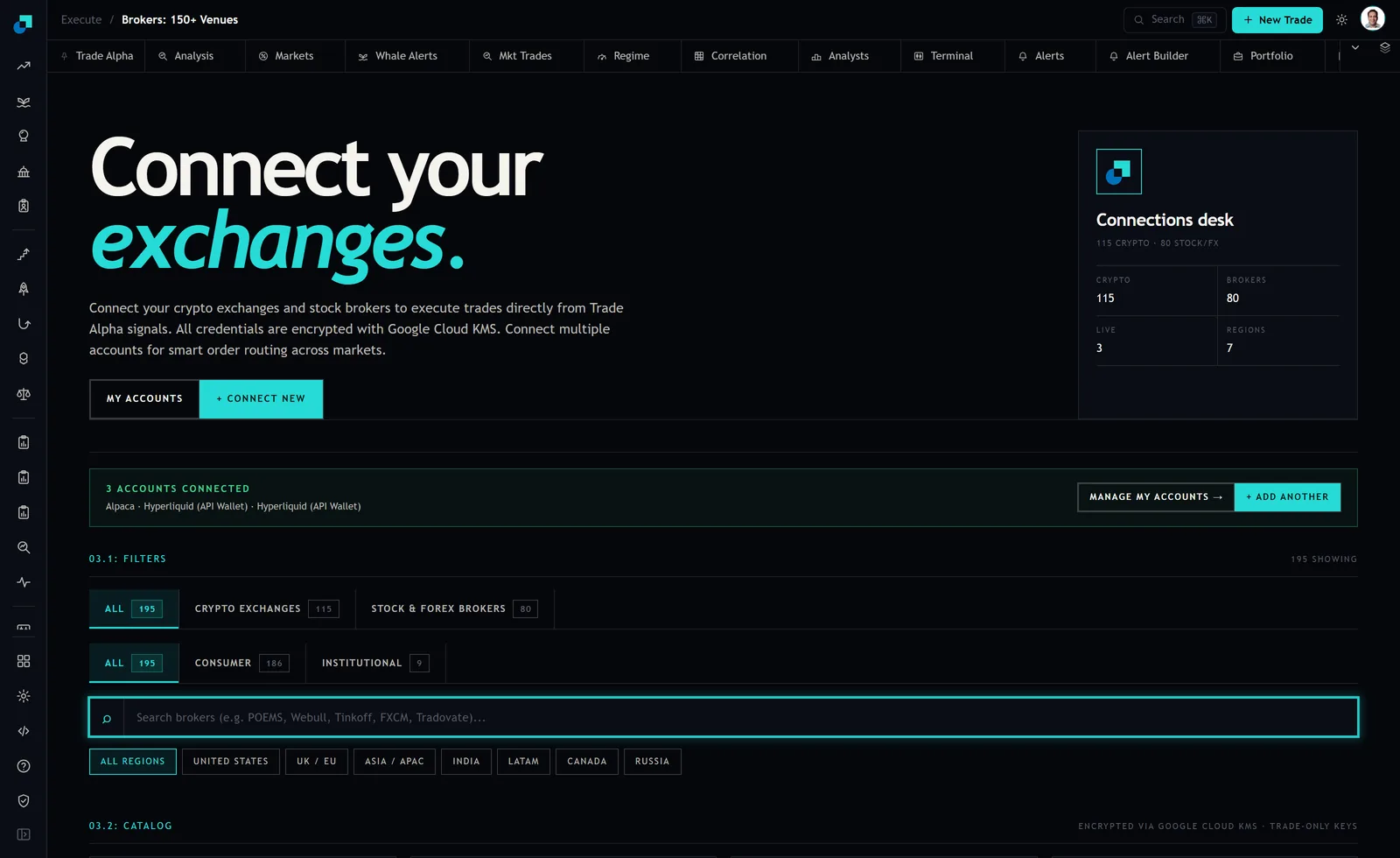
The filters at capture were asset class, splitting 195 showing into 115 crypto exchanges and 80 stock and forex brokers, then customer type at 186 consumer against 9 institutional, then region across seven options, plus a search box whose placeholder suggested names like POEMS, Webull, Tinkoff, FXCM and Tradovate. That is the full set of axes the catalog sorts on. None of them is order type support, and I am not going to describe a capability matrix that is not there.
So the check is manual and it is done once per venue. Open the venue's own order ticket on an instrument you actually intend to trade, and look at what the ticket offers. Ten minutes, and it is the only method that produces an answer you can rely on, because the ticket is the thing that will accept or refuse your order at three in the morning.
Four capabilities, in the order they will hurt you
Test these four, in this sequence, because they are ranked by how much damage the absence causes.
- A resting stop. Can you leave a stop order at the venue that will trigger without you present? This is the one that matters most and it is the one most often missing or restricted on crypto venues, where a stop may exist only for some instrument types or only in a specific margin mode.
- A bracket or an OCO pair. Can a target and a stop coexist so that filling one cancels the other? If they cannot, and you place both manually, you are exposed to both filling and leaving you with an accidental position in the opposite direction.
- Order duration. Does the ticket offer good-till-cancelled, or only good-for-day? A day order on a multi-day signal is not protection, it is protection that expires at the close and leaves you naked overnight without telling you.
- Size granularity. Minimum order size, minimum increment, and whether fractional quantities are accepted. This is the one people never check and it is covered separately below because it changes more than it looks like it changes.
Write the four answers down next to the venue name. It is a four-line note per account and you will refer to it constantly.
What to do when the venue cannot hold the protective leg
Assume you have tested and the answer is that this venue cannot rest a stop for this instrument. You have three options and only three, and two of them are legitimate.
The first is to trade the instrument somewhere that can. This is the correct answer more often than people accept, and it is the reason a second connection can be worth having even when the first one nominally covers the asset class.
The second is to reduce the position until an unprotected adverse move is survivable, and to define the exit as an alert plus a manual action rather than pretending it is automated. If your plan is a mental stop, size the position so that being asleep through the worst plausible move costs you an amount you have decided in advance to accept. That is a real strategy. It is worse than a resting stop and it is honest about being worse.
The third option, which is not legitimate, is to take the position at full size and assume you will be watching. You will not be watching. Everyone believes they will be watching.
The related trap is the bracket that was never accepted. If you send a target and a stop and one of them silently fails to rest, your screen shows an order that does not exist. After placing any protective order, refresh the venue's open orders list and confirm the order is actually there, with the price and quantity you intended. Do this every time until the venue has earned enough trust that you only do it sometimes, and then keep doing it anyway on the trades that are large for you.
Minimum size quietly rewrites your position sizing
This is the capability gap that costs money without ever producing an error message you notice.
Suppose your rule is to risk one percent of a 5,000 dollar account on a stock signal, and the stop sits eight percent below entry. That is 50 dollars of risk and a position of roughly 625 dollars. On a venue supporting fractional shares this is trivially placeable on almost any name. On a venue that requires whole shares, a 200 dollar stock rounds you to three shares at 600 dollars, which is close enough, and a 600 dollar stock rounds you to one share, which is 600 dollars against an intended 625 and is fine, or zero shares if you round down, which means you simply cannot take the trade.
The pattern to watch for is not the occasional impossible trade. It is the systematic drift where rounding always pushes you slightly larger on expensive instruments and slightly smaller on cheap ones, so your realised risk per trade stops matching your intended risk per trade in a way that correlates with price. Over a few dozen trades that is a meaningful distortion of the thing you thought you were controlling.
The fix is to check the minimum and the increment for the specific instruments you trade most, then set your standard position size so that rounding is a rounding rather than a decision. If an instrument's minimum size forces a position larger than your risk rule allows, that instrument is out of range for this account at this size, and knowing that in advance is far better than discovering it with an order ticket open and a signal going stale.