The strategy conversation about congressional disclosure data usually happens six months before the compliance conversation, which is exactly backwards. By the time a portfolio manager is asking whether the signal works, somebody has already pulled the feed into a research environment, and the questions that should have been answered at that moment are now being answered retroactively with a live position on the book.
What follows is the set of review points I would want closed before a disclosure feed is permitted to influence a discretionary account. It is a process checklist, not legal advice, and every item on it is a conversation with your chief compliance officer rather than something a portfolio manager gets to decide alone. Where your firm lands on each point is your firm's judgment. Having no recorded position on them is the actual failure.
Licensing and permitted use come before anything else
The underlying filings are public records. Your access to them, in the form you are consuming them, is not the same thing. A vendor feed carries terms, and those terms differentiate between internal research, use in a discretionary mandate, redistribution to clients, and inclusion in marketing material. Those are four different permissions and firms routinely assume that having the first grants the other three.
Get the specifics recorded. Does the agreement permit use in a fee-earning strategy. Does it permit showing derived output to prospects. Does it permit retention of historical snapshots after termination, which matters enormously because your point-in-time research archive is worthless if you have to delete it when you switch vendors. Does it cover every entity in your group or only the contracting one.
The MNPI question is not the one people expect
The intuitive worry is that trading on a politician's disclosed transaction is trading on inside information. For the filed disclosure itself, that framing does not hold up, because the document is a public filing available to everyone at the moment of publication. Acting on published public information is what every research process does.
The real material nonpublic information exposure sits somewhere else entirely, and it is worth writing down precisely because it is adjacent rather than obvious. It is in the channels around the data. If anyone at your firm has a government relations function, a policy consultant, an expert network relationship touching legislative staff, or a personal connection to a member's office, then your firm has a potential path to information that is not in the public filing, and a strategy explicitly organised around legislative activity makes that path materially more sensitive than it was last year.
So the attestation you want is not "we do not trade on MNPI", which every firm already asserts. It is a narrower, dated statement that the political strategy's inputs are limited to published filings and derived analytics, that no employee involved in the strategy has provided or received non-public legislative or policy information relevant to a position, and that the firm's information barriers have been reviewed specifically in light of this strategy. Refresh it on the same cadence as your other attestations.
Source provenance and the point-in-time record
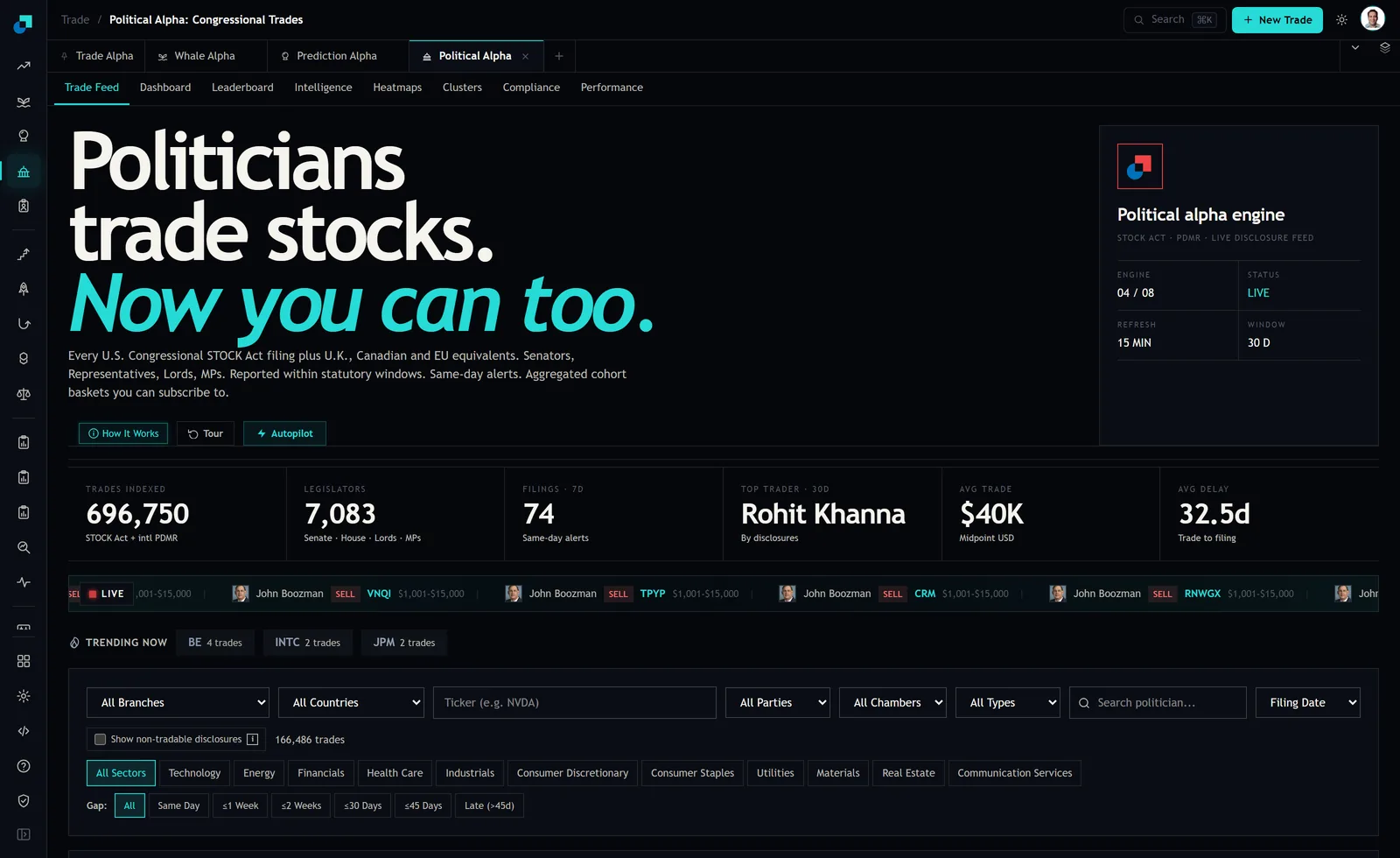
The question that will be asked after a bad outcome is what you knew and when you knew it. That is answerable only if your ingestion preserves two separate timestamps for every row, the date of the underlying transaction and the moment your systems received the record. The module's own header made the reason plain at capture, showing an average delay of 32.5 days between a trade occurring and the filing appearing, and disclosure records are amendable after publication.
If your database stores only the current state of each filing, then every historical query you run silently answers with information that did not exist at the time. That is not merely a backtest hygiene issue. It is a record-keeping problem, because you cannot evidence the basis for a decision if your system has overwritten the basis.
Three concrete requirements. Immutable ingestion snapshots with retention matching your books and records policy. An amendment log rather than in-place updates. And a documented reconciliation, run on a schedule, between the vendor feed and the primary public source, so that when a discrepancy appears you can show it was detected by a control rather than by a client.
Who reviews, who signs, and what they are signing
A systematic-sounding input arriving in a discretionary process creates an accountability gap that regulators and clients both notice. If the model surfaces a name and a manager acts, the file needs to show which of them made the decision.
Decide in advance whether the feed is a candidate generator or an execution trigger, because the supervisory requirement differs sharply. A candidate generator that feeds a human research process needs the same documentation as any other idea source. A rules-based path from filing to order is an algorithmic strategy in substance and needs model governance treatment, including documented change control on the rule set, a named model owner, pre-implementation testing evidence, and a kill process that a supervisor can invoke without an engineer.
Also settle the personal trading overlap. A strategy that publicly follows politicians' disclosures while your own staff hold the same names in personal accounts is an optics problem before it is a policy problem. Decide whether names in the strategy universe go on a restricted or pre-clearance list, and write the reasoning down either way.
What the file has to contain when a position goes wrong
Assume the position is down forty percent and a client has read a news story about the strategy. The file needs to answer four things without anyone reconstructing them from memory.
What the investment thesis was, in its own words, independent of the filing. A disclosure is a candidate generator, and "a member of Congress bought it" is not a thesis that survives a client meeting. The research note has to stand on its own merits.
What the universe rules were on the trade date, and evidence they predate the trade. What the sizing basis was, given that the disclosed band on these filings is a range and the module's own average trade figure sat at $40K on a midpoint convention, which is not a size any institutional book scales from.
And what the strategy was actually told to expect. The module publishes its own performance analytics, and at capture the aggregate readings on that tab were an average 30 day alpha of minus 0.25 percent and a 48.2 percent win rate over 5,000 trades analysed. Whatever your own research concludes, the fact that the vendor's headline cohort numbers were not flattering, and that you saw them and formed a view anyway, is far better in the file than the alternative, which is a record suggesting nobody looked.