Most launch diligence templates I have been handed are one list applied to everything. Twenty questions, a scoring column, a sign-off box. They fail in a specific and repeatable way. Run the same twenty questions across a fair launch, a presale and a points farm and you get three scores that look comparable, produced by a process that never asked the one question that mattered in each case. The template did not catch the risk because the template was never pointed at it.
The fix is not more questions. It is a taxonomy. Classify the distribution structure first, then apply the question set built for that structure, and attach one disqualifier that ends the work immediately when it trips. Three structures cover most of what arrives in a launch feed, and each one conceals something different.
Three structures, three different things being concealed
A fair launch conceals concentration. The distribution is open by design, which is exactly what makes the resulting ownership unobservable at the moment of launch and trivially manipulable by anyone running more than one wallet. The appearance of openness is the mechanism.
A presale conceals cost basis. Someone else's entry price and unlock schedule determine the supply that will arrive above you, and none of it is visible in market data. The token trades, the chart looks like a market, and a material share of the float has a basis you have not been told.
A points farm conceals the size and timing of a future claim. Activity is rented with an unpriced obligation, and the obligation converts into sell pressure on a date the issuer chooses. Every metric that makes the protocol look healthy before the conversion is the thing that makes it fragile after.
These are not three intensities of the same risk. They are three different risks, and a generic checklist averages them into a number.
What the launch ledger can and cannot classify
Before designing question sets, be precise about where the classification comes from, because it does not come from the module. On my capture the launches ledger carried Token, Chain, MCap, Volume, Liquidity, Holders, Score, Safety, Date, DEX and Trade, with the header reading 100 of 3,771 displayed across nine chains. There is no field naming the distribution structure. There is no field for a raise, a vesting schedule or a points programme.
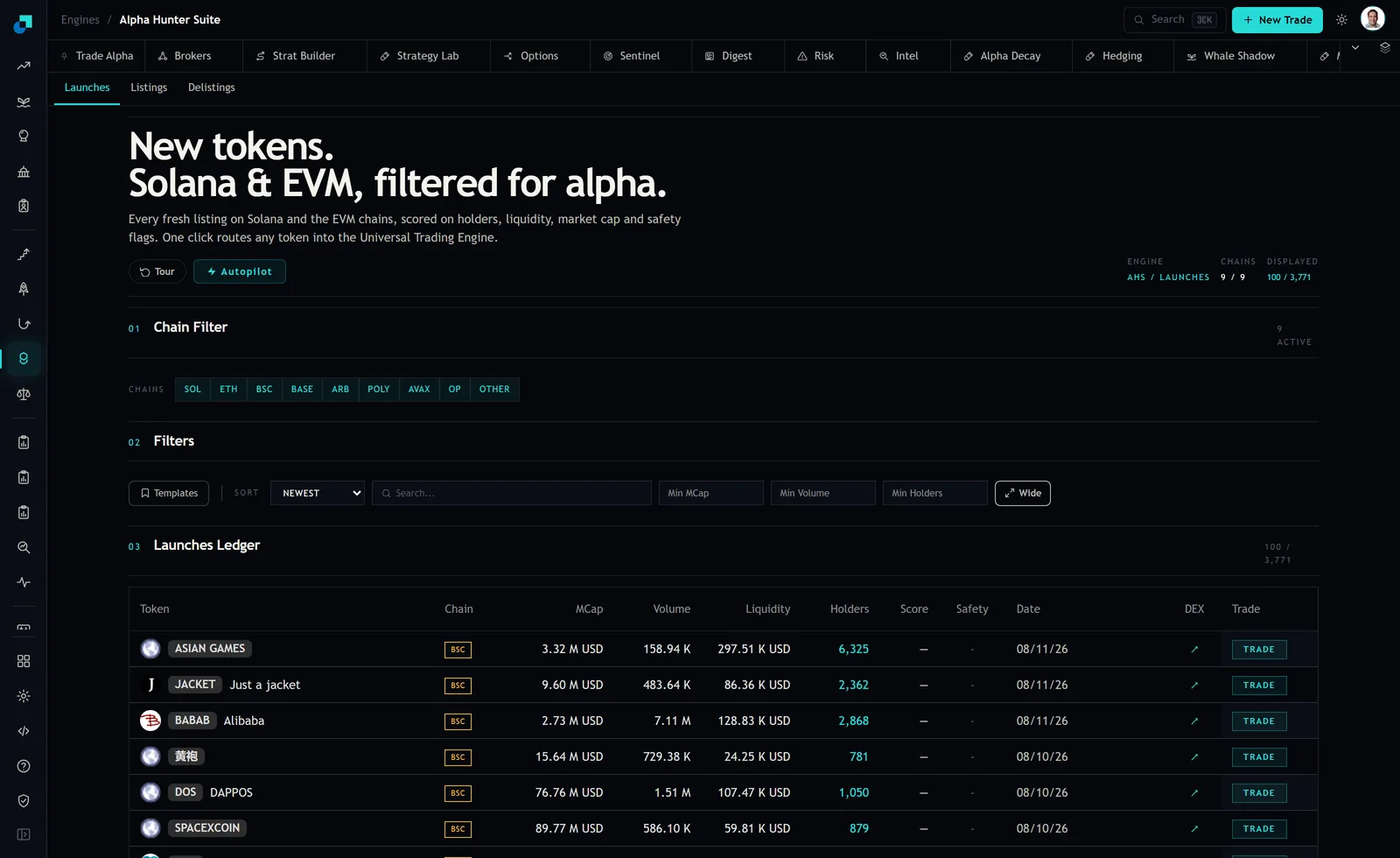
What the ledger gives you is the population and a set of state readings on it. Holders on the visible rows ranged from 512 up to 59,753. Liquidity ran from 12.19 K USD to 297.51 K USD. Those are useful inputs to the question sets below, and they are how you triage a feed of thousands down to something a human can work through. They are not the classification. The classification is an analyst judgement, made from the project's own disclosures, and it must be written down with the evidence that supports it.
Note also that Score and Safety were empty on nearly every visible row, showing a dash rather than a value. Any workflow that waits for those fields to speak before doing diligence will wait indefinitely on most of the feed.
Fair launch, and the concentration question
The question set here is entirely about ownership, because ownership is the thing the structure hides.
Ask what share of supply sits in the largest non-pool addresses at the earliest observable point, and how that share moved over the first days. Ask how many of the top addresses were funded from the same source, since common funding is the cheapest tell for one entity presenting as many. Ask whether the deployer retains a balance and whether the liquidity position is held, locked or burned, and get the transaction rather than the claim. Ask what fraction of holders acquired in the first block or the first minute, because a distribution that was open in principle and captured by automation in practice is not the thing the label describes.
Note what the Holders column can and cannot do for this. A count of 6,325 tells you how many addresses hold. It says nothing about how the supply is split between them, and it is a point-in-time level in the module rather than a series, so a concentration trend has to come from your own snapshots.
The disqualifier: unverifiable ownership at entry. If you cannot establish, from chain data you pulled yourself, what share of supply the top addresses control and where it came from, the file closes. Not a lower score. Closed.
Presale, and the supply arriving above you
Here the questions are documentary rather than on-chain, and they are answered from terms the issuer published or did not.
Ask what was raised, at what implied valuation, and across how many tiers with what price differential between them. Ask what fraction of total supply is unlocked at listing and what the cliff and vesting schedule looks like for the rest, expressed as a monthly supply increase you can plot against observed daily volume. Ask who holds the treasury and under what control arrangement. Ask whether the terms you are reading are the terms that were offered, or a summary published afterwards.
The comparison that does the work is unlock volume against traded volume. A schedule that releases tokens worth several days of turnover every month is a structural downward force on price that has nothing to do with the project's merit and will not stop because sentiment improves. Do that arithmetic before anything else, because it frequently ends the discussion.
The disqualifier: no published, dated allocation and vesting schedule. An undisclosed schedule is not an information gap you can price with a wider margin of safety. It is an unbounded liability, and there is no position size that makes an unbounded liability appropriate.
Points farms, and the claim you cannot size
The distinguishing feature is that the obligation exists before its size is known, and the capital that created it is explicitly there to collect it.
Ask whether a conversion rule from points to tokens has been published, and if so whether it is binding or indicative. Ask what the snapshot policy is and whether it has been changed mid-programme, which is common and is the single most informative governance signal available. Ask what the sybil policy is and how it is enforced, since a programme that cannot detect wallet splitting is measuring effort, not adoption. Ask what share of deposits arrived after the programme was announced, which separates users from farmers with reasonable accuracy.
Then ask the question that most files skip. What does this look like the week after conversion, if every point holder sells on receipt? That is not a pessimistic scenario. It is the base case for capital that was rented, and the burden is on the project to explain what would make it otherwise.
The disqualifier: no published conversion rule at the point you would have to size a position. Sizing against an unquantified future claim is not analysis.
The record that survives a personnel change
The taxonomy is only worth the effort if it is auditable eight months later by someone who was not in the room, and that means the classification is a recorded decision rather than a habit of thought.
Store one file per name, keyed on the contract address rather than the symbol. The launch feed makes the reason obvious. On my capture the symbol TUT occupied nine visible rows with market caps ranging from 601.83 M USD to 14.90 B USD, which are not one token seen nine times. A symbol-keyed file merges unrelated assets and will do so quietly.
Each file carries the assigned structure, the evidence that supports the assignment, the question set applied, the answers with sources and dates, and the disqualifier check with an explicit pass or fail. Where a name is genuinely a hybrid, and some are, record it as the structure whose disqualifier is strictest and note the reason. That rule prevents the reclassification argument from becoming a route around the disqualifier, which is what it will otherwise become.
What this buys you in a review is a specific and defensible sentence. You applied the presale question set because the project published sale tiers, the vesting schedule was disclosed and plotted against volume, and the position was sized at a level you can point to in the file. Whether the position worked is a separate matter, and the file exists precisely so the two questions stay separate.