Three financial conditions indices on one screen, pointing three ways, and a meeting in an hour. The instinct is to work out which one is right. That is the wrong question and it produces the worst kind of answer, which is the index that agrees with the position you already hold.
They disagree because they were built to disagree. Different input sets, different weighting schemes, different normalisation windows, different opinions about whether an equity drawdown is a tightening of conditions or a consequence of one. Each is internally coherent. The reconciliation problem is not about truth, it is about precedence, and precedence is something you decide in advance and write down, or something you improvise under pressure and cannot defend later.
Four construction choices that produce most of the divergence
Before comparing readings, know what you are comparing. Almost all persistent disagreement between conditions indices traces to four decisions.
- The input set. Some indices are built mainly on the price of credit and the shape of the yield curve. Others add equity valuations, implied volatility, exchange rates and survey-based lending terms. An index that includes equity prices will report tightening during an equity drawdown that leaves the cost of corporate borrowing untouched, which is not an error, it is the definition.
- The weighting method. Statistical extraction of a common factor gives you weights that shift with the covariance structure of the sample. Fixed weights do not. The first adapts to the current market and is harder to explain. The second is explainable and will be wrong in exactly the periods where the covariance structure has changed, which tends to be the periods that matter.
- The normalisation window. Most of these indices are standardised against a history, and the choice of history sets the zero. An index normalised over a long sample that includes several different policy regimes will place today's reading differently from one normalised over the last decade. Two indices with identical inputs can print opposite signs purely on this choice.
- Level against change. Some are designed to be read as a level relative to a neutral point, some as a rate of change. Read a change series as a level and you will conclude that conditions are easy when they are merely easing from something worse.
Work through those four for each index you consult and most of the mystery evaporates. What is left is genuine disagreement about the state of the world, which is a smaller and more interesting set.
What the scorecard is in this comparison, and what it is not
Be precise about the third object on the desk, because it is easy to file it in the wrong category. The Macro Risk Scorecard is not a financial conditions index and does not present itself as one. It is a recession risk composite, seven probability models over more than fifty macroeconomic indicators from FRED, the BLS, the BEA and the ECB, resolving to a combined M7 score of 29 out of 100 with a risk band of LOW, a macro health grade of C at 59, and a business cycle phase reading of SLOWDOWN.
Its credit and liquidity coverage is real, described as credit stress monitoring across credit default swap spreads and high yield spreads, together with the dollar index and global liquidity tracking. But that coverage enters as one model among seven. Model 5, Credit Stress, reads 10 and is tagged MINIMAL, next to the GDP two quarter rule at 30, the yield curve at 30, the Sahm rule at 20 and leading indicators at 39.
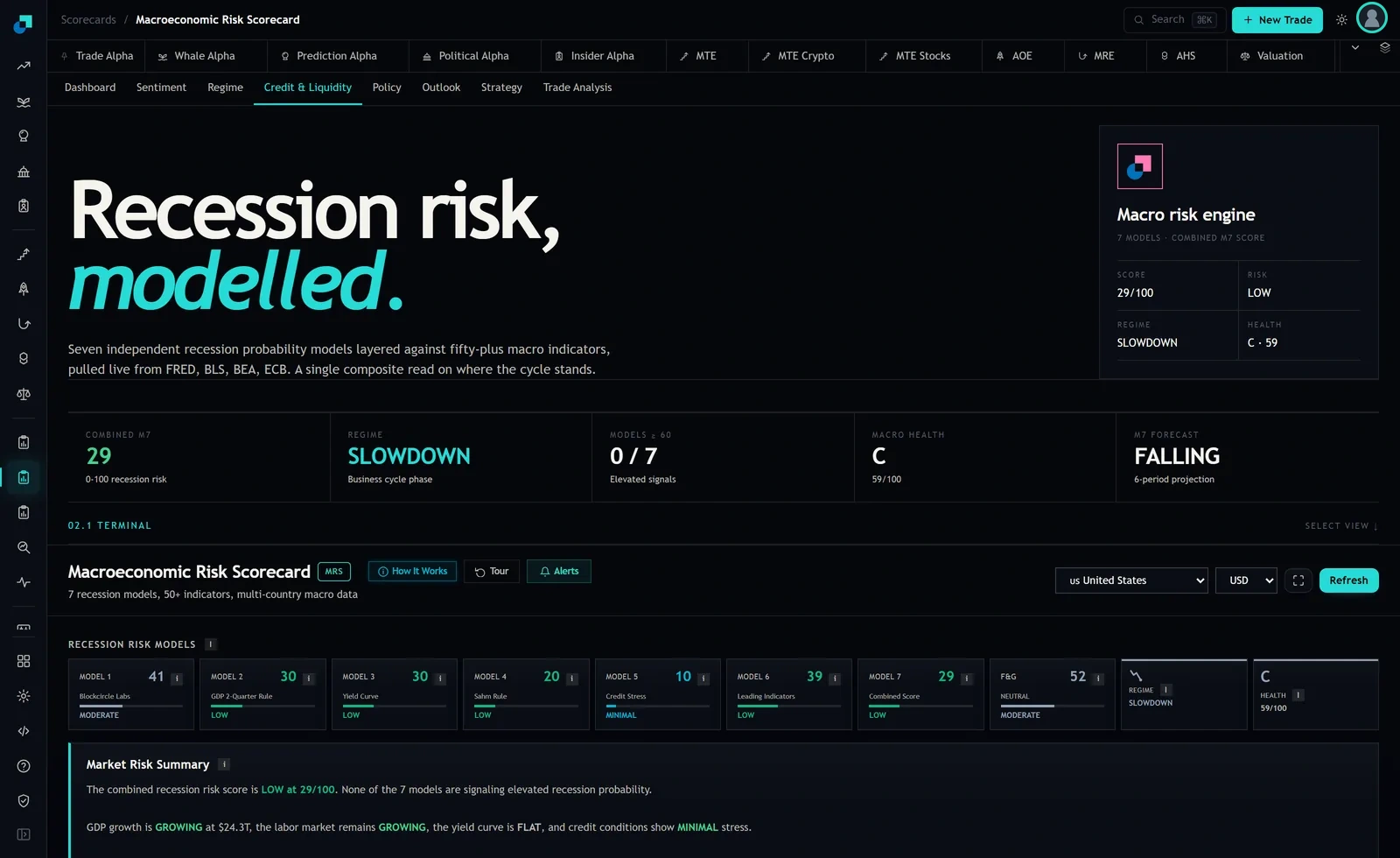
So when the scorecard and an external conditions index conflict, the first thing to establish is whether they even disagree. A conditions index reporting tightening and a recession composite reporting low risk are answering different questions and can both be right. Genuine conflict exists only at the level of the shared input, which here is the credit and liquidity node.
A precedence rule you write before you need it
The rule that has held up for me has three layers, and the reason it works is that it never requires a judgement about which index is better.
Layer one is domain. Each index governs the question it was built for. If the decision in front of you is about the cost and availability of financing, the index whose inputs are financing costs governs, whatever the others say. If the decision is about the probability of a downturn, the recession composite governs. Most apparent conflicts are decisions being adjudicated by the wrong instrument.
Layer two is direction over level. Where indices are genuinely measuring the same thing and disagree on level, they frequently agree on direction, and direction is the more robust of the two because it survives the normalisation choice that produced the level disagreement in the first place. A rule keyed to direction is a rule you will not have to relitigate every time somebody rebases a series.
Layer three is the tie break, and it should be conservative by construction. When domain does not settle it and direction is split, the reading that implies more caution governs the sizing decision, and the disagreement is recorded rather than resolved. That asymmetry is defensible in a review in a way that "we went with the one we found more credible" is not, and it removes the incentive to shop for the index you like.
The reconciliation memo, and why it is short
Whenever a conflict is material enough to change a position, it should produce a written record on the day, not a reconstruction later. Four lines is enough.
Record what each index reads and the date. Record which of the four construction choices you believe explains the divergence, since if you cannot name one, you probably do not understand the disagreement yet. Record which layer of the precedence rule applied and what it delivered. And record what would resolve it, meaning the specific observation that would make the dissenting index agree.
The fourth line is the one that pays. It converts an unresolved conflict into a dated, falsifiable expectation, and reviewing those expectations quarterly is how you find out that one of your three indices has been systematically uninformative for your book. That finding is worth more than any single reading, and there is no way to reach it except by having written the expectation down at the time.
Persistent disagreement is itself a reading
One last point, and it is the reason not to collapse three indices into one blended number, which is the usual instinct.
Averaging destroys the information in the spread between them. When an index heavy in market prices tightens while one built on lending terms and official data does not, that gap is a statement about where the pressure is showing up. It is the difference between the market repricing risk and the actual supply of credit contracting, and those have different implications for how quickly the condition can reverse. Market-priced tightening can undo itself in a week. Contraction in the actual supply of credit does not.
Blend them and you have deleted that distinction to obtain a smoother line. Keep them separate, run the precedence rule, and treat a wide and persistent gap between them as its own observation with its own row in the monthly note. The scorecard's model row makes the same argument in miniature, since the seven models are useful precisely because they are built on deliberately different inputs and can be read against one another. Consolidation is what the combined score is for. It is not what your reconciliation process should be for.