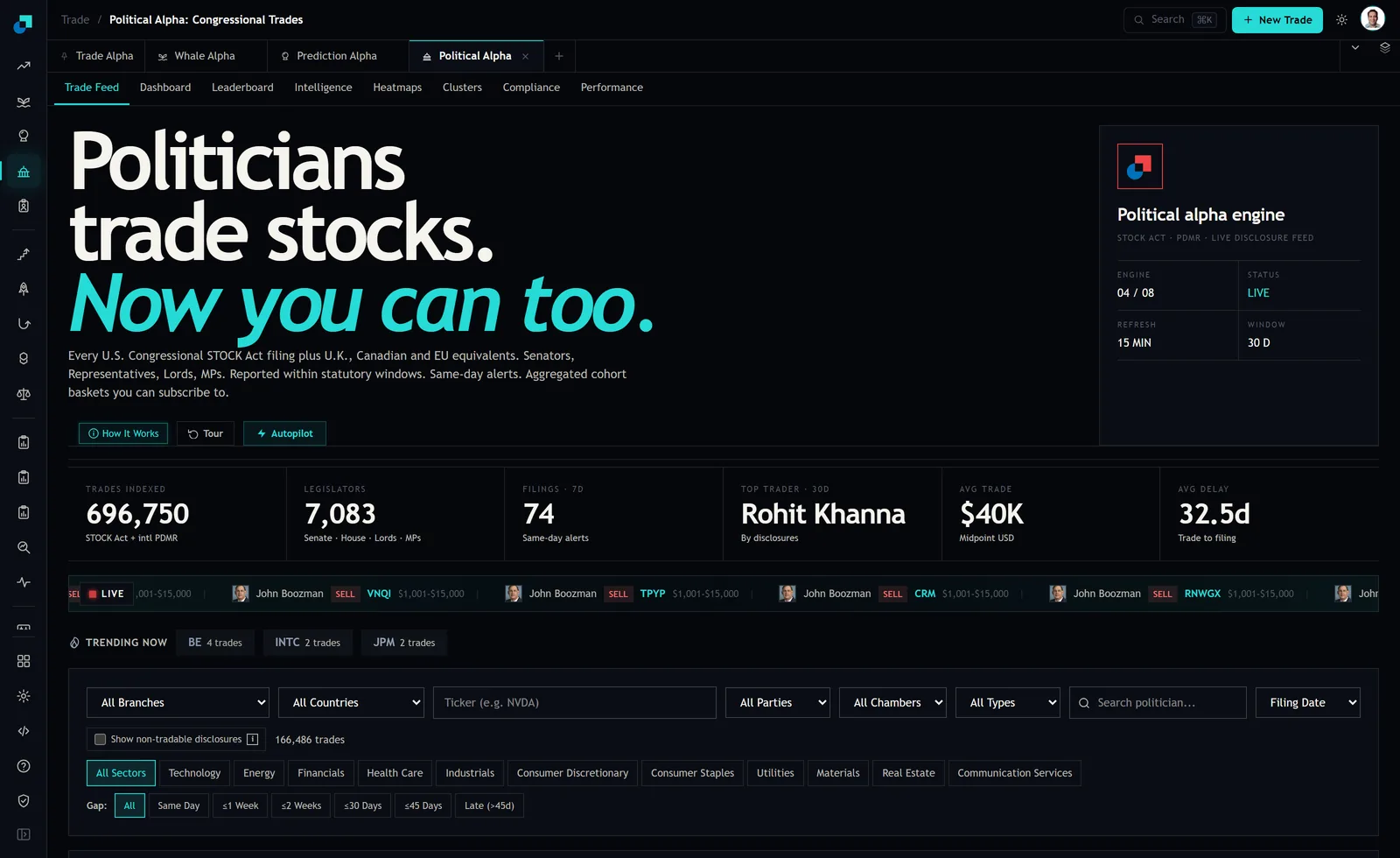
There is a small checkbox on the Political Alpha trade feed labelled "Show non-tradable disclosures", sitting just under the main filter row with an information icon next to it. It is the least glamorous control on the page and it is the first one I touch every single time. Leaving it in the wrong state is the difference between reading a list of trades and reading a list of paperwork.
The reason it exists is that a periodic transaction report is a legal disclosure document, not a brokerage statement. It captures a member's reportable financial activity across everything they hold. Most of that activity is not something a person with a normal brokerage account can act on, and quite a lot of it is not a decision anybody made in the first place.
The number next to the checkbox is the one to watch
Immediately to the right of that checkbox is a live row counter. At capture, with the box unchecked and every other filter set to All, it read 166,486 trades. The header strip above it read 696,750 trades indexed across the STOCK Act and international disclosure regimes.
Those two figures are not a clean subtraction and I am not going to pretend they are. The counter reflects the current filter state and the module's default window, and the indexed total spans the full history including foreign filings. What the pair does tell you honestly is the order of magnitude of the problem. The thing you should do, once, is tick the box, watch the counter jump, untick it, and watch it drop back. That delta, in your own filter view, on your own screen, is the real answer to how much of the feed is noise for you. It is a five second experiment and it will change how you read the page permanently.
What is actually in the bucket
Disclosure filings are broad by design. The kinds of line item that end up in the untradable pile fall into a few recognisable families, and once you can name them you stop being surprised by them.
- Government debt. Treasury bills, notes and bonds show up constantly. They are real transactions, they are reportable, and they carry approximately zero information about anyone's view on a company.
- Education and retirement vehicles. College savings plans and similar accounts generate reportable transactions on schedules nobody chose in the moment.
- Pooled and managed products. Mutual funds, target date funds and other collective vehicles. A member holding a broad fund is telling you nothing about a stock.
- Deferred compensation and pension-style entries, which are contractual accruals rather than trades.
- Non-listed and non-standard holdings. Property interests, private stakes, notes receivable. Real assets, no ticker.
None of these are errors in the data. They are the data doing its job, which is disclosure rather than signal generation. The mistake is entirely on the reader's side, and it is the mistake of assuming that because a row is in a trading feed, it is a trade you could have made.
The rebalance problem, which is the sneakier one
Even after you clear the obviously untradable rows, a second category survives that looks completely legitimate and is equally uninformative. These are transactions that happened inside an account the member does not direct. Automatic rebalances, dividend reinvestments, and the periodic reshuffling that any managed account performs without a phone call.
You can spot the shape of these once you know to look. They arrive in clusters on the same date, they hit multiple unrelated tickers at once, they are frequently in the smallest disclosed band, and they are as likely to be sells as buys. The live ticker at capture was showing four consecutive sells from the same senator across four different symbols, every one of them in the $1,001 to $15,000 band. That pattern is not somebody forming four views on four companies in one afternoon. It is an account doing account things.
The practical rule I use is simple. If a member's filing for a given date contains more than about three unrelated tickers in the smallest band, I stop reading it as a set of decisions and start reading it as one administrative event. It might still be worth noting. It is not worth acting on.
Cleaning in the right order saves you the most time
Order matters here because each step is cheaper than the one after it. Do the free filtering first and the thinking last.
First, confirm the non-tradable box is unchecked. That is one click and it removes the largest block of dead rows. Second, set the Gap filter to something bounded rather than All, since a filing from six weeks ago is a historical record and you have limited attention. Third, drop the smallest disclosed band if your platform view lets you, because the volume of small administrative activity in that band swamps everything else. Only now start reading names.
What is left after those three steps is a list short enough to actually look at, and that is the entire point. The most common way retail readers give up on disclosure data is not disappointment with the signal, it is fatigue from scrolling through hundreds of rows of Treasury purchases and mutual fund reshuffles looking for the two rows that mattered.
The one case for turning it back on
There is a legitimate reason to tick that box, and it is not signal hunting. It is when you are trying to understand a specific member rather than find a specific trade.
The full, uncleaned view of one person's filings tells you how their money is actually organised. Someone whose disclosures are almost entirely government debt and broad funds, with two individual stock trades a year, is a different kind of filer to someone with sixty single-name transactions a quarter. The first person's occasional single-stock trade is unusual for them, and unusual is the only thing that ever carries information. You cannot see that contrast at all in the cleaned view, because the cleaned view has deleted the context and kept only the exceptions.
So the workflow ends up being two different screens for two different jobs. Box unchecked when you are scanning the feed for candidates, which is most of the time. Box checked when you have a name and you want to know whether this particular trade was normal behaviour for that person or a departure from it. The departure is the part worth your attention, and you cannot recognise a departure without having seen the baseline.