Item 4 of the long form ownership schedule is where a filer states the purpose of the transaction and describes any plans across a defined list of categories, including extraordinary transactions, sales of assets, changes to the board or management, changes to capitalisation and dividend policy, and changes to the charter or bylaws.
It is the only place in the ownership regime where intent is written down by the person who holds it. It is also free text, which means it is the field every quantitative process skips and every good analyst reads. This is about turning it into something a desk can use consistently, which is a coding problem rather than a reading problem.
Free text is the problem and the reason it is worth the effort
Everything else in these filings is structured. Filer identity, share counts, percentages, dates, sources of funds. All of it is machine readable, all of it is already in everyone's model, and none of it separates a filer who intends to do something from one who intends to watch.
Item 4 separates them, and precisely because it resists structuring it is under exploited. The cost of using it is that two analysts reading the same document can reach different conclusions, which is exactly the problem a coding scheme exists to solve. If you cannot get two people to the same answer, you do not have a field, you have opinions with a column heading.
The paragraph every filer writes
Open enough of these and you will recognise the reservation of rights language immediately. It says the filer may acquire additional shares or dispose of shares, may engage in discussions with management, the board, other shareholders and third parties, may formulate plans regarding the issuer, and reserves the right to change its intentions at any time.
That paragraph is drafted to preserve optionality and to avoid committing the filer to anything they might later want to abandon. It appears in something close to all of these filings. Treat its presence as zero information. A model that scores intent by looking for words like "discussions", "board", "shareholders" or "plans" will fire on the boilerplate in nearly every document and produce a classifier with no discriminating power at all, which is a failure that looks like success right up until you check the base rate.
The first rule of coding Item 4 is therefore subtractive. Identify and discard the reservation language before you look at anything else. What remains is the part the filer chose to write.
The language that commits the filer to something
Commitment shows up as specificity that would be embarrassing to walk away from. Four categories are worth separating.
- Named demands. A specific action requested of the board, with enough detail that success and failure are distinguishable. Sell the division. Replace the chief executive. Return the cash balance. Not "engage regarding capital allocation".
- Proposals with a price. An indication of interest or a proposal to acquire the company at a stated value. A number in Item 4 is the strongest form of commitment available, because it can be publicly rejected.
- Nomination and solicitation. A stated intention to nominate directors, to solicit proxies, or to call a special meeting. These carry cost and deadlines, and filers do not announce them casually.
- Executed agreements. A cooperation agreement, a standstill, a nomination agreement or a settlement referenced in the item and attached as an exhibit. This is not intent, it is a completed transaction between the filer and the company, and it usually means the campaign has already resolved in some form.
The exhibits deserve particular attention because they are the highest information part of the document and the part fewest people open. A letter to the board is dated, addressed, signed and specific. It tells you what the filer thinks is wrong in their own words, at length, without legal compression. If you are going to read one thing per situation, read the exhibit rather than the item that references it.
Coding it so two analysts agree
A scheme that has held up for me is a four level ordinal, applied to each filing and stored per document rather than per situation.
Level zero is reservation language only. Level one is stated concerns without a specific request, the filer says the stock is undervalued or governance is deficient but asks for nothing identifiable. Level two is a specific demand, an action named clearly enough that you could later record whether it happened. Level three is committed action, a nomination, a solicitation, a priced proposal, or an executed agreement.
Two rules make it work. First, anything above zero requires evidence in the file, a quoted sentence or an exhibit reference, recorded at coding time. This is what makes the field auditable and what stops level inflation, which is the natural drift when analysts are enthusiastic about a situation. Second, code every amendment, not just the original, and store the sequence.
The sequence is the point. A filer sitting at level one for four consecutive filings is not running a campaign whatever the headlines say. A filer who moves from one to two to three across a quarter is escalating, and the transition is a dated observable you can test against outcomes. The level is a description. The transition is the signal.
Measure your own disagreement rate. Have two analysts independently code the same twenty documents and compare. If they diverge on more than a small fraction, the definitions are not tight enough and the field is not yet usable. That measurement is also the thing you show when someone asks how a subjective field ended up in a risk process.
Where the coded field sits in the process
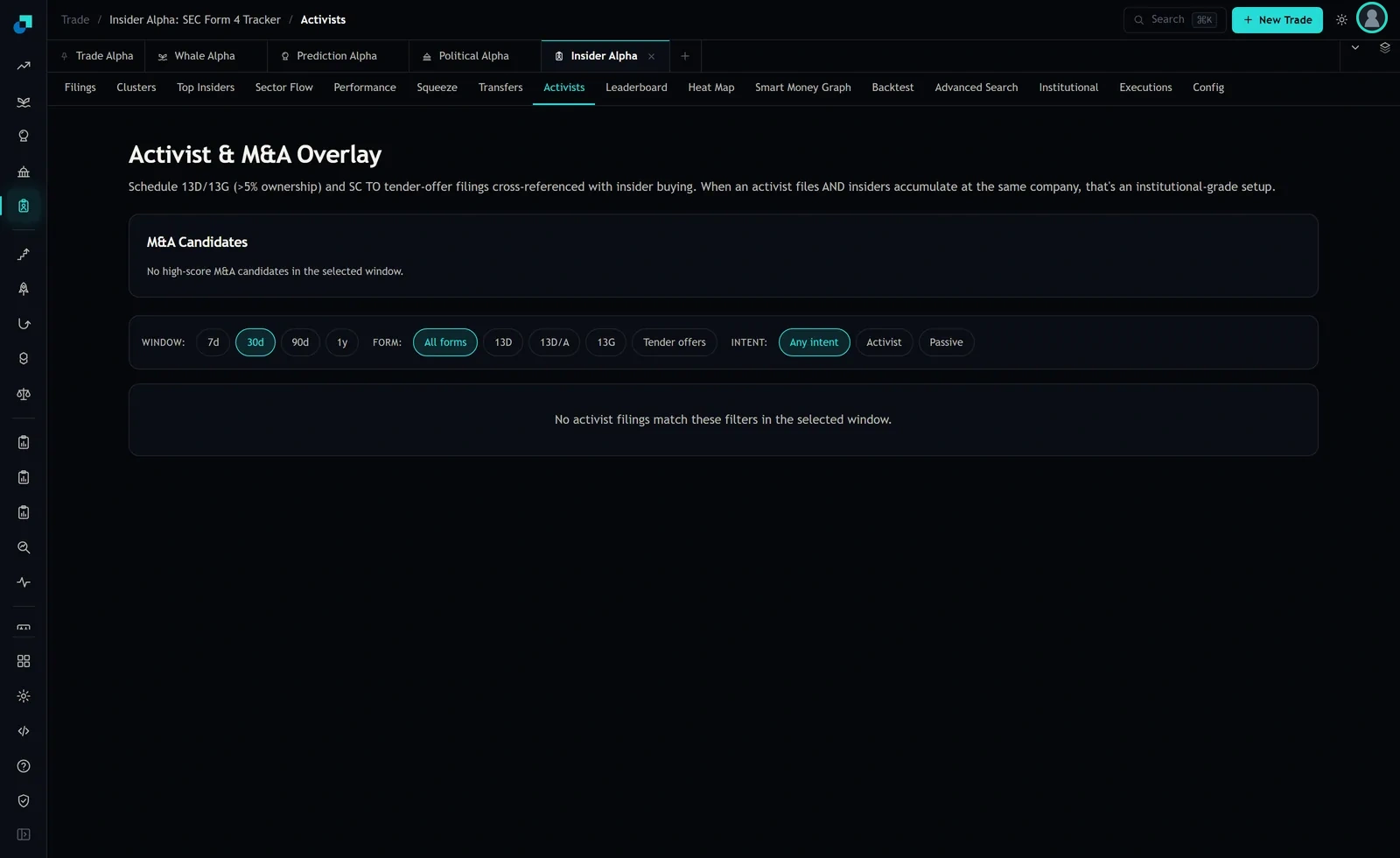
Be clear about the division of labour, because it determines what you build. The Activists tab supplies the universe and the filters over it, FORM across 13D, 13D/A, 13G and tender offers, INTENT across activist and passive, WINDOW across four lookbacks, plus a panel that surfaces high score M&A candidates. That is a document selection layer and a good one.
The purpose text is not on that page. So the workflow runs in two stages. The screen answers which filings exist and are worth pulling. Your analysts pull those documents, code Item 4 against the scheme, and record the evidence. The coded field lives in your own store, joined back to the situation by issuer and filer group.
One caution on the INTENT filter in this context. It offers an activist and a passive state, and the page does not document what those tags key off. If you use it to pre-filter which documents get coded, you have let an undocumented classifier decide what your own classifier ever sees, and any selection bias in the first one propagates silently into the second. For a research set, pull on form and window and code the whole thing. Save the intent filter for triage, where a false negative costs an analyst nothing worse than reading a boring document.