The Asset Outperformer Engine lists precious metals as one of its asset categories, and it names the constituents precisely: gold, silver, platinum and palladium. Four names. That is a smaller universe than any other tab in the module, and it changes what a ranking is for.
With three thousand tokens or five hundred stocks, a ranking is a search. It finds the handful of rows worth your attention out of a field you could not read manually. With four names there is nothing to search for. You can see all of them at once. The ranking is not doing discovery, it is forcing you to answer a question you would otherwise avoid, which is which one you actually want and why.
What the metals tab returns at capture
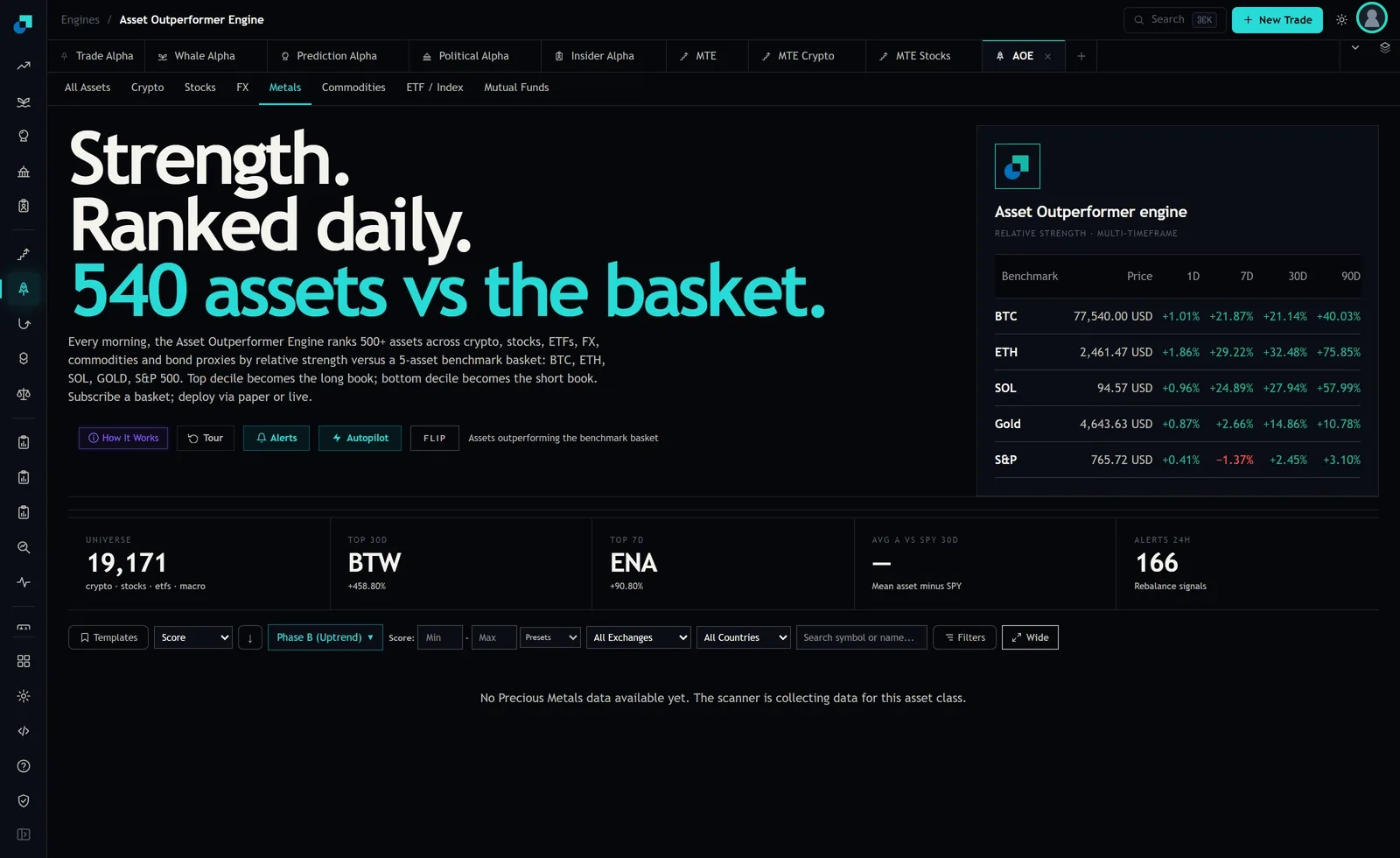
Be straight about the current state before building anything on it. Opening the Metals tab at capture returned one line of text where the rows should be: no precious metals data available yet, the scanner is collecting data for this asset class.
So there is no four way board to read today. The category is declared, the tab exists in the selector between FX and Commodities, and the rows have not arrived. Anyone describing what the metals ranking currently says is describing something that is not on the page, and the honest version of this article is about the comparison you run yourself in the meantime.
One of the four is available anyway, and it is the most useful one. Gold is not only an asset in this engine, it is one of the five benchmarks every other asset is scored against, so it sits in the benchmark panel on every tab regardless of whether the metals rows have populated.
Gold's own numbers already contain a finding
Read those four windows in order rather than picking the one that suits you. Up 0.87 percent on the day, 2.66 over a week, 14.86 over a month, and 10.78 over three months.
The last two do not sit in the order most people expect. A thirty day gain larger than the ninety day gain means the earlier part of the quarter was negative. Divide one plus the ninety day figure by one plus the thirty day figure and the first two months of that window come out at roughly minus 3.6 percent. Gold spent most of the quarter going backwards and did all of its work in the final month.
That single observation is more useful than any ranking of four names, because it tells you the character of the move rather than its direction. A quarter's worth of gain delivered in its last month is a recent, fast move, and recent fast moves in metals are the ones most likely to be reversed, most likely to have been driven by a specific event, and most likely to be crowded by the time a retail buyer reads about them. It is not a reason not to buy. It is a reason to know what you are buying into.
Run the same check on any metal you are considering: compare the thirty day figure to the ninety day figure. When ninety is larger, the move is long and steady. When thirty is larger, everything happened recently. Those two situations deserve different position sizes.
What it means when silver leads gold
Now the comparison the tab will eventually make for you, and the piece of it that trips people up.
Silver leading gold over a thirty day window is common in metals rallies and it is not a separate signal from gold. Silver is the higher volatility expression of largely the same trade, with a smaller market, a meaningful industrial demand component and a habit of moving further in both directions. When metals are working, silver usually outperforms. When they stop working, silver usually gives back more than it gained relative to gold.
So a board showing silver at the top over thirty days is mostly telling you that the metals move has been strong, not that silver is a better asset than gold. Reading it as a stock picking style recommendation, where the top ranked name is the one to buy, imports an assumption from equity screening that does not hold in a four name universe of closely related assets.
Platinum and palladium are a further step away and should not be treated as the same trade at all. Both carry heavy industrial demand tied to specific end uses, which means they can move on news that has nothing to do with the monetary story people usually buy gold for. A ranking that puts palladium on top may be describing an industrial supply event rather than anything about metals as a store of value. If the reason you hold metals is the monetary one, that top rank is not your signal, it is somebody else's.
Leadership in one window versus leadership that persists
The distinction the angle of this whole comparison turns on is between winning a window and winning consistently, and you can build that read yourself with the four windows available.
Take each metal's return over 1D, 7D, 30D and 90D, put them in four columns, and count how many of the four windows each metal leads the others in. A metal leading three or four of them is showing genuine persistence. A metal leading only the thirty day window while trailing on seven and ninety has had one good month inside an otherwise ordinary quarter, and that is a very different proposition to hold.
That count is your own version of what the engine's breadth column does elsewhere on the platform, where the board tallies contests won out of fifteen. You are running four contests instead of fifteen and doing the tally by hand, but the logic is the same and so is the interpretation: breadth tells you how consistent, the return columns tell you how large, and the two together are worth far more than either alone.
The case where they disagree is the interesting one. Silver ahead of gold on the thirty day number but behind it on the count is exactly the profile of a fast move in a high beta asset, and the honest reading is that you are late rather than early. The reverse, a metal leading the count while trailing the headline return, is a steadier trend that has not yet had its violent month.
Sizing four names that are mostly one trade
The trap at the end of all this is diversification that is not diversification. Buying all four because the ranking is close is a very natural response and it does almost nothing for your risk, because the four move together most of the time. What you have built is a single metals position with extra transaction costs and four sets of spreads to pay.
Decide the size of the metals allocation first, as one number, before looking at any ranking. That number comes from your overall portfolio and your reasons for wanting metals in it at all, and it should not move because silver had a good month. Then use the comparison to decide how that fixed allocation is expressed, which is the only question the four way ranking can actually answer.
A reasonable default expression is gold as the core, because it is the least volatile of the four and the one whose behaviour is most tied to the reason most people hold metals, with a smaller silver position if you want more of the move and can tolerate more of the drawdown. Platinum and palladium belong in that allocation only if you have a specific view about their industrial demand, and if you cannot state that view in a sentence, the ranking is not a substitute for having one.
Check the tab again in a few weeks. When the rows appear, the first thing worth doing is not sorting them. It is comparing the thirty day and ninety day columns on each of the four, exactly as you would have done by hand, and seeing whether the board's ordering agrees with the reading you would have reached on your own.