The regime tile on the Macro Risk Scorecard reads SLOWDOWN, described underneath as the business cycle phase. It will keep reading SLOWDOWN through every day between now and the next set of official releases, because the series that determine it have not been published yet. That is correct behaviour and it is also a gap you have to manage, since the interval between monthly prints is long enough for the underlying economy to change and short enough that you will be asked about it in a meeting.
Two failure modes bracket the problem. One desk treats the label as current until it changes, which means carrying a stale read for weeks at a time and being visibly surprised on release day. The other builds an internal nowcast and starts trading it as though it had the standing of a confirmed statistic. The first is negligent, the second is worse, because it converts an estimate into a position without ever writing down that it did.
What can and cannot change between prints
Sort the module's coverage by publication clock and the answer falls out. The scorecard runs seven recession probability models over more than fifty macroeconomic indicators drawn from FRED, the BLS, the BEA and the ECB, across the United States, the euro area, the United Kingdom, Japan and China.
Some of that is quoted continuously. Credit default swap spreads, high yield spreads, Treasury yields and the dollar index all reprice through the session. Some of it is weekly. Some is monthly with a publication lag and a revision schedule attached. Some is quarterly, and the output series that anchor the growth models are in that bucket.
So on any given Tuesday, the honest statement is that the market-priced inputs have moved and the official evidence set has not. The Credit Stress model reads 10 and can move tomorrow. The GDP 2-Quarter Rule at 30 and the Sahm Rule at 20 cannot, whatever happens tomorrow, until the data that feeds them is published. The combined M7 score of 29 out of 100 sits on top of both groups and is not required to tell you which half moved.
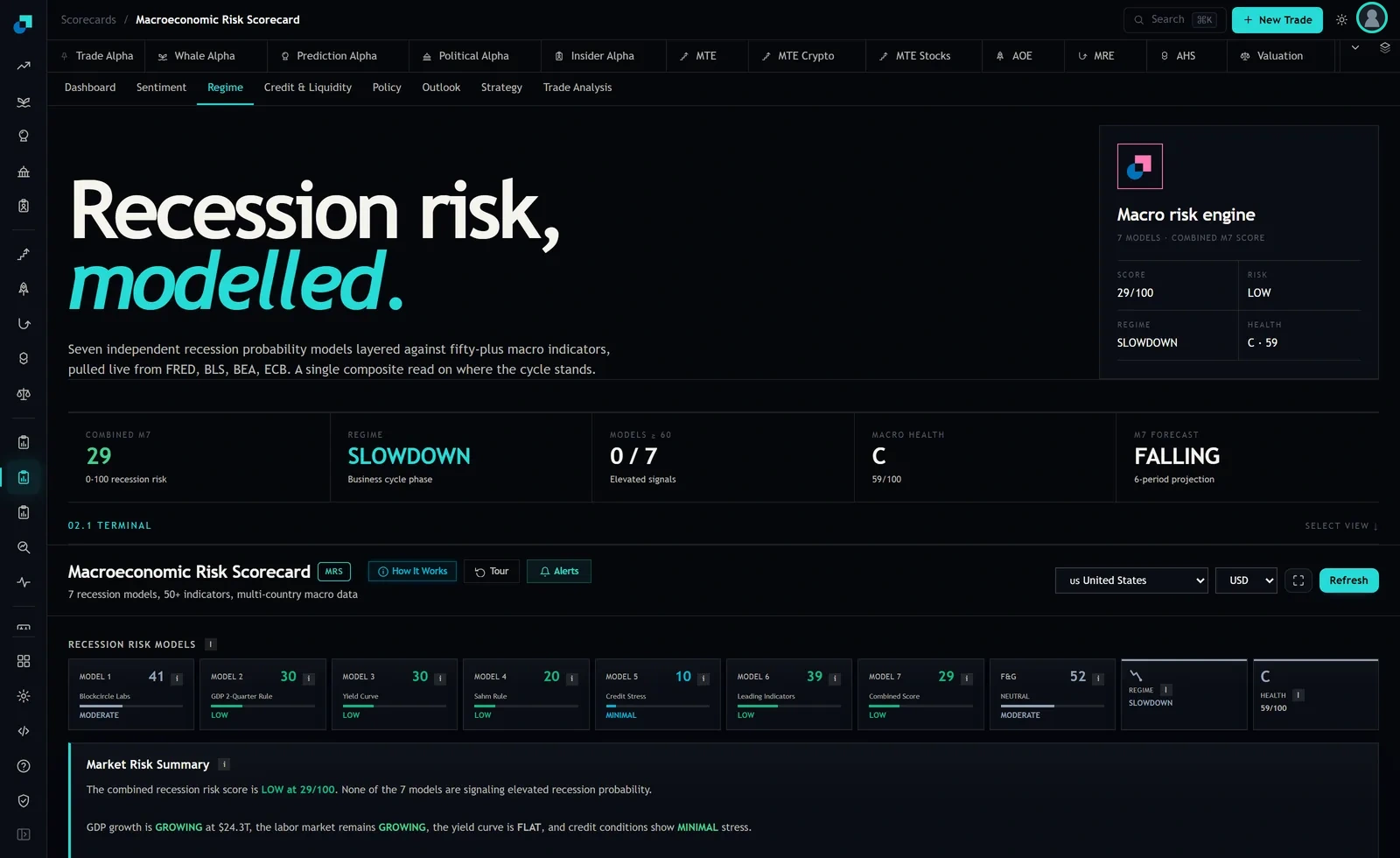
Note the M7 forecast tile, which reads FALLING and is described as a 6-period projection. The unit of the period is not stated on the tile, so if you are minuting this reading, record it as the module presents it and do not convert it into months in your notes. Half the errors in macro documentation come from somebody helpfully translating a label into units nobody verified.
The proxy set, and what each proxy is entitled to say
The interim read should be built from series that are genuinely faster, not from faster renderings of the same slow series. Three groups do real work.
Weekly labour data is the closest thing to a high frequency read on the growth side, and it is the one to lean on hardest because it is a count rather than a survey. Its weakness is that it is noisy week to week and carries seasonal adjustment artefacts around holidays, so it is used as a four week average or not at all.
Market-priced credit and rates are the fastest inputs and the most contaminated. They tell you what the marginal buyer of risk thinks, which is information, but it is information you already hold in your marks. Their honest role in an interim read is as a corroborator. If the weekly hard data is deteriorating and credit is widening at the same time, you have two independent-ish witnesses. If credit alone is moving, you have a repricing.
Survey and sentiment data arrives faster than the hard output series and is the weakest of the three, because it captures how respondents feel about conditions rather than what they did. Useful for direction, close to useless for magnitude. The scorecard carries a separate Sentiment tab and a fear and greed style gauge reading 52 and NEUTRAL, which is the right way to hold that input, next to the models rather than inside them.
A weighting rule that survives a committee review
The question is not whether to nowcast. It is what standing the nowcast has. I have found only one framing that holds up under challenge, which is to give the provisional read a lower weight and to write that weight down in advance, before you know which way it points.
The rule that works is asymmetric by design. A provisional read may reduce risk. It may not increase risk. The reasoning is that the cost of being early and wrong in the direction of caution is measurable and small, and the cost of being early and wrong in the direction of exposure is neither. Written into policy, that asymmetry removes the argument entirely, because the answer no longer depends on how convincing this month's proxies look.
Beyond that, three constraints keep the interim read from quietly acquiring the authority of a print. Cap the size of the adjustment a provisional read can drive, as a fraction of what the same signal would justify once confirmed. Require the proxies to agree, so a single fast series moving on its own does not qualify. And set the interim read to expire on the next release date, so it has to be renewed against the confirmed number rather than persisting by default.
What the interim read is actually for
Most of the value of keeping the regime read fresh is not in the position. It is in the preparation, and that is worth saying plainly because it changes what you build.
An interim read that says conditions are deteriorating should trigger work, not trades. Refresh the liquidity profile of the book so you know what you could exit and at what cost. Identify the positions you would cut first and confirm the borrow and financing on them is still there. Draft the note you would send if the next print confirms it. None of that costs basis points and all of it is the reason a desk that saw it coming still executes badly when it arrives.
The second use is calibration of your own process. If you record the provisional read before each release and then the confirmed outcome after it, you accumulate a dated record of how often your proxy set pointed the right way. After a year you can say something specific about whether your interim read has any content at all, and if it does not, you can stop maintaining it. Very few desks do this, and it is the only way the question ever gets settled.
Where the approach breaks and you should say so upfront
Two structural problems limit how good this can get, and both belong in the documentation rather than in a footnote discovered later.
Revisions are the first. The confirmed print you are treating as ground truth is itself provisional, and the series that feed the growth models are revised, sometimes materially and sometimes in a direction that changes the label. A regime history reconstructed from final data is not the history you traded, and any backtest of a regime overlay built on final vintages is quietly using information you did not have. If you are going to test this properly, you need the data as it was published at the time, and if you cannot get that, the honest move is to state the limitation rather than to report the result as though it were clean.
The second is that turning points are exactly where proxies are weakest. Fast series are noisy, and the moment their noise matters most is the moment their level is ambiguous. A proxy set that looks decisive in the middle of a regime will be split at the edges, which is when you want it. That is not a fixable defect, it is the nature of the instrument, and the correct response is the asymmetric weighting above rather than a search for a better proxy.