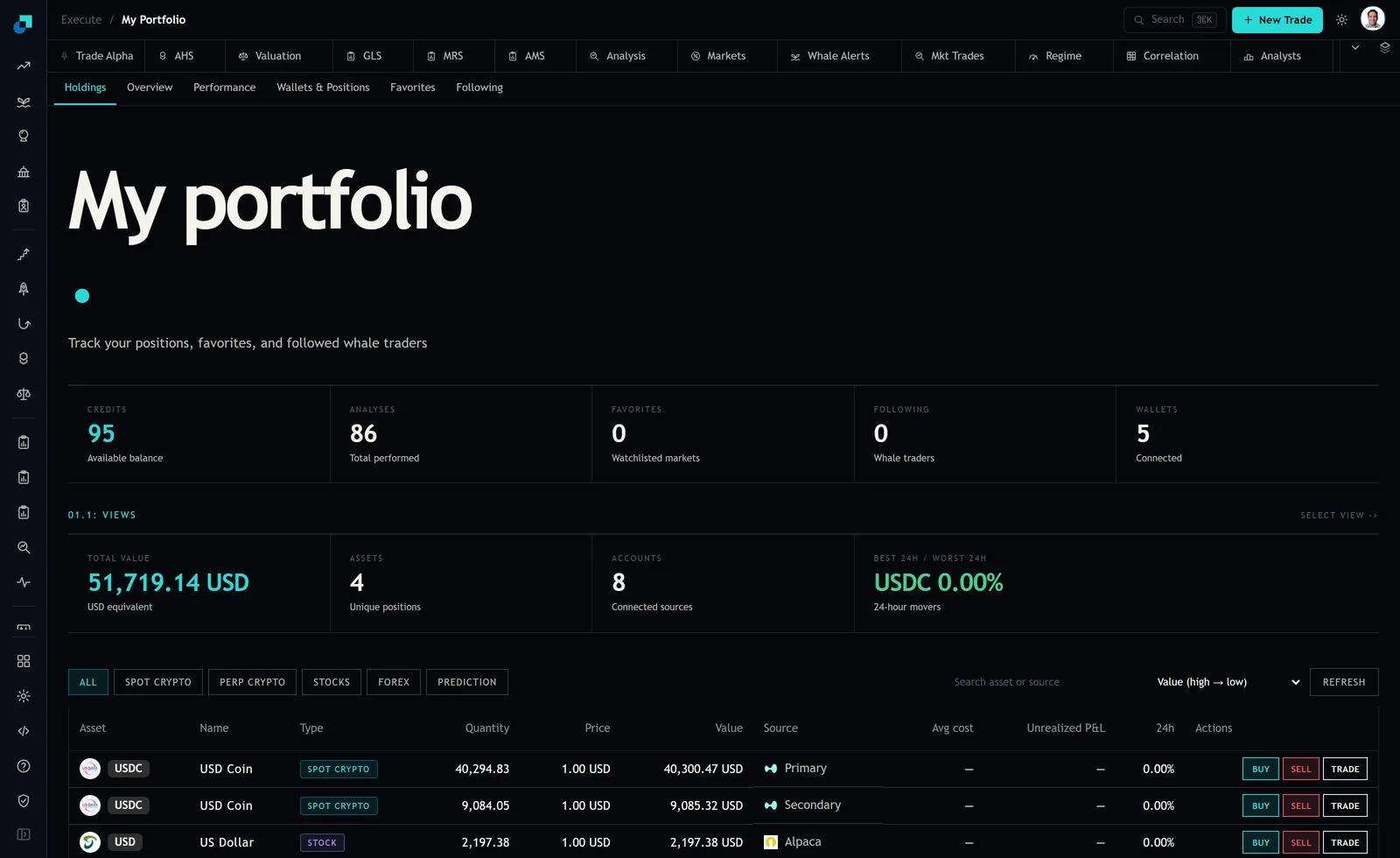
The first time you connect a second venue and refresh Holdings, something looks broken. USDC is in the table twice. Two rows, same ticker, different quantities, different dollar values, and no obvious button to make them one. Nothing is broken and nothing is being counted twice. The table is keyed on the position, and a position is an asset plus the place it is sitting. Two places, two rows.
The tiles above the table give this away before you scroll. On the account in the screenshot below, the ASSETS tile reads 4 unique positions while ACCOUNTS reads 8 connected sources and the WALLETS tile reads 5 connected. Four assets spread across eight sources was never going to render as one clean row per coin. Duplicate tickers are the normal state of a connected book, not a defect in it.
A row is an asset at a place
The Source column is the one most people skim past, and it carries most of what you need. Quantity tells you how much you own. Source tells you what you can do with it this afternoon. Half a BTC on an exchange where you are already verified and funded is something you can sell in under a minute. Half a BTC in a hardware wallet is something you can sell after a transfer, a network fee, and however many confirmations the exchange wants before it credits the deposit. Same ticker, same price feed, two genuinely different instruments as far as your next decision is concerned.
That is why collapsing the rows into one line would be a downgrade rather than a convenience. A single row reading 1.0 BTC hides the fact that only half of it is sellable inside the window where you actually want to sell. Almost every ugly exit I have watched in a mixed book started with someone sizing a trade against a total they could not reach in time.
Three things that turn one coin into two rows
The plain case is the same asset on two venues. You bought SOL on one exchange, bought more later on another because the first one was down or the fee was better, and never consolidated. Two rows, both spot, both liquid, and the split is mostly administrative.
The second case is the same underlying in two different forms. Spot and a perpetual on the same coin are separate rows for a good reason, and the type filters running across the top of the table, SPOT CRYPTO and PERP CRYPTO and STOCKS among them, exist to keep those populations apart. A spot BTC row is an asset you own outright. A perp row is an exposure financed by margin that can be closed or liquidated without any coin ever moving. Adding those two quantities together gives you a number that describes nothing real.
The third case is the same asset in two states at one venue. Free versus staked, posted as collateral, sitting behind an open order, or locked in a vesting contract. Whether your table breaks those out on separate lines or not, you need the number, because locked quantity is not exitable quantity. The fastest way to find out is to try to withdraw one unit and read what the venue says the available balance is.
When adding the rows together is the right move
Sum the rows whenever the question is about price. Concentration, correlation and how much of your money rides on one chart do not care where the coin sleeps. If you hold a token across three venues and the combined value is 22,000 against a book total of 51,715.70, you have roughly 43 percent of everything in one asset, and the fact that it arrived in three pieces is irrelevant to that risk. I do this sum on paper about once a month, because the eye reads three medium rows as three medium positions rather than one large one.
Sum them also when you are working out cost basis, since your record of what you paid does not care which venue held the coin afterwards. And sum them for any question that begins with what happens to me if this thing drops 40 percent. Drawdown maths runs on the total, always.
When the split is the number you needed
Do not sum when the question is about getting out, or about who is holding your money. Four situations where the per venue number is the only one that matters:
- Withdrawal and sale limits. A venue can cap what leaves per day, freeze withdrawals during an incident, or hold a deposit for days. The quantity you can act on is the quantity at the venue that is currently working, not the total.
- Depth where you would actually sell. Selling 15,000 of a mid cap token is trivial on a deep venue and moves the price against you on a thin one. The row that matters is the one at the venue with a real order book, and the rest of your position has to travel first.
- The cost of moving. Consolidating is not free. Network fee plus withdrawal fee plus the spread you pay on both sides adds up, and on a 400 dollar position it can be a meaningful slice of the trade you were planning.
- Counterparty concentration. If 80 percent of your book sits at one exchange, that is a single point of failure regardless of how many tickers the table shows. The wallet rows are the part of the book that cannot be frozen by somebody else's decision.
There is a version of this split that is deliberate and worth keeping. A long term holding in self custody, a trading sleeve on an exchange, and a small stablecoin float for fees. That is three rows of the same coin doing three different jobs, and merging them in your head is how the long term holding quietly gets traded.
The pass I run before adding to a duplicated position
When I am about to add to something I already hold in two places, I spend five minutes on this and it has saved me from bad sizing more than once.
- Filter or sort so every row of that ticker is visible together and read the Source column on each one. Write the quantities down in two columns, sellable today and not sellable today.
- Take the sellable number and ask what it would cost to move it in one order at the venue that holds it. If the honest answer is that you would have to sell in pieces over a day, your effective position is smaller than the table says.
- Decide whether the split is deliberate or accidental. Accidental splits are usually the residue of chasing a fee or a listing, and they cost you clarity for no benefit.
- If you are consolidating, price the move before you make it. Fee to withdraw, network cost, and the spread on the far side. If that total is more than roughly one percent of the amount you are moving, the split stays where it is and you write the combined number in your own notes instead.
- Set the rule for the next buy. Same venue as the existing sleeve unless there is a specific reason, because every new venue adds a row, a login, and one more balance you have to remember to check.
The tile that keeps me honest here is ACCOUNTS. Eight connected sources against four unique assets is a book where fragmentation is the default rather than the exception, and a book like that punishes anyone who reads only the ticker and the total. Read the Source column first, then the quantity. The split is not clutter, it is the part of the table that tells you what you can actually do.