An unconstrained relative strength decile has no opinion about sectors, which is not the same as having no sector exposure. It has whatever exposure falls out of the ranking, it changes every time the board refreshes, and on this module you cannot see it, because there is no sector column on the row.
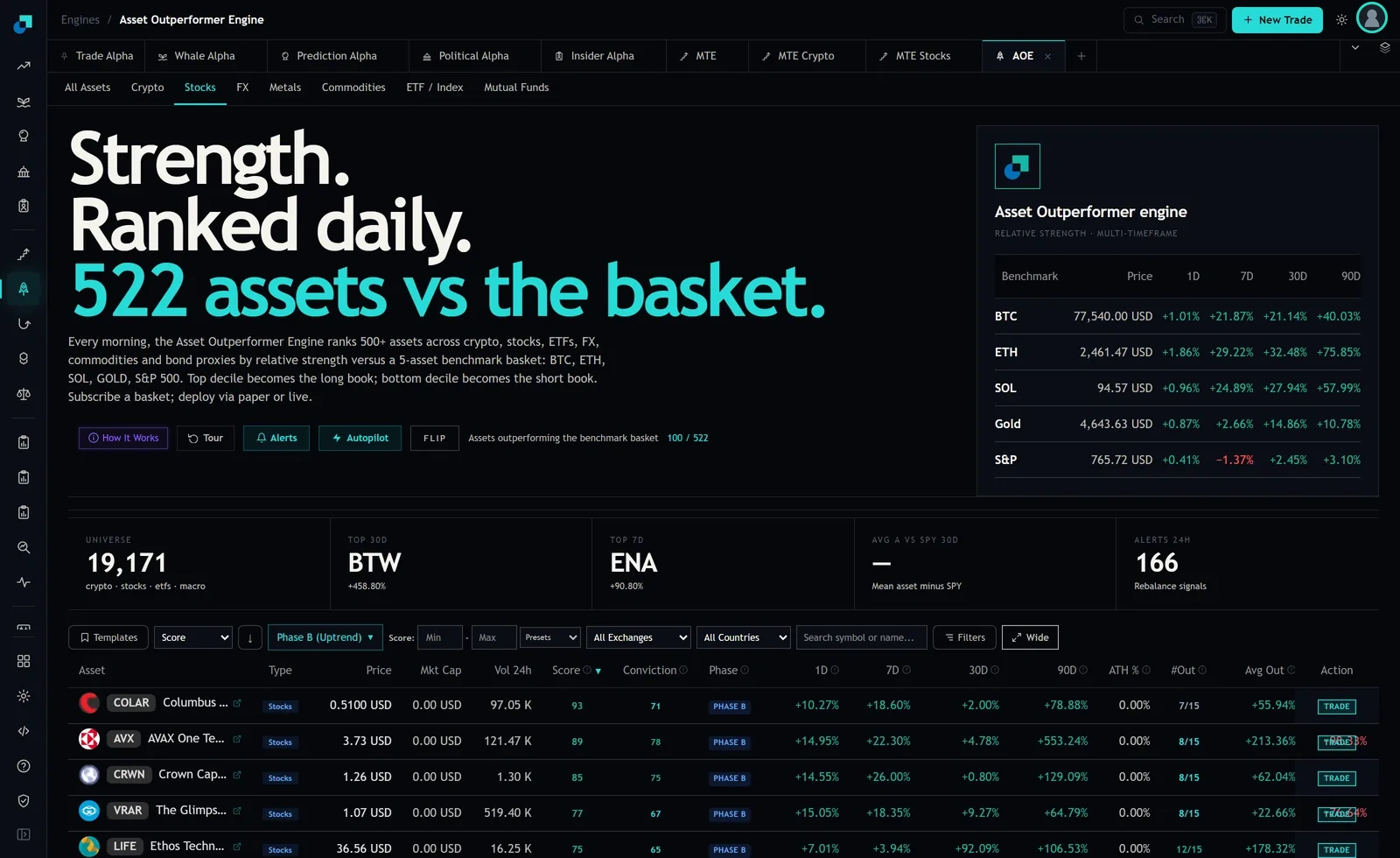
The stocks tab ranked 522 assets at capture with 100 shown as outperforming the benchmark basket. What that decile is made of, in sector and size terms, is a question the interface cannot answer and your risk system has to.
Two fields the board does not give you
The stocks row carries Asset, Type, Price, Mkt Cap, Vol 24h, Score, Conviction, Phase, four return columns, ATH %, #Out, Avg Out and an action cell. There is no sector, no industry and no country field on the row itself.
Market cap is present but not usable on this tab. Every visible row read 0.00 USD, from Columbus Acquisition at a score of 93 down through Ethos Technologies at 75. So you cannot compute a cap-weighted exposure, you cannot compare the decile's size profile with a policy benchmark, and you cannot even sanity check whether a name belongs to the large cap universe, all from the board.
That makes the workflow an export and a join rather than a screen. Pull the ranked symbols, join them to your own security master for sector, industry, country, market cap and free float, and do the exposure work there. The important consequence is that the concentration check cannot be a step somebody performs when they remember to. It has to be inside the pipeline between the ranking and the order file, because a manual step positioned between a signal and a trade is a step that gets skipped in the week it matters.
What a hand count of fifteen names shows
You can get a first read in two minutes by classifying the visible names by hand. This is coarse and it is not a substitute for a taxonomy join, but it is enough to tell you whether the problem is worth taking seriously.
Of the fifteen scored rows on the stocks tab at capture, four read as life sciences by name alone: Medivir, Active Biotech, Personalis and Predictive Oncology. Two are blank-check acquisition vehicles, Columbus Acquisition and Rising Dragon Acquisition. One is a gold miner, NovaGold. Two or three are software, depending on how you treat The Glimpse Group and MindForge alongside Similarweb. One is a jeweller.
Against a broad US equity benchmark, a decile in which more than a quarter of the names sit in one sector and an eighth are pre-deal shells is a very large active bet. Not a slightly overweight position, a bet, and one that nobody in the investment process chose.
The size profile is worse and you can see it without market caps. Five of those fifteen were quoted under two dollars: Columbus Acquisition at 0.5100, Crown Capital at 1.26, The Glimpse Group at 1.07, Medivir at 1.90 and Rising Dragon at 0.0852. A sub-two-dollar share price is not proof of a microcap, but five of them in fifteen is a distribution, and it is not the distribution of a large cap sleeve.
The described universe and the funded decile are different objects
This is the part that belongs in front of an investment committee before anything is funded.
The module describes its equity coverage as 400 or more US equities drawn from the S&P 500, the NASDAQ 100 and sector leaders. The board at capture ranked 522 assets on that tab. Read the top fifteen and none of them is a recognisable member of the cohort in that description. Meanwhile, the rows sitting with a dash in every price and return column and a score of 0 included Snowflake, Appian and CareDx, which are exactly the sort of names the description points at.
So the universe as described and the decile as ranked are not the same population. The large, liquid, well covered names were unscored at that moment, and the top of the board was occupied by small, cheap, thinly followed listings. Whether that is a data coverage state on the day or a persistent property is precisely the thing to measure before allocating, and it is measurable: capture the ranked set daily for a month and count how often each name is scored. Names that are scored intermittently should not enter the sleeve at all, because an intermittent score produces turnover driven by data availability rather than by relative strength.
The constraint layer, and where it belongs
Constraints applied after ranking are the standard approach and they are the wrong one here. Ranking first and trimming afterwards means the trim is always fighting the signal, the discarded names are always the highest ranked, and the resulting portfolio has neither the pure signal nor a clean exposure profile.
Put the constraints in front. Three that do real work on a board shaped like this one.
- A per-sector cap expressed against the policy benchmark rather than in absolute terms, so a sector that is genuinely large in the benchmark is allowed a proportionate presence and a sector that is small is not allowed to become a quarter of the book.
- A size floor, applied on market cap and free float from your own data rather than on the board's field, and a hard exclusion for pre-deal acquisition vehicles. A blank-check shell has no operating business for a relative strength signal to be measuring, so its rank is a statement about deal speculation and should not be funded as stock selection.
- A minimum scoring continuity requirement, which is the one people forget. A name has to have been continuously scored for some defined window to be eligible, which removes exactly the intermittently covered rows that generate phantom turnover.
Each of those costs you signal, and each cost is measurable by running the constrained and unconstrained deciles side by side. Do that before funding, not after, so the tradeoff is a decision with a number attached.
The residual check that decides whether the sleeve is stock selection
Once the constraints are set, run the decile's historical returns through your factor model and look at what is left after sector, size, value and momentum are taken out.
Be prepared for the uncomfortable answer. Relative strength deciles frequently load heavily on momentum and size by construction, because that is more or less what the ranking is built from, and a composition like the one above will load on sector too. If the residual after neutralisation is small, the sleeve is a factor and sector expression rather than a stock selection strategy, and it should be sized against your existing factor exposures rather than added alongside them as though it were independent.
That conclusion is not a reason to reject the sleeve. Cheap, systematic factor expression is a legitimate thing to own. It is a reason to stop describing it as stock selection in committee papers, because the description determines where the risk budget comes from and how the position is reviewed when it goes wrong.
The specific sentence worth having in the strategy document, written before the first trade, is the one that names the largest sector position the sleeve is permitted to hold and who is allowed to approve an exception. Concentration incidents are almost never caused by an absent limit. They are caused by a limit that existed and had no owner.