Here are two lines from a scan. "Insider buying cluster, four officers, filed Tuesday." And "Positioning looks stretched into the print." They occupy the same amount of space, they are written in the same confident register, and they arrive at the same moment on the same screen. One of them points at a document with a date on it. The other one is the model's impression, dressed identically.
Nothing in how the line is rendered will separate them for you. Language models produce grounded claims and ungrounded claims in exactly the same voice, because the voice is a property of the writing rather than of the evidence. Separating them is manual work, it takes under a minute per line, and it is the difference between using a scanner as a research tool and using it as an oracle.
Two kinds of line that look the same
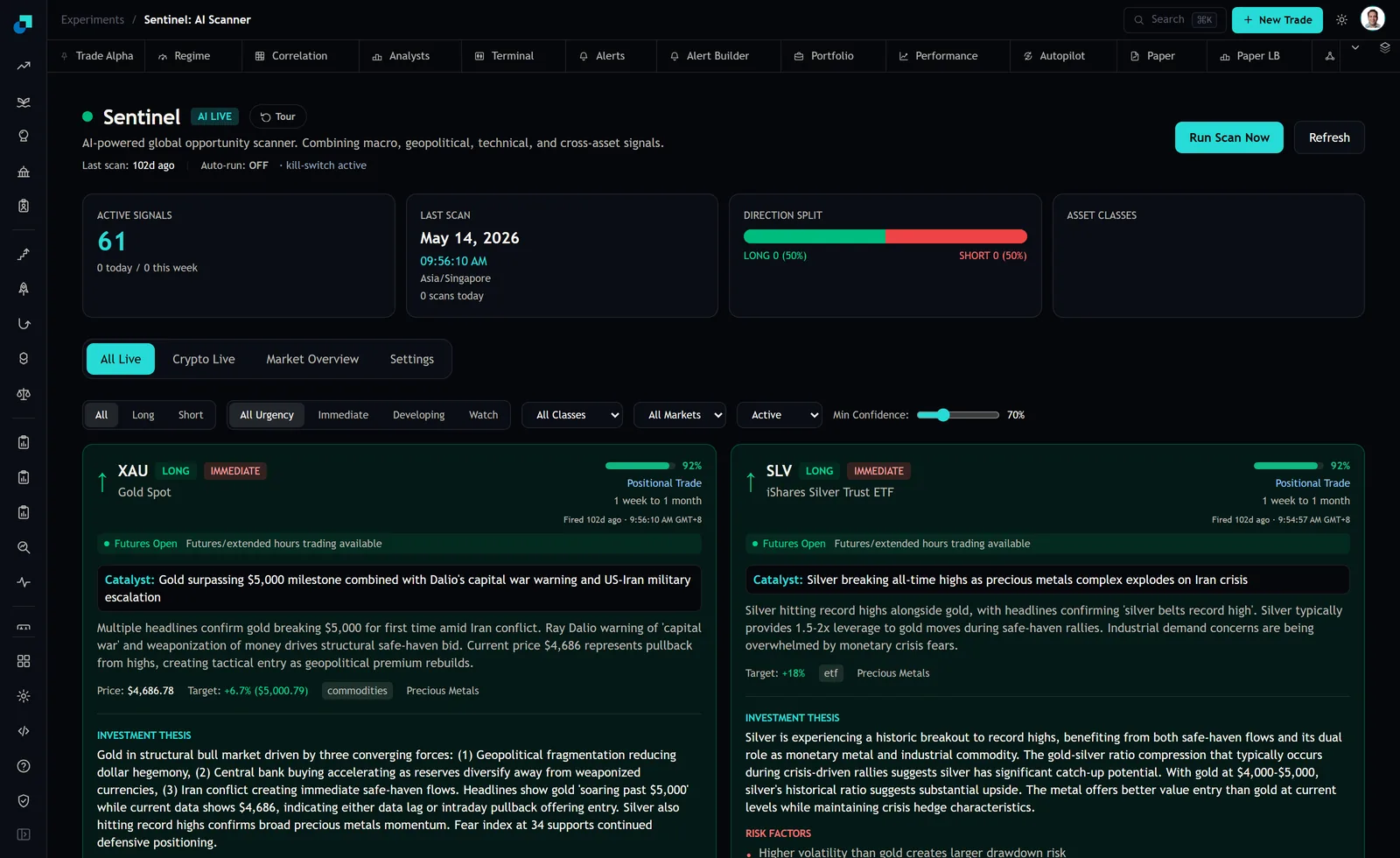
Sentinel describes itself as combining macro, geopolitical, technical and cross-asset signals. Read that sentence as a map, because those four inputs have wildly different verifiability and the difference is not subtle.
Technical and cross-asset claims sit on price and volume series. Those are checkable in seconds. Either the stock closed above its July high on triple average volume or it did not, and you can settle it on a chart before you finish reading the row. Macro claims sit on releases and prints, which are also checkable, with the caveat that the interpretation attached to a print is not the print.
Geopolitical claims are where the ground gets soft. Not because the underlying events are fake, but because the chain from event to instrument is inferential by nature. "Escalation in the strait raises risk premium for the shipping complex" is a reasoning step, not an observation, and there is no artifact anywhere that says it. It may still be a good reasoning step. It is simply not the same kind of object as a filing, and it should not get the same position size.
The four questions that settle it
Run these on a single line, in order, and stop at the first no.
- Can I name the artifact? Not the category, the artifact. "A Form 4" is a category. "A Form 4 filed by the CFO on the 12th" is an artifact. If the line does not let you name a specific document, print, or series, everything after this is guesswork about guesswork.
- Can I open it? Go and find it. The regulator's site, the exchange, the chart, the release calendar. This takes thirty seconds for anything real and it fails fast for anything that is not.
- Does it say what the line says? This is where most failures actually happen, and they are rarely dramatic. The filing exists but it is a sale under a pre-arranged plan rather than an open-market buy. The volume spike exists but it was an index rebalance. The artifact is real and the characterisation of it is wrong, which is a much more dangerous failure than an invented source because it survives a lazy check.
- Is it dated, and is that date recent enough to matter? A real, correctly described event from six weeks ago is a real event you are late to. This question is also your defence against the staleness problem, since a scanner that has not run recently will keep presenting old evidence in the present tense.
Four questions, four possible failures, and only the first one gets called hallucination. The other three get called bad luck.
The tells that a line is inference
You can pre-sort most of a list without opening anything, using the wording. These are the tells I trust.
Passive attribution with no owner. "Is reportedly", "sources suggest", "has been noted". Real sourcing names the source. Inference borrows the grammar of sourcing without the content.
Claims about mental states. Anything describing what institutions think, what the market expects, what management intends, or what somebody is positioning for. Positioning is occasionally measurable and usually not, and intent is never measurable. A line about what a company is likely to announce is a forecast wearing the costume of an observation.
Suspiciously round magnitudes. Real readings are ugly. Twenty three point four percent is a measurement. "Roughly twenty percent" in a scanner row is often an estimate that has been smoothed into confidence.
Causal joins between two real facts. Both halves check out, the join does not exist anywhere. "Insider buying alongside sector rotation into industrials" contains two verifiable things and one invented relationship, and the relationship is the part you were about to trade.
The categories where inference is near certain
Some claim types are inference essentially by construction, and it saves time to treat them as such without running the full check. Sentiment readings, unless the line names the specific index and window. Anything about what is priced in. Anything about crowding or consensus positioning outside the few datasets that actually measure it. Anything predicting a corporate action that has not been announced.
None of these are worthless. Macro and geopolitical reasoning is genuinely useful for deciding what to pay attention to and which way to lean. It is the wrong input for deciding where a stop goes, because a stop needs a level and inference does not produce levels. That mismatch is where retail accounts get hurt. You take an inference-grade idea, you cannot find an invalidation point because there is not one, so you use a round percentage instead, and now your risk management is also an estimate.
What to do with a guess instead of deleting it
The instinct after learning this check is to throw out everything that fails it. That is an overcorrection and it will empty your list.
Demote instead. I keep two buckets. Grounded lines, where I named the artifact, opened it, confirmed it says what the row claims, and it is dated within my window. Those are tradeable at normal size, with the invalidation level taken from the artifact itself, usually the price at which the event's implication stops holding.
Inference lines go on a watchlist with no size attached and one job, which is to tell me where to point the next grounded search. An inference line saying the shipping complex is exposed to a strait escalation is a decent instruction to go and check tanker rates and the filings of three specific operators. It is a terrible instruction to buy a shipping name on Monday at two percent of the account.
The arithmetic makes the case better than the principle does. On a $10,000 account with a two percent risk budget, you are risking $200 per idea. A grounded line gives you a real level, so you can size the position properly against the distance to that level. An inference line gives you a guess about a stop, which means your $200 of risk is itself a guess, and a stop set by aesthetics gets hit by noise. You will lose the $200 not because the idea was wrong but because you had nothing to measure the trade against. Do that four times a month and the inference bucket has cost you eight percent of the account without ever having been tested.