Almost nobody knows their own number. Ask a competent retail trader how long it takes from an alert arriving to an order sitting on the book and you will get a confident answer that is wrong by a factor of three, because the estimate is built from the fast case and the fast case is not what happens when the alert arrives while you are on a call.
The fix takes one afternoon. Time the whole path with a stopwatch, once, honestly. Then look at where the minutes went, because the useful discovery is not the total. It is that most of the total sits in two or three hops that have nothing to do with markets and everything to do with logging in.
Timing your own path, once, properly
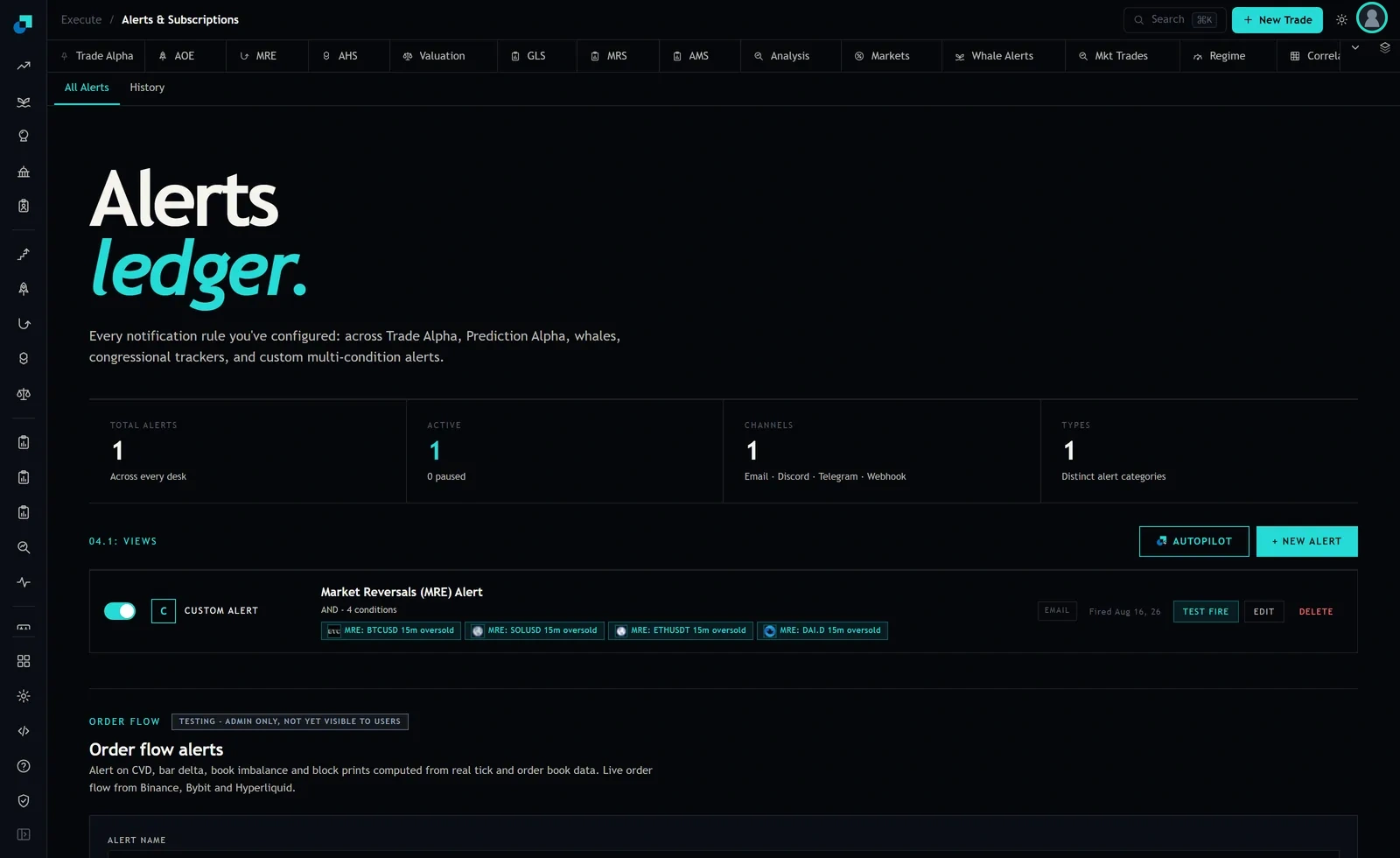
Do this deliberately rather than waiting for a real alert, because a real alert is a terrible measurement environment. Every alert row in the ledger carries a test fire control, which exists to confirm a rule can produce a message and that the message reaches its channel. It also gives you a moment you chose, which is exactly what a stopwatch needs.
Note the time, press test fire, then run the whole sequence you would run for real: see the notification, open whatever you use to check the setup, decide, open the broker or exchange app, get to the ticket, enter a size and a limit, submit, and wait for the confirmation. Place a genuinely small order so the sequence is real all the way through, then cancel it. Record the total and the point at which each stage finished.
Do it three times across different situations. Once at your desk with everything already open. Once from your phone away from home. And once at the worst realistic moment, which for most people means during the working day with the phone locked. The spread between those three numbers is the thing you are actually measuring, and it is wide.
Where the minutes actually go
Sort the hops by who controls them, because that is what tells you which are worth attacking.
The first hop is not yours at all. A condition on a fifteen minute construct cannot be known until that fifteen minute period completes, and no amount of tuning changes that. It is a property of the signal you chose. The visible example on the ledger is a custom alert requiring four separate fifteen minute oversold conditions at once, which is a sensible way to cut noise and also means the earliest possible knowledge is the close of that period.
The second hop is delivery, and it is where the largest avoidable delay lives. The channel list on this page reads email, Discord, Telegram and webhook. Email is not a fast channel and was never designed to be one; delivery can be near instant or can sit in a queue, and you have no visibility into which. A chat app on your phone with notifications enabled is the closest thing here to a real push, and moving a time sensitive rule off email onto Telegram or Discord is usually the single largest improvement available to a retail setup.
The third hop is you noticing, which depends entirely on your phone's settings and on whether the alert is competing with forty others. This is where a noisy alert estate costs you time rather than attention: if your urgent channel also carries informational rules, you have taught yourself to check it slowly.
The fourth is deciding, and it is longer than anyone admits. Opening a chart to confirm what the alert already told you can double your total on its own.
The fifth is the broker path: unlocking, launching, authenticating, finding the instrument, and building the ticket. If your session has expired and a second factor is involved, this hop alone can dwarf everything above it.
Removing hops without removing yourself
Four changes cost nothing and between them usually take out most of the avoidable time.
Move time critical rules to a chat channel and give that channel its own notification behaviour on your phone, distinct from everything else. Keep informational rules on email so the urgent channel stays quiet enough to be believed.
Decide the size and the price band before the alert, not after. For each rule that can lead to a trade, write down in advance the instrument, the position size in dollars, and the limit rule you will use, such as a fixed offset from the touch. Most of the deciding hop is not analysis, it is arithmetic you could have done on Sunday.
Stay logged in on one device during the hours your rules can fire, and know the exact path to the ticket. This is a mundane change with a large effect, and it is the one people skip because it is not interesting.
And where your venue supports it, stage the order in advance rather than building it under time pressure. A resting limit that you place ahead of the condition and cancel if the day passes is a different instrument from a market order chased after a notification, and for most retail setups it is the better one, because it converts your latency problem into a price problem you chose.
The setups that cannot survive a human in the middle
Some strategies do not tolerate any of this and it is cheaper to say so than to keep failing at them.
Anything where the edge is measured in the first minute is out. A new listing on the day it opens, a thin token immediately after a launch, a violent reversal on a fast timeframe: by the time you have seen a notification and unlocked a phone, the participants you are competing with have been filled and are managing risk. Your fills will be systematically worse than any backtest of that idea, and the gap is not small.
Anything requiring you to act inside a fixed window you cannot guarantee being awake for is also out, unless you automate it. Crypto trades around the clock and your attention does not.
What remains is a large and perfectly good universe: setups whose edge decays over hours rather than seconds, positions entered with resting limits, and rules whose purpose is to make you look at something rather than to make you act instantly. Match your alerts to that universe and the latency question mostly disappears.
If you close the gap with automation, the guardrails come with it
The obvious answer to a human hop is to remove the human, and the platform supports that. The alerts page links straight through to Autopilot, which automates signal execution across connected exchanges with paper mode, risk guards, trailing stops and partial take profits. Removing the hop is real. So is what you take on when you do it.
The module states the terms on its own page: with paper mode off it places real orders on connected exchanges, execution prices may differ from signal prices because of market conditions and latency, and you are solely responsible for all trades. It tells you to start in paper mode, verify the behaviour, then switch to live with small sizes. Take that literally rather than as boilerplate, and give it more than a weekend.
Two guardrails are not optional if you go this route. A hard cap on position size and on how many positions the profile can hold at once, set at the profile rather than held as an intention, because the whole point is that you are not there. And a rule about how you find out, since an automated path that nobody watches for a fortnight is how a configuration error becomes a habit.
Understand the failure mode before you rely on it. The fleet level controls on the Autopilot page, pause all, resume all, and the emergency kill switch, are manual buttons. Nothing is watching your latency, your fill quality or your drawdown and halting on your behalf, so the automation removes the delay in acting and does not remove the need for someone to notice. If your plan is that you will see it in the morning, then the guards on the profile have to be tight enough that the morning is soon enough.