The first time you scroll a launch ledger and find the same four letters staring back at you from row after row, the instinct is to assume the feed is broken. It is not. Those are different contracts, deployed by different addresses, at different times, and every one of them is entitled to that symbol because nothing anywhere says otherwise.
Nine is not a magic number. A contested symbol might occupy two rows or twenty, and the count changes hour to hour. What does not change is the structure of the problem, which is that you are looking at a set of contracts, exactly one of which is probably the thing people are talking about, and the ledger cannot tell you which by symbol alone because symbol is not an identifier.
Why nothing makes a symbol unique
In equities, a ticker is issued. Somebody governs the namespace, the symbol is unique on a venue, and there is an authoritative mapping from the symbol to a security identifier that everyone agrees on.
A token symbol is a string set in the contract at deployment. There is no issuer of symbols, no uniqueness check, and no cost to picking one that is already in use. On most chains, deploying a token costs a trivial amount of gas. Deploying twenty of them with the same symbol costs twenty times a trivial amount.
Multiply that by the number of chains the feed covers, nine of them with Solana and the EVM chains including Ethereum, Base, Arbitrum, Optimism and Polygon, and a symbol that gets any attention at all will be reused across several of them within hours. The ledger showing 3,771 launches is not showing 3,771 distinct projects.
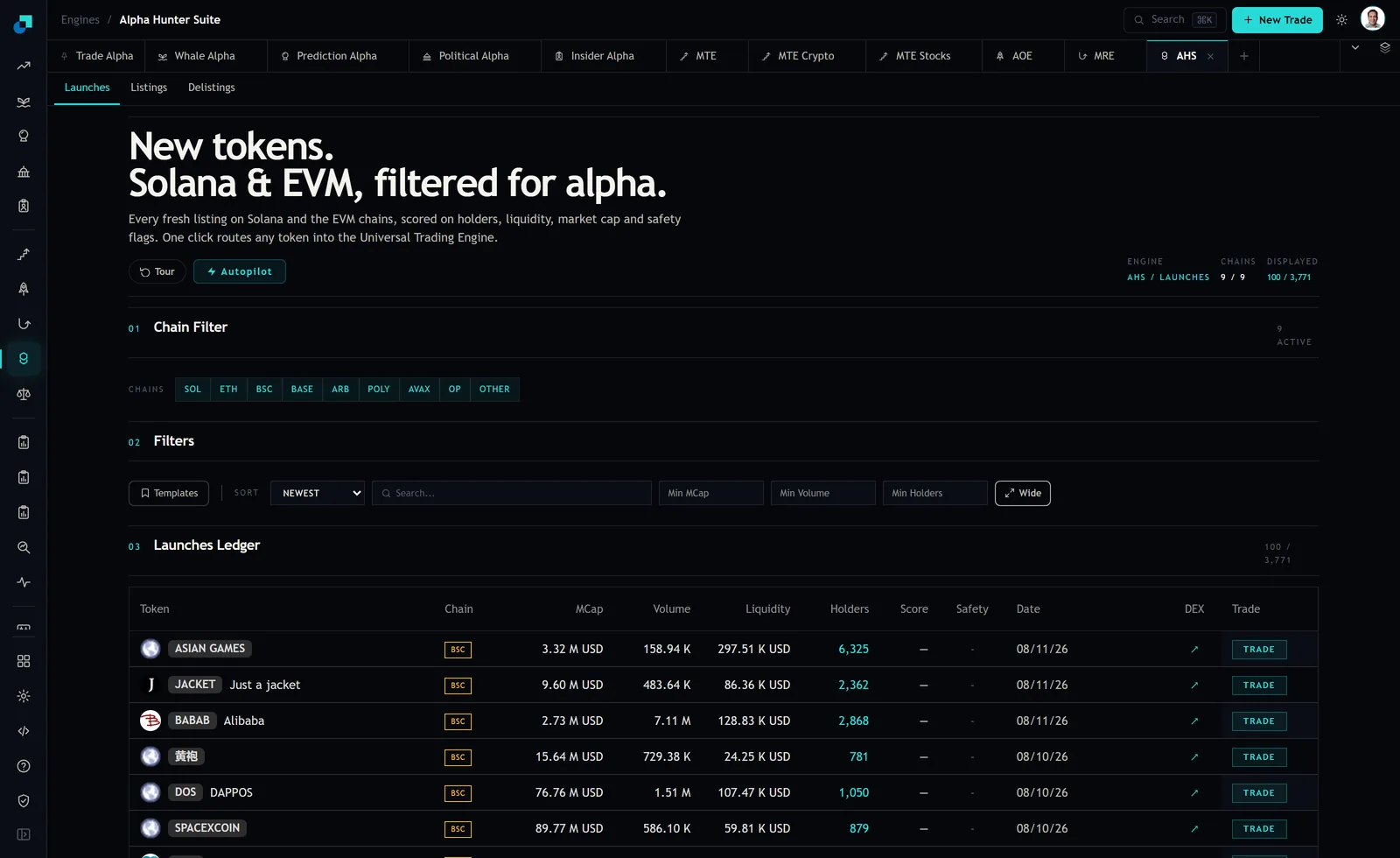
That is worth doing before anything else. A symbol appearing on four chains may be four separate projects, or one project deployed in four places, or one project and three impostors. Cutting to the chains where you can execute collapses the question to a size you can actually answer.
The four ways one symbol becomes many rows
The duplicates are not all the same kind of thing, and the response differs.
- Redeployment. The same team deployed the token more than once, usually because the first attempt had a bug, wrong supply, or a botched liquidity setup. The old contract is dead but it still exists and it still has a row.
- Multi-chain deployment. One project, several chains, several addresses. All of them are real. They have separate pools and separate exits, and buying the one on the chain nobody is trading gets you the right project and the wrong liquidity.
- Copycats. Somebody saw a symbol getting attention and deployed their own with the same three letters, hoping to catch search traffic and reflexive buying. The contract may be perfectly ordinary in its code and still be the wrong asset.
- Deliberate impersonation. Same symbol, same name, sometimes a cloned logo, deployed specifically to be found by people in a hurry. This one is aimed at exactly the moment you are scrolling a fast-moving ledger.
Categories three and four are the ones that cost money, and the annoying part is that they are structurally identical to category two from the outside. Same symbol, real contract, real pool, real trades. Nothing in the row is false.
The three fields that pick the live one
Contract age, holder count and pool depth, read together, resolve most of these. Read separately, none of them do.
Contract age is the first because it is the hardest to manufacture. A clone deployed to ride attention is by definition younger than the thing it is riding, so on a contested symbol the older contract is usually the original. The exception is redeployment, where the newest contract is the live one and the old ones are abandoned, which is why age cannot be used alone.
Pool depth separates the abandoned from the live. Whichever contract carries the real liquidity is the one the market is treating as the asset, and this is the strongest single field because pool depth is deposited capital rather than a claim. In a redeployment, the old contract will be old and empty while the new one is young and funded, and the pair of readings tells you the story immediately.
Holder count is the tie-break and the sanity check. A clone can have depth if somebody funded it, but building a holder base takes participants. When two rows both show meaningful depth, the one with the broader holder distribution is more likely to be the one people are actually in.
The combination that identifies the live contract is oldest of the funded ones, or newest of them if the older ones are empty, with holders consistent with the depth. The combination that should stop you is a young contract with real depth and almost no holders, sitting next to an older contract with the same symbol. That is what a funded clone looks like.
When the three-field test is confidently wrong
It fails in two situations and both are worth knowing because in each of them the test returns a clear answer rather than an uncertain one.
The first is a genuine migration where the team has moved liquidity to a new contract and the old one still holds a stale pool nobody has removed. Both rows are old-ish, both have depth, and holders may be split across them. The test picks whichever one looks larger, and if the migration is recent that can easily be the deprecated one. The tell is holder count moving in opposite directions across two readings of the ledger, and the only real fix is going to the project's own published channel and reading which address they claim.
The second is a well-funded impersonation. Somebody willing to put real money into the pool of a fake contract can make it outrank the original on depth for as long as they leave it there. Depth is the strongest field precisely because it is expensive, but expensive is not impossible, and the amount involved is small compared to what the exercise can extract.
Both failures share a property: they are resolved by leaving the ledger. That is not a criticism of the feed. No feed can resolve an identity question whose answer lives in a project's own announcement.
Checking the address, and why it goes last
The definitive check is the contract address, compared against whatever the project itself publishes. It is definitive and it should still be the last step, for a practical reason.
Address verification is slow. It means leaving the screen, finding the project's real channel, which is itself a thing that gets impersonated, and comparing a long string carefully enough that a matching first and last four characters does not fool you. If you do that for every duplicate row you find, you will spend the session verifying tokens you had no intention of buying.
So the three-field test is a triage that gets you from nine rows to one candidate, and the address check is what you run on the one candidate before any money moves. The order matters because it is the only arrangement where the expensive check is performed once.
One habit makes the whole thing cheaper over time. When you resolve a contested symbol, write down the address you settled on and the ones you rejected. Contested symbols stay contested, and the next time those letters appear in the ledger the useful knowledge is not just which contract was right last week, it is that the symbol is contested at all and deserves the slow check rather than the fast one.