Regime names are marketing for the underlying readings. Learn the names and you can repeat them. Learn the readings that produce them and you can work out which environment you are in before the label on the card catches up, which is the only version of this skill that is worth anything.
So this is a tour of the readings, cell by cell.
What the screen confirms, and what I will not invent
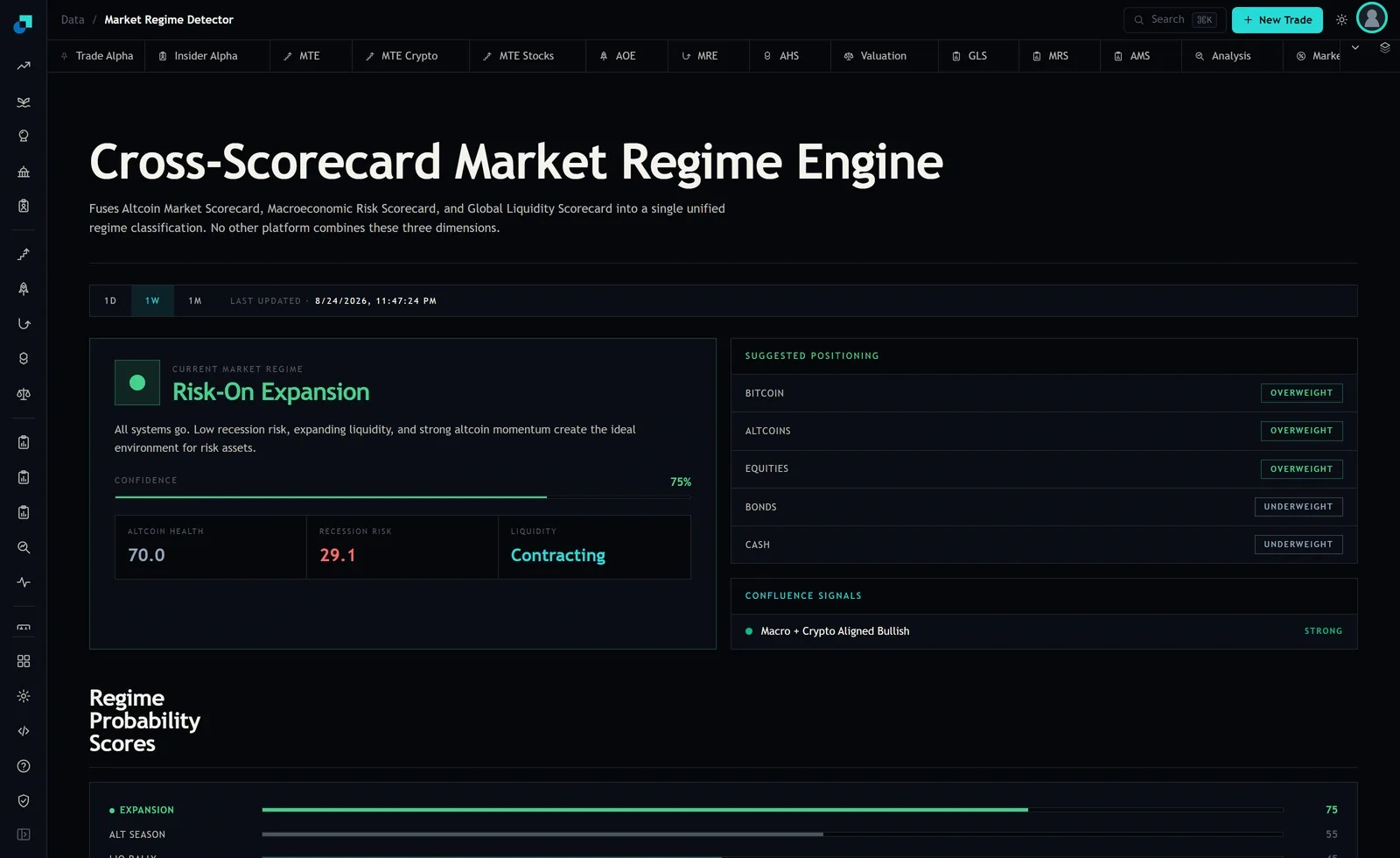
Being straight about the evidence first. In the capture I am working from, the card showed one named regime, Risk-On Expansion, at 75 percent confidence. The score panel below it showed three bars labelled Expansion, Alt Season and Liq Rally, and the panel continues past the bottom of my capture. I do not have the full roster of the engine's own label names in front of me, so I am not going to list eight names and pretend they came off the product.
What I do have is the thing that actually matters. The engine fuses three scorecards, and the card prints one reading from each. Altcoin health, which was 70.0. Recession risk, which was 29.1. Liquidity direction, which read Contracting.
Three inputs, each of which is meaningfully high or low, gives eight combinations. Eight is not a coincidence of the taxonomy, it is the arithmetic of the inputs, and every one of those eight is a real market you will recognise once it is described by its readings. The names below are my shorthand for my own notes, not the platform's labels.
Three inputs, two states each, and the cell this capture was in
Before the tour, the observation that makes the grid useful. The card said Risk-On Expansion. Its liquidity tile said Contracting. That means the strongest risk-on label the engine printed was compatible with liquidity going the wrong way, which tells you the label is not a simple three-out-of-three agreement.
Practically, it means you should never assume a good label implies all three inputs are good. Check the tiles. Two strong inputs and one weak one is a normal state of the world and it is a genuinely different market from three strong inputs, even when the same words appear on the card.
The four cells where altcoin health is strong
Altcoin health high, recession risk low, liquidity expanding. Everything aligned. This is the environment where dips get bought within hours, laggards catch up, and almost any long works. It feels easy, and easy is the tell. The mistake available here is not being wrong about direction, it is arriving at your largest size at the point where the last input turns.
Altcoin health high, recession risk low, liquidity contracting. This is where the capture was. Strong tape, thinning fuel. Momentum in the front-running names is intact while breadth quietly narrows underneath. It feels like the first cell and is not, and the practical difference is that rallies here need more concentrated participation to go the same distance. Own risk, but own it in size you would be comfortable holding through a fast twenty percent drawdown.
Altcoin health high, recession risk high, liquidity expanding. Speculation running against a weakening economy, with liquidity covering the gap. It feels violent. Sharp rallies on policy headlines, sharp reversals on data. The character to plan for is high two-way volatility rather than a trend, so wider stops and smaller size, or no position at all if your account cannot absorb the swings.
Altcoin health high, recession risk high, liquidity contracting. The most dangerous cell on the board, and the one that produces the best-looking charts. Crypto strength with the macro deteriorating and liquidity draining is a move being carried by positioning rather than by conditions. It feels like a melt-up and it ends without a warning candle. If you are here, the thing to have decided in advance is your exit, because you will not want to make that decision while it is happening.
The four cells where altcoin health is weak
Altcoin health low, recession risk low, liquidity expanding. The economy is fine, money is available, and none of it is coming to alts. Rotation is happening somewhere else, frequently into the largest names or out of crypto entirely. It feels frustrating rather than frightening. The correct read is usually that your exposure is in the wrong place, not that it is the wrong time to be invested.
Altcoin health low, recession risk low, liquidity contracting. The grind. Nothing is broken and nothing is working, ranges are tight, and every breakout fails within a session. This cell destroys more retail accounts than the outright bear cells do, because it does it slowly through overtrading rather than quickly through a crash. The winning move is to trade less, and it is very hard to make.
Altcoin health low, recession risk high, liquidity expanding. A weak economy meeting a policy response. This is where bottoms are attempted, repeatedly and unsuccessfully, and then eventually successfully. It feels like being early over and over. If you are going to accumulate anywhere, it is here, and the only way to survive doing it is in planned instalments rather than in one conviction-sized purchase.
Altcoin health low, recession risk high, liquidity contracting. Full risk-off. Correlations converge, the things you owned for diversification fall alongside everything else, and cash is the only position that behaves. It feels like nothing works, because nothing does. There is no clever tilt available in this cell. The decision is how much exposure you keep, and the answer is less than you think you can tolerate.
Setting your own high and low, because the panel does not
The grid needs cutoffs and the screen does not give you any. Altcoin health 70.0 and recession risk 29.1 are numbers on scales the card does not label, and calling 70 high is a guess until you have context.
Build the context the cheap way. Once a week, on the same timeframe toggle, write down the three readings. After ten or twelve weeks you have a small distribution, and your cutoff is your own median. Above your median is high, below is low. This is crude and it is enormously better than importing a threshold from someone whose screen you have never seen.
Two habits make the log worth keeping. Record the liquidity word every time, because it is the input most likely to flip while the headline label stays put, and a flip there is often the first thing that moves. And record which cell you decided you were in, in your own words, before you look at the label on the card. When your cell and the card's label disagree, that disagreement is the most informative thing on the screen, and it happens most often at exactly the moments a regime is turning.
The eight cells do not need to be memorised. What needs to be memorised is the habit of reading three tiles before reading one name, because the name is a summary of the tiles and summaries always arrive last.