Following one insider is a better idea than trading the whole filing feed, and most people who say they are doing it are not. What they are actually doing is seeing a large purchase, recognising the name of the buyer, and buying. That is not following an insider. That is reacting to a headline that happens to be sourced from a filing, and it produces the same outcome as reacting to any other headline, which is a position with an entry reason and no exit reason.
Doing it properly takes about an hour of work up front, once, per insider. The hour is spent establishing that the person has a record, that the record is made of the kind of trades you can copy, and that you can hold the position long enough for their thesis to be tested. Here is the order I would do it in, and what the module gives you at each step.
What the Top Insiders table is actually ranking
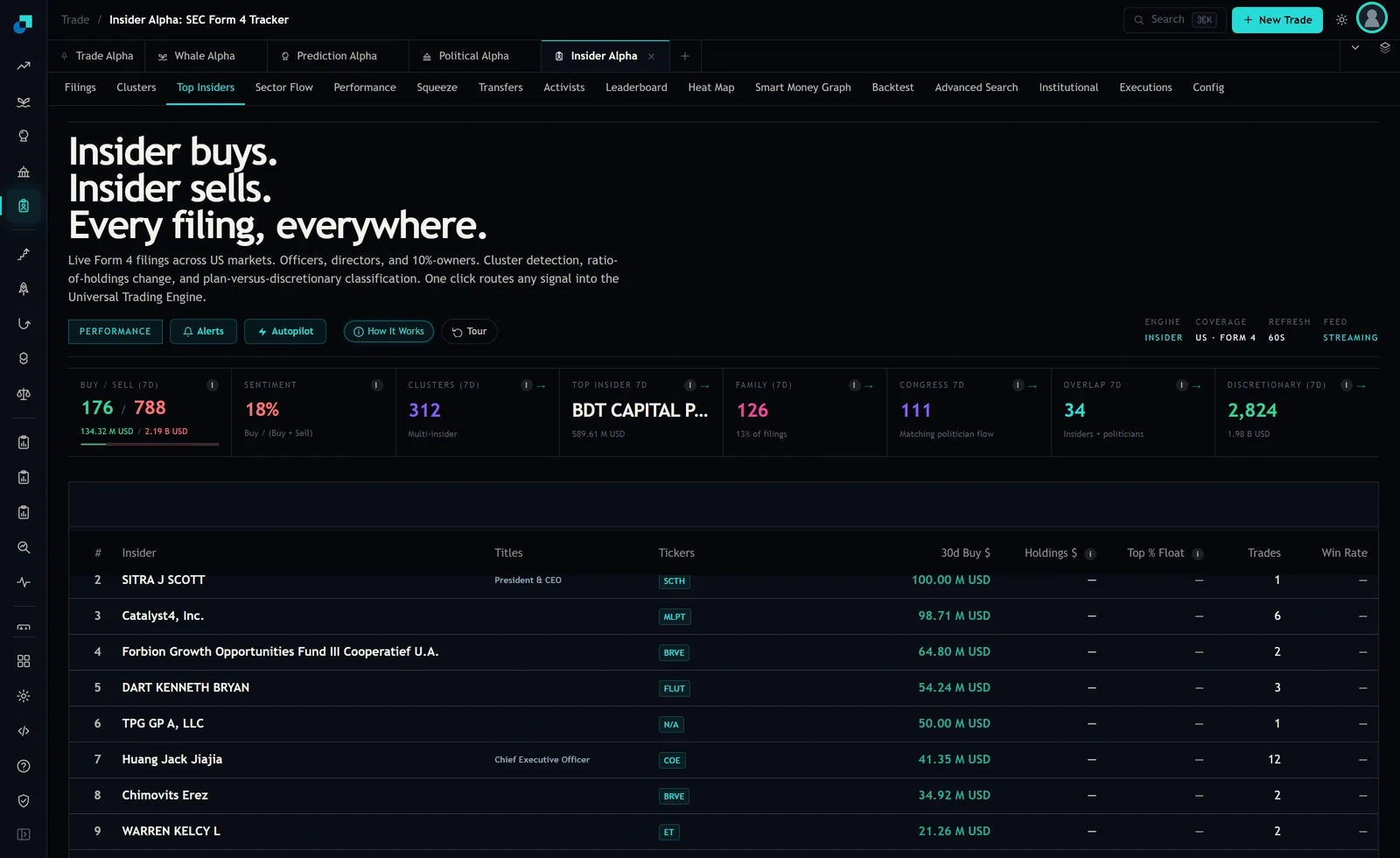
Open the Top Insiders tab and read the column headers before the rows. At capture they were, in order, rank, insider, titles, tickers, 30 day buy dollars, holdings dollars, top percent of float, trades, and win rate. The table was sorted by the 30 day buy dollar column, which is the important thing to notice. The default view is a list of the biggest recent buyers, and being the biggest buyer of the last month tells you nothing at all about being right.
The visible rows made that concrete. Sitra J Scott, President and CEO, buying 100.00 M USD of SCTH across one trade. Huang Jack Jiajia, Chief Executive Officer, 41.35 M USD of COE across twelve trades. Dart Kenneth Bryan, 54.24 M USD of FLUT across three. A single hundred million dollar ticket and a twelve trade programme are completely different objects, and the dollar ranking puts the single ticket on top.
Half these rows are not people
Before anything else, filter mentally for humans. Among the visible rows were Catalyst4, Inc. at 98.71 M USD, Forbion Growth Opportunities Fund III Cooperatief U.A. at 64.80 M USD, and TPG GP A, LLC at 50.00 M USD with the ticker field showing N/A. The seven day top insider tile above the table named a capital partners entity at 589.61 M USD. These are funds and general partner entities filing because they cross the ten percent ownership line, and the module says so plainly in its coverage description, which lists officer, director and ten percent owner transactions together in one feed.
A fund's purchase is usually a subscription in a financing at a negotiated price, or a transfer between related vehicles. Copying it means copying a capital deployment schedule you have no visibility into and cannot exit alongside. There is nothing wrong with those filings existing, they belong in the feed, but they are not a person forming a view about their own company and putting personal money behind it. That is the thing you set out to copy. Start by requiring a named individual with an officer or director title in the titles column.
Five things to check before you mirror anyone
Once you have a human, work through these in order. Any one of them can end the process, which is the point.
- Open market purchases only. An option exercise and a grant are compensation events, not decisions to buy at the market price. So is anything sold under a pre arranged plan. The module's own description of the feed says it separates plan sales from discretionary activity and classifies open market buys, open market sells, option exercises and plan sales as distinct categories, so the distinction is available to you. Insist on it.
- Size relative to the person, not to the company. A quarter of a million dollars from someone whose stake is worth eighty million is a rounding error. The same amount from someone whose stake is worth two million is a statement. The holdings and top percent of float columns exist for exactly this comparison and were empty on the rows I could see, so for now this is a number you pull off the filing itself, where the post transaction holding is reported.
- Repeat behaviour across market conditions. One purchase in a rising market is not a track record. What you want is somebody who has bought in at least two distinct drawdowns, because buying when the price is down is the only version of the behaviour that is inconvenient enough to mean something.
- A holding period you can actually serve. You will read the filing at least a day or two after their trade, often more, and their thesis is measured in quarters. If you know you will not hold a position through a 30 percent drawdown for a year, this strategy is not available to you, and it is cheaper to find that out now than at month four.
- The price you can get, not the price they got. They bought at their price. You are buying after a public filing on a screen that refreshes every sixty seconds, alongside everyone else reading the same screen. In a thin name that difference can be several percent before you have done anything wrong.
The ten year part, and where you actually verify it
Now the honest bit, because the phrase verified ten year track record is doing a lot of work and I want to be exact about what backs it. The module states that it maintains a per insider track record with forward return performance scoring, and the Top Insiders table has a win rate column. On the screens I read, that win rate column contained no values on any visible row, and the holdings and float columns were empty as well. I am not going to describe a per filer profile page walking you through a decade of somebody's trades, because I could not confirm from what I saw that such a page exists in that form.
What I can tell you is where the underlying record lives, because it is public and free. Every Form 4 an individual has ever filed sits under their filer identifier on the SEC's own system, going back far longer than ten years. Pull that list, and count only the open market purchases, which carry transaction code P. Purchases are the ones worth counting, since sales happen for tuition, houses, divorces and diversification, and the long standing finding in the insider trading literature is that purchases carry more information than sales for exactly that reason. Then take each purchase date, look at what the stock did over the following twelve months, and write the outcomes in a row.
Ten purchases is enough to form an opinion. Three is not, whatever the win rate attached to them says, and if a leaderboard ever shows you a perfect record on a handful of trades, treat the number as decoration. An hour of this per candidate is the whole cost, and it is the difference between following an insider and following a headline.
The exit problem, and the size that makes it survivable
Here is the part that gets skipped. Copying an insider gives you an entry signal and no exit signal, and the asymmetry is structural rather than a gap in the data. Their purchase is discretionary and informative. Their eventual sale, when it comes, is very often executed under a pre arranged plan set up months earlier, which by design carries no view at all. You will not get a symmetric message telling you to leave.
So write the exit before you enter, in plain terms, and put it somewhere you will actually see it. A time stop is the most honest version. Twelve months from entry, if the thesis you wrote at the time has not shown up in results, you are out regardless of price. Add a thesis break, meaning the specific thing that would prove you wrong. Add a size limit, because with no exit signal your position sizing is your only real risk control. One mirrored insider is one position among eight or ten, not a concentrated bet, and if a two thousand dollar position going to zero would change your year, the position is too large.
The people who do well at this are boring about it. One or two filers they have checked properly, positions they can hold, a time stop they honour, and total indifference to the other three hundred rows on the leaderboard.