There is a column on the exchange listings ledger labelled Conf%, and the natural reading of it is wrong in a way that costs money. It looks like a quality rating. A row at 100% looks like a good listing and a row at 0% looks like a bad one, and if you sort the ledger by confidence you appear to have ranked the opportunities.
You have not. The column is about data, not about the trade. The listings screen cross-references exchange announcements with on-chain liquidity and attaches a confidence score to each match. The score is describing how well an announcement was matched to an on-chain token. It says nothing whatsoever about whether the token is worth owning.
The problem the score exists to solve
An exchange announcement is a string. It says a name and a ticker, and often not much else. There are thousands of contracts across nine chains that could answer to the same three or four letters, and there is no registry that makes tickers unique.
So between the announcement and anything you can check on chain there is a resolution step. Which contract, on which chain, is the thing this exchange is talking about. When that step succeeds cleanly, the row can carry a chain, a market cap, a pool depth and a link to the DEX. When it does not, those columns have nothing to put in them.
That is the job Conf% is reporting on. Read it as an answer to "do we know which token this is", not as an answer to "is this token any good".
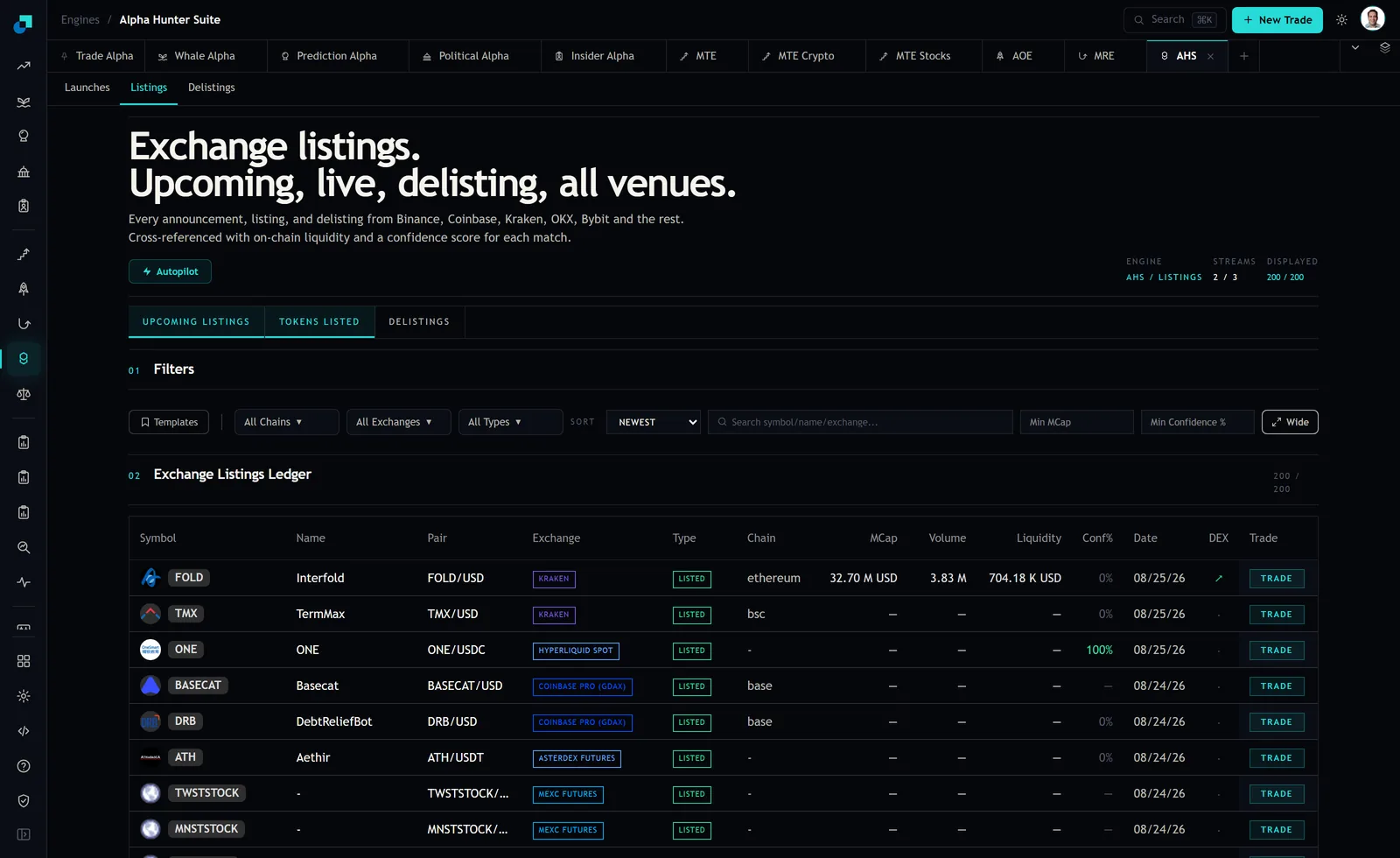
What the column actually looked like on a live screen
The screenshot above is worth reading carefully because it breaks the intuition faster than an explanation does. Three distinct states are visible on nine rows.
The first row, a Kraken listing on ethereum, shows 0% confidence and yet has a market cap of 32.70 M, volume of 3.83 M and liquidity of 704.18 K populated next to it. So a zero in that column did not mean the row was empty of data.
Three rows down, a Hyperliquid Spot listing shows 100% confidence with a dash in the chain field and nothing in the cap, volume or liquidity columns. So a hundred in that column did not mean the row was rich with data either.
And two rows carry neither a number nor a zero, just a dash. A blank is a third state. It means the score is absent, which is different from a score of zero, in the same way that an unanswered question is different from a no.
The honest conclusion from that screen is narrow and useful. Conf% and data completeness are not the same axis, and neither of them is a verdict on the token. Treat the confidence figure as one signal about resolution and treat the populated columns as another, and do not let a high number in one talk you into trusting the other.
What a 0% row lets you do
A low confidence row is not a fake listing. The announcement is still an announcement from a real exchange, and it is still an event with a date and a venue attached. What you have lost is the on-chain half of the picture.
So the things still available to you are the venue-side things. You can trade the listing on the exchange itself once it goes live, because you do not need to know the contract address to buy a pair on a venue that has already resolved it. You can note the venue and the pair and check whether you have an account and the right quote asset.
The things not available are everything that requires a contract. No pool depth check, so you cannot size off liquidity. No holder count. No pre-listing route into the on-chain market. And critically, no self-service resolution: if you go and find a contract yourself that matches the ticker and buy it, you have just performed the exact step the confidence score was telling you it could not perform cleanly, without any of the checks that would tell you whether you got it right. Buying the wrong contract is the single most expensive mistake available on a listing announcement, and a 0% row is where it happens.
What a 100% row lets you do
A high confidence row unlocks the on-chain workflow. You have a resolved asset, so the liquidity figure is about that asset, the chain field tells you where it lives, and the DEX link is a route rather than a guess.
That means you can do the checks that actually govern position size. Read the pool depth and work out the largest ticket you can put on. Look at whether the on-chain market has already moved on the announcement, which is common and is the reason so many listings open flat or lower. Decide whether the trade you want is the venue listing or the on-chain asset that is already trading.
What it still does not tell you is anything about quality. A perfectly matched row can be a token with a two hundred thousand dollar pool and nine hundred holders. The confidence score is high because the identification was clean, and a cleanly identified bad token is still a bad token.
Using the column instead of ranking by it
The filter bar carries a Min Confidence % input and the sort control offers Confidence as an ordering, and both are useful once you stop treating the column as a quality score.
The practical setup is two lists rather than one ranked list. Set a minimum confidence and treat what survives as your on-chain workable set, the rows where you can do depth and holder work before deciding. Then look at what the filter excluded as a separate venue-only set, where the only thing you can act on is the exchange listing itself and the size has to be decided some other way.
Two habits follow from that split. Never carry a number from a low confidence row into a calculation, because the columns that are populated may be describing a resolution the score itself is not confident about. And never let a blank sit in your notes as a zero, because you will read it later as a rejected row when it was actually an unanswered one, and the difference between those two is the difference between a decision and an accident.